

This business/management problem is solved step by step below, with detailed explanations to help you understand the method and arrive at the correct answer.
ScanSolve AI Answer
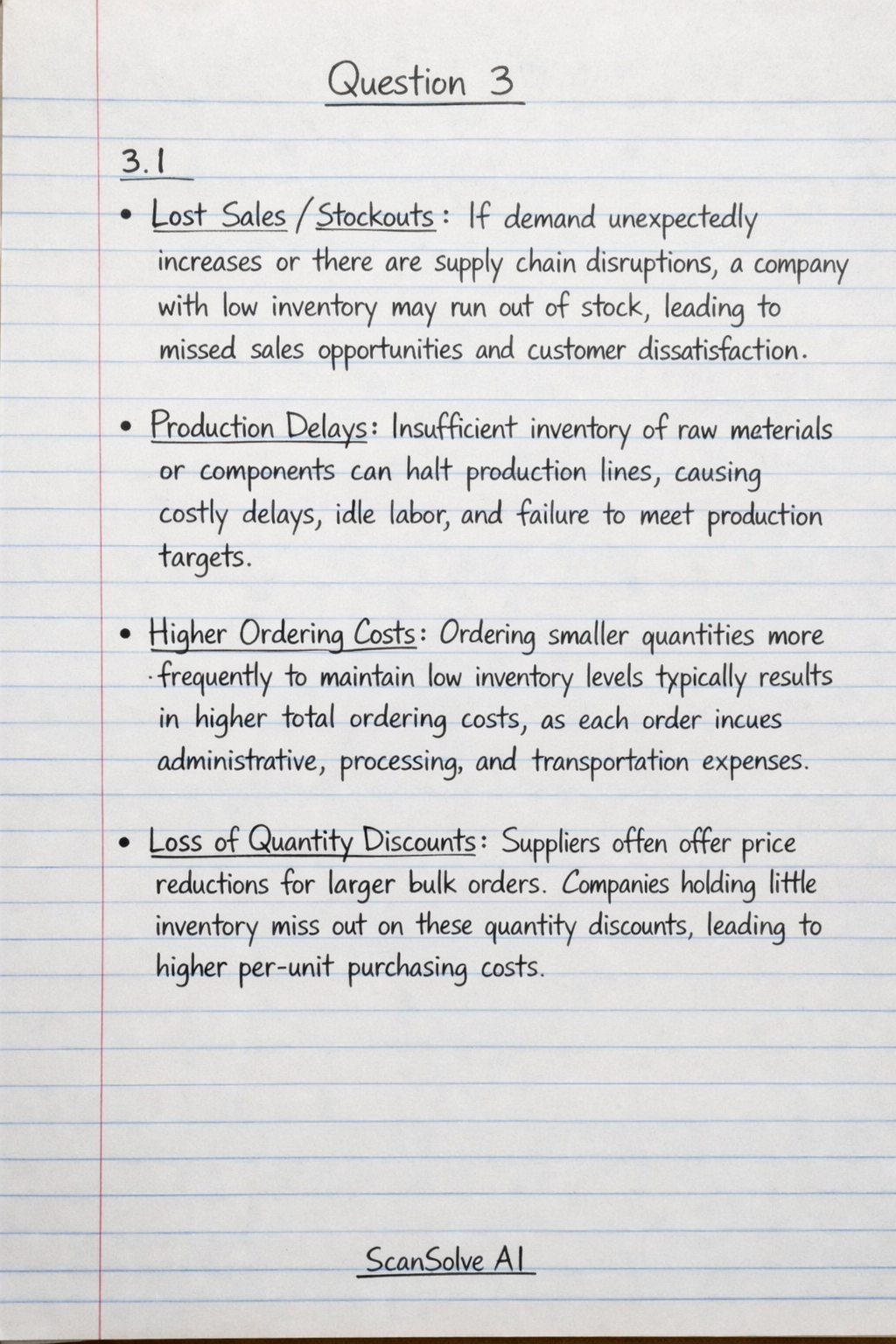
Question 3 3.1 Here are four costs and risks of holding little inventory: • Lost Sales/Stockouts: If demand unexpectedly increases or there are supply chain disruptions, a company with low inventory may run out of stock, leading to missed sales opportunities and customer dissatisfaction. • Production Delays: Insufficient inventory of raw materials or components can halt production lines, causing costly delays, idle labor, and failure to meet production targets. • Higher Ordering Costs: Ordering smaller quantities more frequently to maintain low inventory levels typically results in higher total ordering costs, as each order incurs administrative, processing, and transportation expenses. • Loss of Quantity Discounts: Suppliers often offer price reductions for larger bulk orders. Companies holding little inventory miss out on these quantity discounts, leading to higher per-unit purchasing costs. 3.2 Step 1: Calculate the total annual demand (D). Annual demand for the first 4 months: 5250 units/month × 4 months = 21000 units Annual demand for the remaining 8 months: 3625 units/month × 8 months = 29000 units Total Annual Demand (D) = 21000 units + 29000 units = 50000 units Step 2: Identify the carrying cost per unit (H) and cost per order (S). Carrying cost per unit (H) = R2 per year Cost per order (S) = R1,000 Step 3: Apply the Economic Order Quantity (EOQ) formula. EOQ = sqrt((2DS)/(H)) EOQ = sqrt((2 × 50000 × 1000)/(2)) EOQ = sqrt(50000000) EOQ ≈ 7071.07 The EOQ should be a whole number of units. EOQ = 7071 units 3.3 Here are three factors that may influence the ability of an enterprise to secure adequate financing: • Creditworthiness and Financial Health: Lenders and investors assess a company's financial statements, credit history, profitability, and cash flow to determine its ability to repay debt or generate returns. A strong financial position increases confidence and access to financing. • Business Plan and Viability: A clear, well-researched business plan demonstrating market potential, competitive advantage, and realistic financial projections is crucial. It assures financiers that the enterprise has a viable strategy for growth and profitability. • Collateral and Guarantees: The availability of assets (like property, equipment, or inventory) that can be pledged as collateral significantly reduces the risk for lenders. Personal guarantees from owners can also provide additional security, making it easier to obtain loans. 3.4.1 Step 1: Calculate Current Liabilities (CL) for each company. Current Liabilities = Total Liabilities - Non-Current Liabilities For Company A: CL_A = R75231 - R45232 = R29999 For Company B: CL_B = R85010 - R34142 = R50868 For Company C: CL_C = R95010 - R53434 = R41576 Step 2: Calculate the Current Ratio for each company. Current Ratio = Current Assets / Current Liabilities For Company A: Current Ratio_A = R95123R29999 ≈ 3.17 For Company B: Current Ratio_B = R102343R50868 ≈ 2.01 For Company C: Current Ratio_C = R152342R41576 ≈ 3.66 The current ratios are: Company A: 3.17 Company B: 2.01 Company C: 3.66 3.4.2 Step 1: Calculate the Acid Test Ratio (Quick Ratio) for each company. Acid Test Ratio = (Current Assets - Inventories) / Current Liabilities For Company A: Acid Test Ratio_A = R95123 - R5412R29999 = R89711R29999 ≈ 2.99 For Company B: Acid Test Ratio_B = R102343 - R6454R50868 = R95889R50868 ≈ 1.88 For Company C: Acid Test Ratio_C = R152342 - R10343R41576 = R141999R41576 ≈ 3.42 The acid test ratios are: Company A: 2.99 Company B: 1.88 Company C: 3.42 That's 2 down. 3 left today — send the next one.