
We read your photo as:
Calculate the price, in cents per gram, for each packet of apples. Identify the option that gives the best value for money. Explain why prices do not always increase proportionally as quantity increases.
ScanSolve AI Answer
Step-by-step solution
4 stepsAnswer 3.1 by calculating the price per gram for each packet.
To calculate the price in cents per gram, first convert kilograms to grams (1 kg = 1000 g) and Rands to cents (1 R = 100 cents).
-
1 kg packet:
- Quantity:
- Price:
- Price per gram:
-
2 kg packet:
- Quantity:
- Price:
- Price per gram:
-
5 kg packet:
- Quantity:
- Price:
- Price per gram:
The prices per gram are:
- 1 kg packet:
- 2 kg packet:
- 5 kg packet:
-
Answer 3.2 by identifying the option that gives the best value for money.
The best value for money is the option with the lowest price per gram. Comparing the calculated prices:
- 1 kg packet: 2.5 cents/g
- 2 kg packet: 2.2 cents/g
- 5 kg packet: 2 cents/g The 5 kg packet has the lowest price per gram. The option that gives the best value for money is the .
Answer 3.3 by explaining why prices do not always increase proportionally as quantity increases.
Prices do not always increase proportionally with quantity due to economies of scale and marketing strategies. Supermarkets often offer bulk discounts for larger quantities because the cost of packaging, handling, and transportation per unit decreases. This allows them to sell larger packets at a lower price per unit (e.g., per gram) while still maintaining profitability and encouraging customers to buy more.
Address Question 4.
The provided image for Question 4 (Jabu's savings) only contains the introductory text and an image. It does not include any specific sub-questions (e.g., 4.1, 4.2, 4.3, 4.4) or a table to complete. Therefore, Question 4 cannot be answered without further information.
Still stuck on this one?
Ask a follow-up, and the answer starts from this question.
More Mathematics Questions
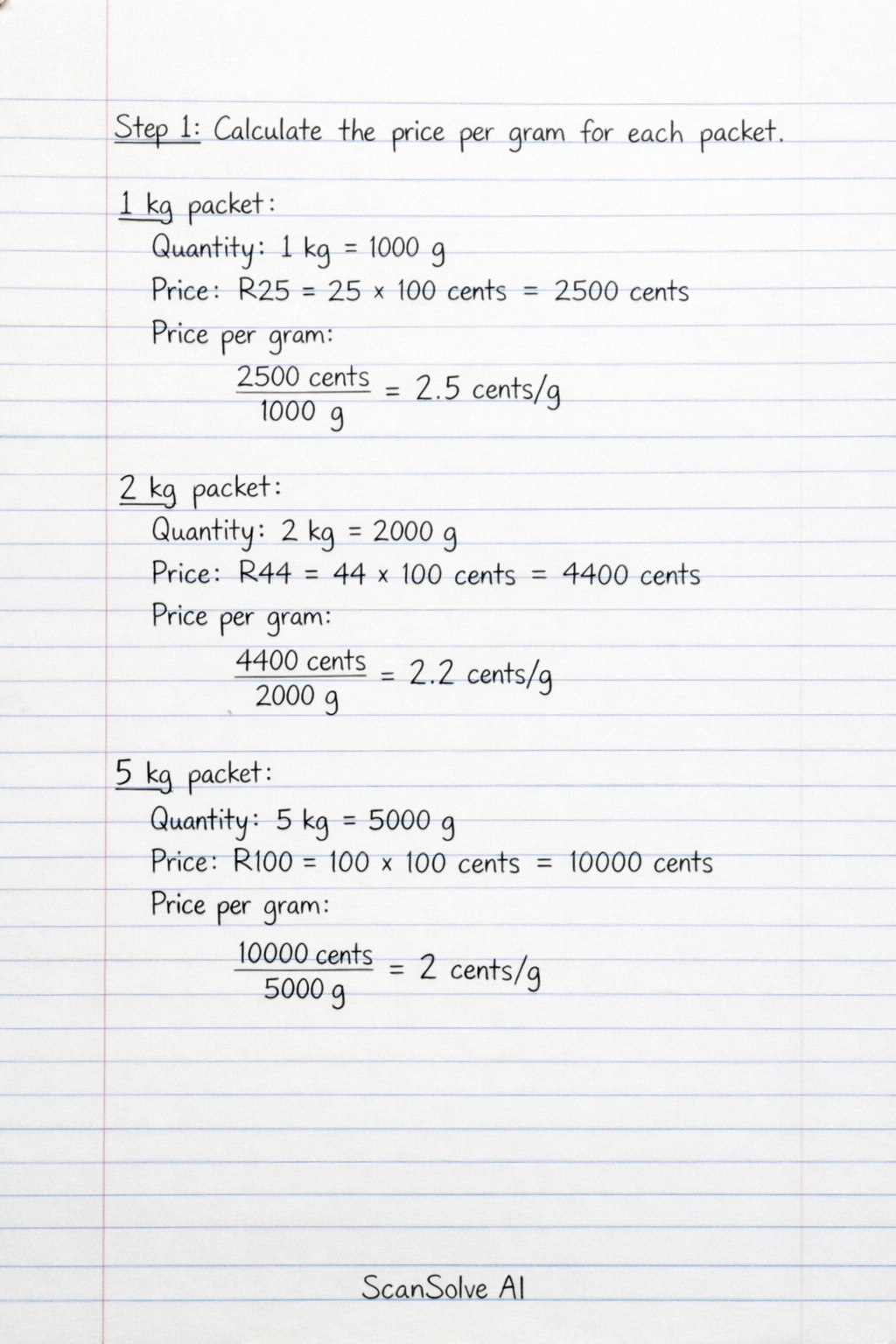
Handwritten Step-by-Step Solution
Get this as a handwritten image on WhatsApp — like a tutor wrote it for you.
Try on WhatsApp