
We read your photo as:
Answer the following independent questions: 1.1 Distinguish between a public company and a private company. 1.2 Outline six circumstances in which Agency agreements can be terminated. 1.3 State and briefly explain four requirements for the validity of a partnership.
Business/Management
ScanSolve AI Answer
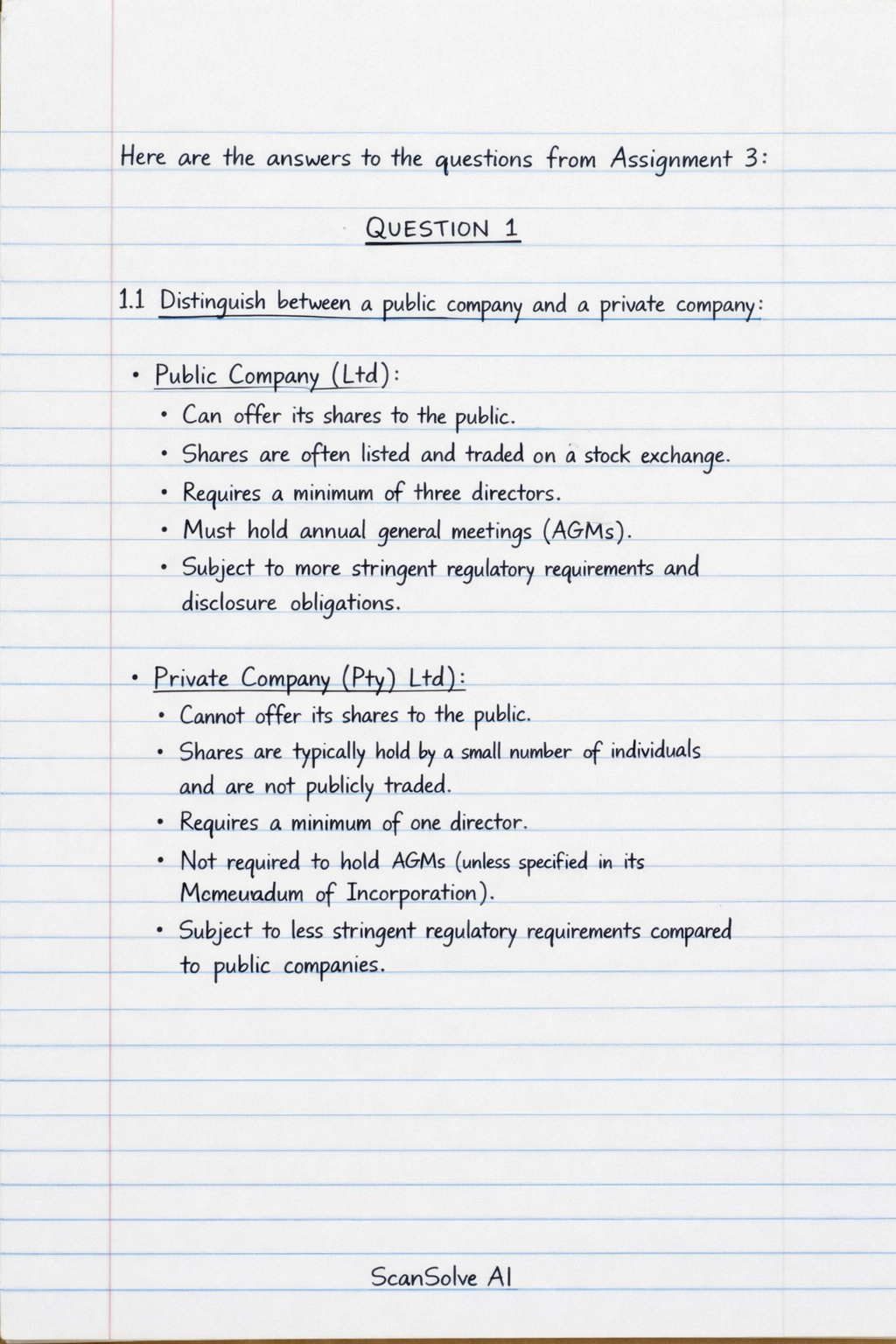
Here are the answers to the questions from Assignment 3:
QUESTION 1
1.1 Distinguish between a public company and a private company:
- Public Company (Ltd):
- Can offer its shares to the public.
- Shares are often listed and traded on a stock exchange.
- Requires a minimum of three directors.
- Must hold annual general meetings (AGMs).
- Subject to more stringent regulatory requirements and disclosure obligations.
- Private Company (Pty) Ltd):
- Cannot offer its shares to the public.
- Shares are typically held by a small number of individuals and are not publicly traded.
- Requires a minimum of one director.
- Not required to hold AGMs (unless specified in its Memorandum of Incorporation).
- Subject to less stringent regulatory requirements compared to public companies.
1.2 Six circumstances in which Agency agreements can be terminated:
- Completion of the mandate: The agent successfully performs the task they were appointed to do.
- Expiry of the agreed period: If the agency was for a fixed term, it terminates when that period ends.
- Mutual agreement: The principal and agent agree to end the agency relationship.
- Revocation by the principal: The principal withdraws the agent's authority (though this may lead to a claim for damages if it breaches a contract).
- Renunciation by the agent: The agent informs the principal that they no longer wish to act as an agent.
- Death or insolvency: The death or insolvency of either the principal or the agent typically terminates the agency agreement.
1.3 Four requirements for the validity of a partnership:
- Contribution by each partner: Each partner must contribute something to the partnership, such as money, property, skill, or labour.
- Joint benefit: The partnership must be carried on for the joint benefit of the partners.
- Profit motive: The primary object of the partnership must be to make a profit.
- Lawful business: The business or undertaking of the partnership must be lawful.
QUESTION 2
2.1 Four requirements that need to be met for set-off to occur:
- The debts must be liquidated, meaning they must be certain and ascertainable in amount.
- The debts must be due and payable, meaning they are not subject to a suspensive condition or time clause.
- The debts must be reciprocal, meaning the parties owe each other in the same capacities.
- The debts must be of the same kind, typically meaning money for money.
2.2 Remedies available to an innocent party to a contract when breach has occurred:
a) Cancellation:
- Cancellation is a drastic remedy that allows the innocent party to terminate the contract, bringing it to an end.
- It is generally available only for a material breach of contract (e.g., a fundamental breach or a breach of a material term).
- Upon cancellation, both parties are released from their future obligations, and any performance already rendered may need to be returned (restitution).
b) Damages:
- Damages refer to monetary compensation awarded to the innocent party for financial losses suffered as a direct consequence of the breach of contract.
- The purpose of damages is to place the innocent party in the financial position they would have been in had the contract been properly performed (the "positive interest").
- The innocent party must prove that they suffered actual loss, that the loss was caused by the breach, and that the loss was foreseeable.
2.3 Differentiate between a void, voidable and valid contract:
- Valid Contract: A contract that meets all the essential legal requirements for its formation (e.g., agreement, capacity, legality, possibility of performance, formalities). It creates binding obligations on the parties and is fully enforceable by law.
- Void Contract: A contract that lacks one or more of the essential elements for its formation from the very beginning. It is considered to have never legally existed and has no legal force or effect. Neither party can enforce a void contract, and any performance rendered under it may be reclaimed through other legal means.
- Voidable Contract: A contract that is initially valid and binding, but one of the parties has the option to set it aside due to a defect in its formation (e.g., misrepresentation, duress, undue influence, or lack of full contractual capacity). If the innocent party chooses to set it aside, the contract is treated as if it were void from the beginning. If they choose not to set it aside, it remains a valid and enforceable contract.
Was this helpful?
Still stuck on this one?
Ask a follow-up, and the answer starts from this question.
Got a different question?Ask your own question
More Business/Management Questions
QWhat are the answers and explanations to these multiple choice questions about partnership…QDiscuss the following different forms of partnerships: (i) General partnership (ii) Limited…QBriefly distinguish between privatisation and nationalisation; Memorandum of Association and…QMultiple choice questions on partnership accounting: goodwill, dissolution, and capital.QMultiple choice questions on partnership dissolution and retirement.
Browse by topic:Business
Handwritten Step-by-Step Solution
Get this as a handwritten image on WhatsApp — like a tutor wrote it for you.
Try on WhatsApp