
We read your photo as:
Briefly distinguish between privatisation and nationalisation; Memorandum of Association and Articles of Association; and Public Corporation.
ScanSolve AI Answer
Question 3
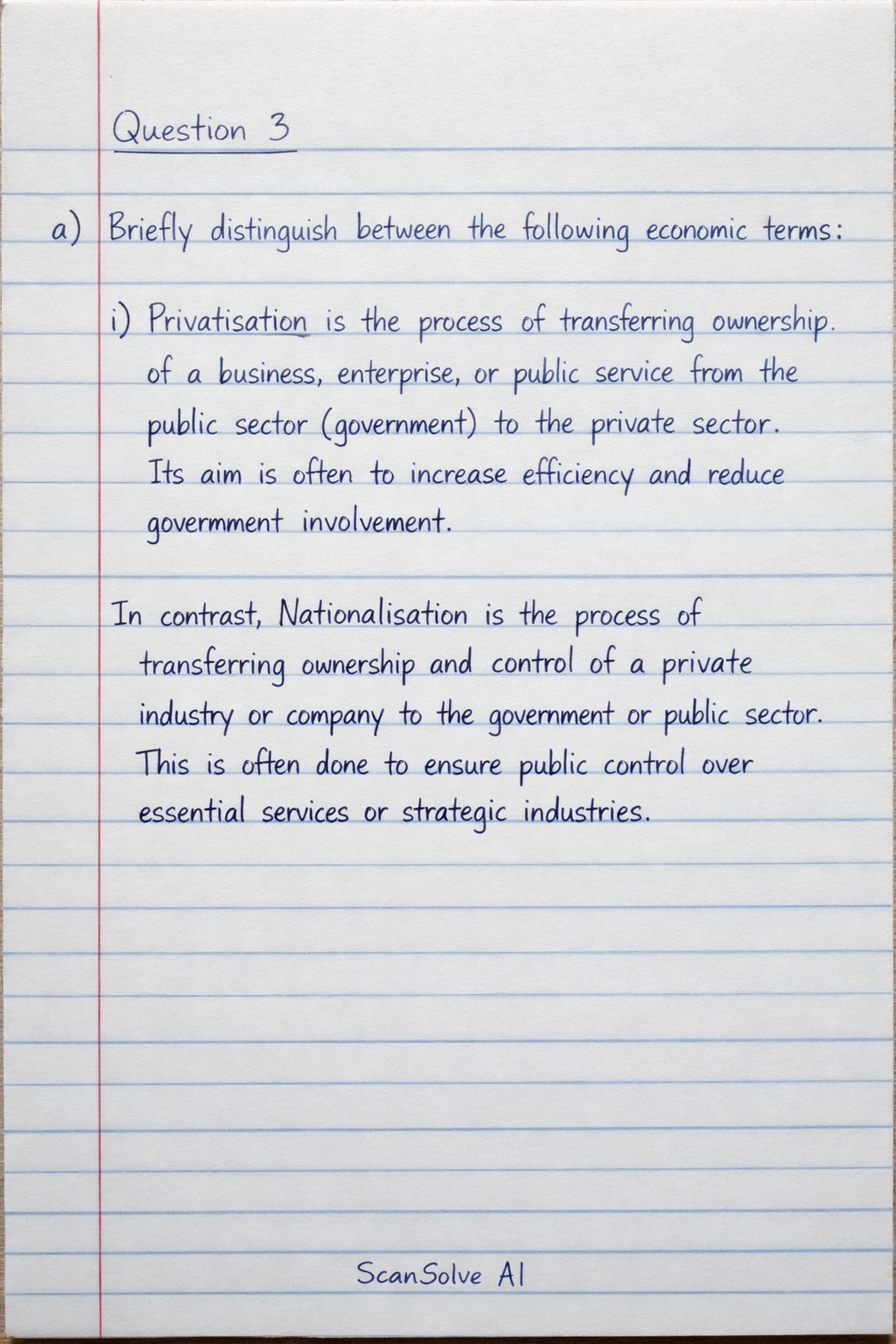
a) Briefly distinguish between the following economic terms:
-
i) Privatisation is the process of transferring ownership of a business, enterprise, or public service from the public sector (government) to the private sector. Its aim is often to increase efficiency and reduce government involvement. In contrast, nationalisation is the process of transferring ownership and control of a private industry or company to the government or public sector. This is often done to ensure public control over essential services or strategic industries.
-
ii) A Memorandum of Association (MOA) is a foundational legal document that defines the company's constitution, its objectives, powers, and its relationship with the outside world. It outlines the company's name, registered office, objects, liability, and capital. The Articles of Association (AOA), on the other hand, is a legal document that specifies the internal rules and regulations for the management of a company. It governs the rights, duties, and powers of the company's directors, shareholders, and other members.
-
iii) A Public Corporation is a state-owned enterprise established by a special act of parliament to provide public services or goods, often operating on commercial principles but without the primary goal of profit maximization. Its shares are not traded on a stock exchange. A Public Company (or Public Limited Company - PLC) is a company whose shares are offered to the general public and can be traded on a stock exchange. It is typically formed under company law and aims to generate profit for its shareholders.
-
iv) Scarcity is the fundamental economic problem of having unlimited human wants and needs in a world of limited resources. It implies that not all wants can be satisfied, forcing choices to be made. Opportunity cost is the value of the next best alternative that must be foregone when a choice is made. It is the cost of choosing one option over another, representing the benefits that could have been received by taking the alternative action.
b) Classification of sources of finance to firms in Cameroon:
-
Internal Sources of Finance:
- Past savings (of the firm)
- Retained profits
- Depreciation funds
- Sale of assets
-
External Sources of Finance:
- Sale of shares and debentures
- Bank credits
- Subsidies
- Hire purchase
c) Four (4) characteristics of a mixed economy such as Cameroon:
- Coexistence of Public and Private Sectors: A mixed economy features both private individuals and firms, as well as the government, owning and controlling resources and means of production. The private sector operates for profit, while the public sector aims for social welfare and provides public goods.
- Economic Planning and Regulation: While market forces play a significant role, the government actively intervenes through economic planning, regulations, and policies to guide the economy, correct market failures, and achieve social and economic objectives like stability and growth.
- Social Welfare and Equity: The government takes responsibility for providing essential public goods and services such as education, healthcare, and infrastructure. It also implements policies aimed at reducing income inequality and ensuring a basic standard of living for its citizens.
- Protection of Private Property and Freedom of Choice: Individuals and firms generally have the right to own private property and make economic decisions (e.g., what to produce, what to consume). However, these rights are often subject to government regulations and interventions in the public interest.
Question 4
a) Define the following terms as used in Economics:
-
i) National income refers to the total value of all final goods and services produced within a country's borders in a specific period (usually a year), plus net income from abroad. It represents the total income earned by a country's residents and businesses from their economic activities.
-
ii) Unemployment is a situation where individuals who are actively seeking employment are unable to find a job. It refers to the portion of the labour force that is willing and able to work at the prevailing wage rate but is currently without work.
b) Three (3) reasons for measuring the national income of a country:
- To Gauge Economic Performance and Growth: National income figures (such as Gross Domestic Product - GDP) provide a crucial indicator of a country's economic health and growth over time. By comparing national income from one period to another, policymakers can assess whether the economy is expanding, contracting, or stagnant.
- To Formulate Economic Policies: Governments use national income data to understand the structure of the economy, identify areas of strength and weakness, and formulate appropriate fiscal and monetary policies. This data helps in making informed decisions regarding taxation, government spending, and interest rates to achieve macroeconomic objectives like full employment, price stability, and sustainable growth.
- To Make International Comparisons: National income statistics allow for comparisons of economic performance and living standards between different countries. This helps international organizations and governments assess relative development, determine aid requirements, evaluate trade relationships, and understand global economic trends.
c) Three (3) measures used by the Cameroon government to reduce unemployment:
- Promoting Small and Medium-sized Enterprises (SMEs): The government can implement policies to support the establishment and growth of SMEs, which are significant job creators. This includes providing access to affordable credit, offering training and mentorship programs, and simplifying business registration processes.
- Investment in Infrastructure Projects: Government investment in large-scale public infrastructure projects, such as roads, bridges, energy facilities, and public buildings, directly creates jobs in the construction sector. It also indirectly stimulates employment in related industries and improves the overall business environment, encouraging private sector job creation.
- Vocational Training and Education Reforms: The government can invest in and reform the education and vocational training systems to align skills development with the needs of the labour market. This helps reduce skills mismatches, making job seekers more employable and equipping them with the specific skills demanded by industries.
d) Distinguish between fiscal policy and physical policy:
Note: "Physical policy" is not a standard economic term. Assuming it is a typo for "monetary policy", the distinction is provided below.
Fiscal Policy refers to the use of government spending and taxation to influence the economy. It is enacted by the legislative and executive branches of government. Its primary tools are government expenditure (e.g., on infrastructure, education, defense) and various forms of taxation (e.g., income tax, corporate tax). The objective is to manage aggregate demand, stabilize the economy, reduce unemployment, control inflation, and promote economic growth.
Monetary Policy refers to actions undertaken by a central bank to influence the availability and cost of money and credit in an economy. Its primary tools include adjusting interest rates (e.g., the policy rate), setting reserve requirements for commercial banks, and conducting open market operations (buying or selling government securities). The objective is to control inflation, stabilize the currency, maintain full employment, and ensure financial stability.
Still stuck on this one?
Ask a follow-up, and the answer starts from this question.
More Business/Management Questions
Handwritten Step-by-Step Solution
Get this as a handwritten image on WhatsApp — like a tutor wrote it for you.
Try on WhatsApp