

This business/management problem is solved step by step below, with detailed explanations to help you understand the method and arrive at the correct answer.
ScanSolve AI Answer
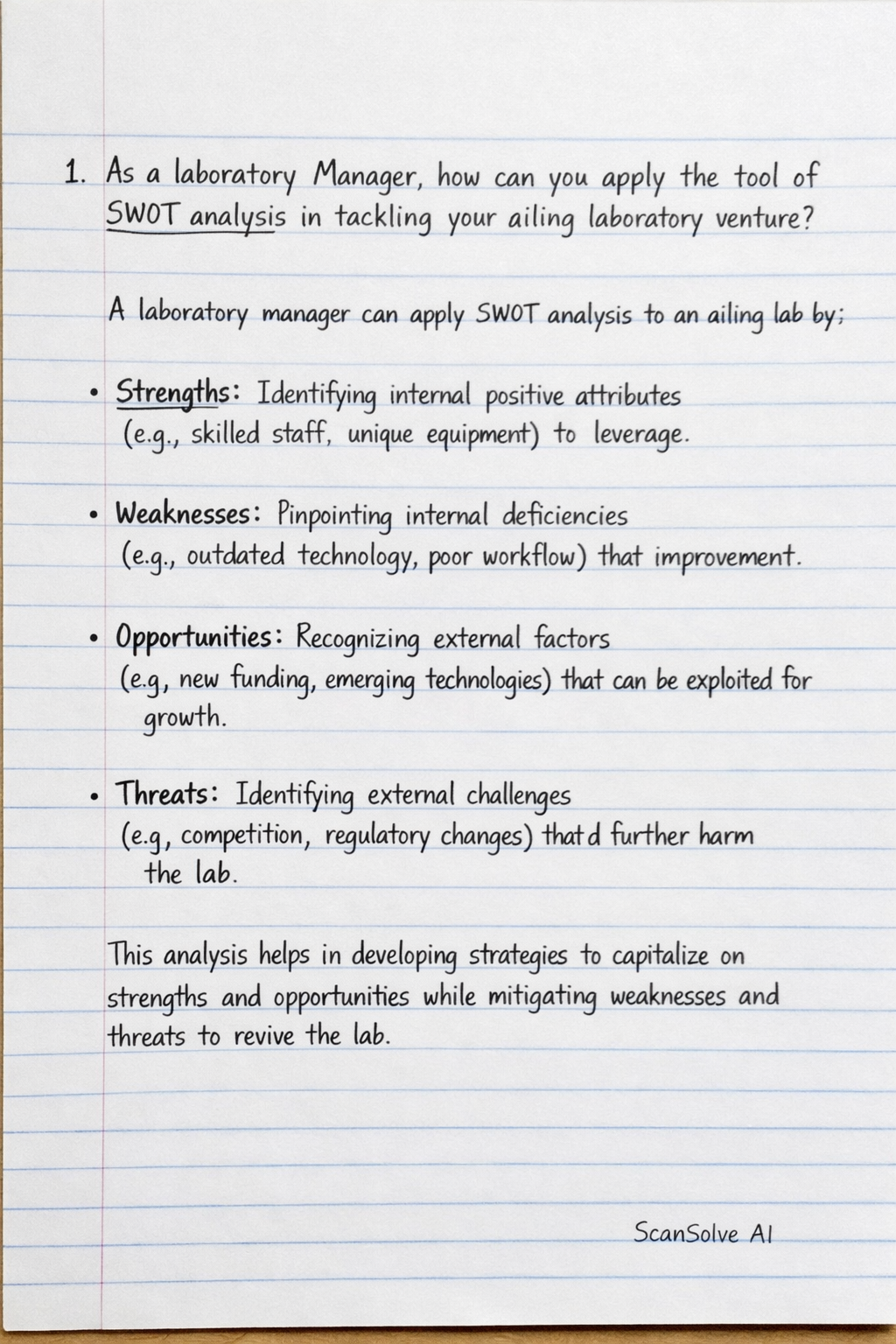
here are the answers to the first seven questions from the image: 1. As a laboratory Manager, how can you apply the tool of SWOT analysis in tackling your ailing laboratory venture? A laboratory manager can apply SWOT analysis to an ailing lab by: Strengths: Identifying internal positive attributes (e.g., skilled staff, unique equipment) to leverage. Weaknesses: Pinpointing internal deficiencies (e.g., outdated technology, poor workflow) that need improvement. Opportunities: Recognizing external factors (e.g., new funding, emerging technologies) that can be exploited for growth. Threats: Identifying external challenges (e.g., competition, regulatory changes) that could further harm the lab. This analysis helps in developing strategies to capitalize on strengths and opportunities while mitigating weaknesses and threats to revive the lab. 2. As a laboratory manager, explain how you can apply the concept of "helicopter view" in ensuring the smooth running of your laboratory. Applying a "helicopter view" means a laboratory manager takes a step back to see the entire operation, not just individual tasks. This involves understanding how all departments, processes, and personnel interact and contribute to the lab's overall goals. By having this broad perspective, the manager can identify bottlenecks, anticipate potential issues, allocate resources effectively, and ensure that all components are working in harmony, leading to a more efficient and smoothly running laboratory. 3. Describe the process of developing and implementing a laboratory quality management system (LQMS). Developing and implementing an LQMS involves several key steps: Planning: Define the scope, objectives, and policies of the LQMS, aligning with regulatory requirements and organizational goals. Documentation: Create comprehensive Standard Operating Procedures (SOPs), quality manuals, forms, and records for all lab processes. Training: Educate all staff on the new LQMS, their roles, and the importance of quality practices. Implementation: Integrate the documented procedures into daily operations, ensuring adherence to new protocols. Monitoring & Review: Regularly audit the system, collect data on performance indicators, and conduct management reviews to identify areas for improvement. Continuous Improvement: Use feedback and audit results to refine processes, update documentation, and enhance the LQMS over time. 4. Discuss the significance of Standard Operating Procedures (SOPs) in laboratory operations and quality ASSURANCE. Standard Operating Procedures (SOPs) are crucial in laboratory operations and quality assurance because they: Standardize Processes: Ensure consistency and uniformity in how tasks are performed, reducing variability and errors. Ensure Safety: Provide clear instructions for handling hazardous materials and operating equipment safely, protecting personnel. Facilitate Training: Serve as essential training tools for new staff, ensuring they learn correct and approved methods. Support Quality Control: Outline steps for quality checks, calibration, and maintenance, contributing to accurate and reliable results. Aid Regulatory Compliance: Demonstrate adherence to regulatory standards and accreditation requirements, providing an audit trail. 5. Explain how you can apply LIMS in ensuring quality service delivery in a modern laboratory setting. A Laboratory Information Management System (LIMS) enhances quality service delivery by: Sample Management: Providing robust tracking from sample receipt to disposal, minimizing loss or mix-ups. Workflow Automation: Automating test ordering, instrument interfacing, and result reporting, reducing manual errors and turnaround times. Quality Control (QC) Integration: Managing QC data, flagging out-of-range results, and ensuring compliance with QC protocols. Data Integrity: Maintaining a secure, centralized database for all lab data, ensuring accuracy, traceability, and easy retrieval. Reporting & Auditing: Generating comprehensive reports and audit trails, which are vital for quality assurance, accreditation, and client satisfaction. 6. Discuss inventory management techniques used in laboratories to minimize waste, prevent stock-outs, and ensure cost effectiveness. Effective inventory management in laboratories uses techniques such as: Just-In-Time (JIT): Ordering supplies only when needed to minimize storage costs and waste, though it requires reliable suppliers. ABC Analysis: Categorizing inventory items by value (A-high value, B-medium, C-low) to focus management efforts on critical items. First-In, First-Out (FIFO): Ensuring older stock is used before newer stock to prevent expiry and waste, especially for reagents. Perpetual Inventory System: Continuously tracking inventory levels in real-time using software or barcodes to prevent stock-outs and over-ordering. Centralized Purchasing: Consolidating orders to leverage bulk discounts and streamline procurement processes. These techniques collectively help optimize stock levels, reduce waste, and control costs. 7. Critically examine the role of occupational health and safety programmes in laboratory. Occupational Health and Safety (OHS) programs are fundamental in laboratories, playing a critical role in: Protecting Personnel: Safeguarding staff, students, and visitors from physical, chemical, and biological hazards through risk assessments, PPE, and safe work practices. Preventing Accidents & Illnesses: Implementing protocols for emergency response, waste disposal, and equipment maintenance to minimize incidents and exposure. Ensuring Regulatory Compliance: Adhering to local and international health and safety regulations, avoiding legal penalties and maintaining accreditation. Fostering a Safety Culture: Promoting awareness, training, and accountability among all lab users, making safety an integral part of daily operations. Improving Productivity: A safe environment reduces downtime due to accidents or illness, leading to a more efficient and productive workforce. You've got this! Send the next one 📸