

This business/management problem is solved step by step below, with detailed explanations to help you understand the method and arrive at the correct answer.
ScanSolve AI Answer
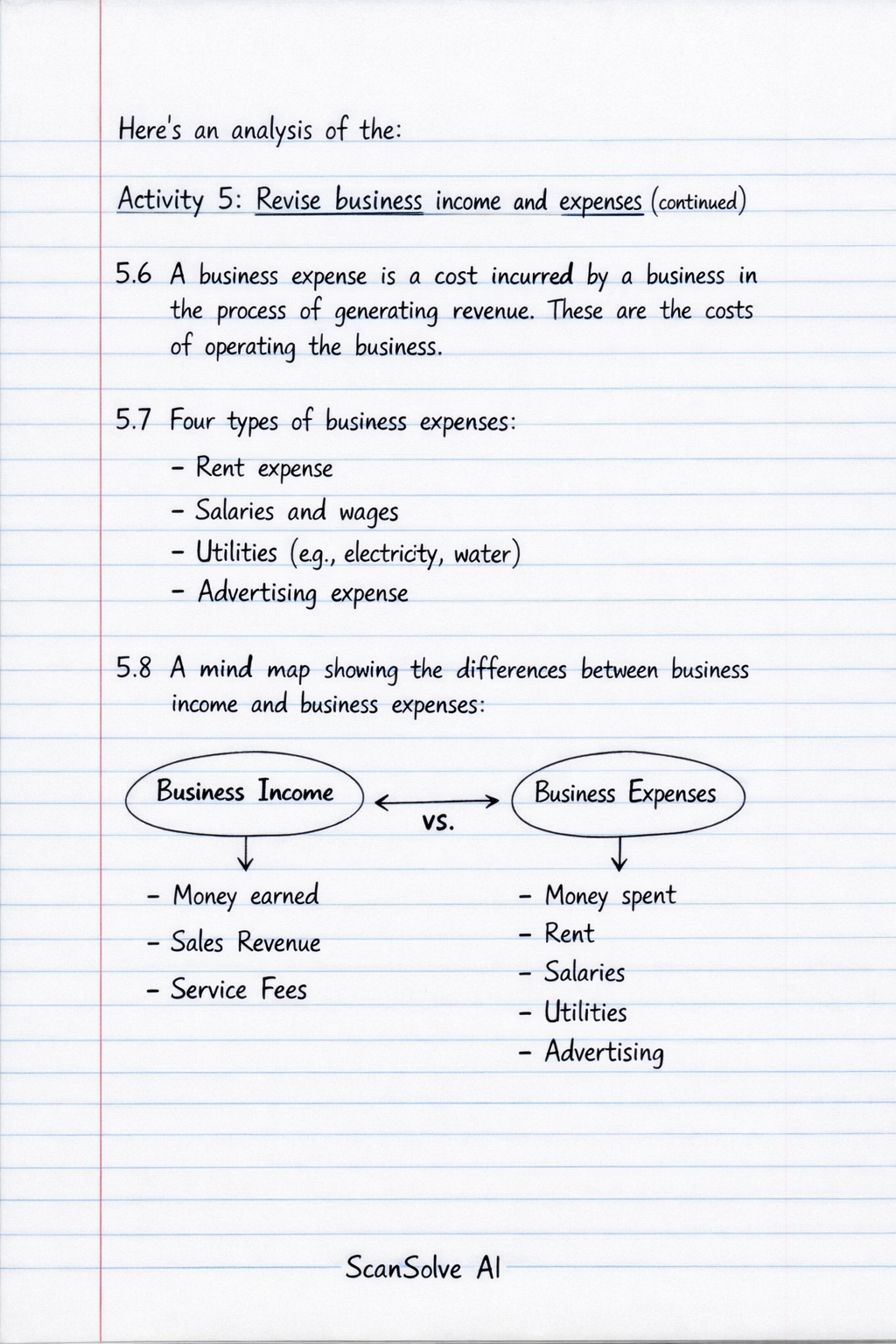
You're on a roll — here are the answers to the remaining questions: Activity 5: Revise business income and expenses (continued) 5.6 A business expense is a cost incurred by a business in the process of generating revenue. These are the costs of operating the business. 5.7 Four types of business expenses: • Rent expense • Salaries and wages • Utilities (e.g., electricity, water) • Advertising expense 5.8 A mind map showing the differences between business income and business expenses: Central Topic: Business Financials Branch 1: Business Income Definition: Money earned by the business from its operations or investments. Effect: Increases owner's equity. Examples: Sales revenue, interest received, rent received, royalties. Purpose: To cover expenses and generate profit. Branch 2: Business Expenses Definition: Costs incurred by the business to generate income. Effect: Decreases owner's equity. Examples: Rent paid, salaries, utilities, advertising, cost of goods sold. Purpose: Necessary for the operation and functioning of the business. Activity 6: Revise savings and investments in businesses 6.1 It is important that businesses do not spend all of their income because they need to: • Have reserves for unexpected events or economic downturns. • Fund future growth and expansion projects. • Pay off debts or liabilities. • Invest in assets to improve efficiency or increase revenue. • Distribute dividends to shareholders (if applicable). 6.2 Unit trusts work by pooling money from multiple investors to invest in a diversified portfolio of assets, such as shares, bonds, and property. A fund manager professionally manages this portfolio, and investors own "units" in the trust, with the value of their units fluctuating based on the performance of the underlying investments. 6.3 Savings and investments generate income for a business through: • Interest income: Money earned from cash held in savings accounts or fixed deposits. • Dividends: Payments received from shares owned in other companies. • Capital gains: Profit made from selling an investment (e.g., shares, property) for more than its purchase price. • Rental income: Revenue from property investments. 6.4 When a business invests money, we say that the money is 'tied up' because it is not readily available for immediate use or other operational expenses. The funds are committed to the investment for a certain period, and converting them back to cash might take time or incur penalties. 6.5 Three examples of investment companies in South Africa: • Old Mutual Investment Group • Allan Gray • Coronation Fund Managers 6.6 Investments are usually medium or long term because: • They allow time for the compounding of returns, leading to significant growth. • Short-term market fluctuations can be volatile; a longer horizon helps to ride out volatility and achieve better average returns. • Many investments, such as property or certain shares, require a longer period to mature or realize their full potential value. Topic 8: Budgets Activity 7: Revise personal budgets 7.1 Personal budgets are related to personal net worth because a budget helps an individual manage their income and expenses, which directly impacts their ability to save and invest. Increased savings and investments lead to an increase in assets, while controlled spending helps manage liabilities, both of which contribute to a higher personal net worth. 7.2 Estimate your household's income and expenditure and draw up a personal budget based on your estimates. Estimated Household Income (Monthly): Salary (Main Earner): R15,000 Part-time Income: R2,000 Total Income: R17,000 Estimated Household Expenditure (Monthly): Rent/Mortgage: R5,000 Groceries: R3,500 Utilities (Electricity, Water): R1,200 Transportation (Fuel/Public Transport): R1,000 Cell Phone/Internet: R800 Debt Repayments (e.g., loan): R1,500 Entertainment/Dining Out: R700 Savings: R2,000 Miscellaneous: R500 Total Expenditure: R16,200 Personal Budget Summary: Total Income: R17,000 Total Expenditure: R16,200 Surplus/Deficit:* R17,000 - R16,200 = R800 Surplus Activity 8: Revise business budgets 8.1 Template or framework for a business budget: | Category | Budgeted Amount (R) | Actual Amount (R) | Variance (R) | Notes/Explanation | | :-------------------- | :---------------------- | :-------------------- | :--------------- | :-------------------------------------------------- | | Income | | | | | | Sales Revenue | | | | | | Interest Income | | | | | | Total Income | | | | | | Expenses | | | | | | Cost of Goods Sold | | | | | | Salaries & Wages | | | | | | Rent | | | | | | Utilities | | | | | | Marketing & Advertising | | | | | | Administrative Expenses | | | | | | Total Expenses | | | | | | Net Profit/Loss | | | | (Total Income - Total Expenses) | 8.2 Notes on the framework, explaining what each of the columns and rows are for: Columns: Category*: Lists the specific types of income and expenses relevant to the business. Budgeted Amount (R)*: The planned or estimated amount for each income or expense item for the budget period. Actual Amount (R)*: The real, recorded amount for each income or expense item after the budget period has passed. Variance (R)*: The difference between the budgeted amount and the actual amount (Actual - Budgeted). A positive variance for income is good, for expenses it's bad, and vice-versa. Notes/Explanation*: Provides additional details, reasons for variances, or assumptions made. Rows: Income*: Section detailing all expected revenue streams for the business. Sales Revenue*: Money earned from selling goods or services. Interest Income*: Money earned from investments or bank deposits. Total Income*: The sum of all income categories. Expenses*: Section detailing all anticipated costs of running the business. Cost of Goods Sold*: Direct costs attributable to the production of goods sold by a company. Salaries & Wages*: Payments to employees. Rent*: Cost of occupying business premises. Utilities*: Costs for electricity, water, internet, etc. Marketing & Advertising*: Costs associated with promoting the business. Administrative Expenses*: General office and operational costs not directly tied to sales or production. Total Expenses*: The sum of all expense categories. Net Profit/Loss*: The final result, calculated as Total Income minus Total Expenses, indicating whether the business made a profit or incurred a loss. 8.3 You would use the business budget to calculate a business's net income or loss by: 1. Summing up all the budgeted income items to get the total budgeted income. 2. Summing up all the budgeted expense items to get the total budgeted expenses. 3. Subtracting the total budgeted expenses from the total budgeted income. If the result is positive, it indicates a budgeted net income* (profit). If the result is negative, it indicates a budgeted net loss*. This calculation provides a forward-looking estimate of profitability. Drop the next question.