
We read your photo as:
How can the Batho Pele Principles be applied to improve service delivery and public trust in the Johannesburg Metropolitan Municipality?
ScanSolve AI Answer
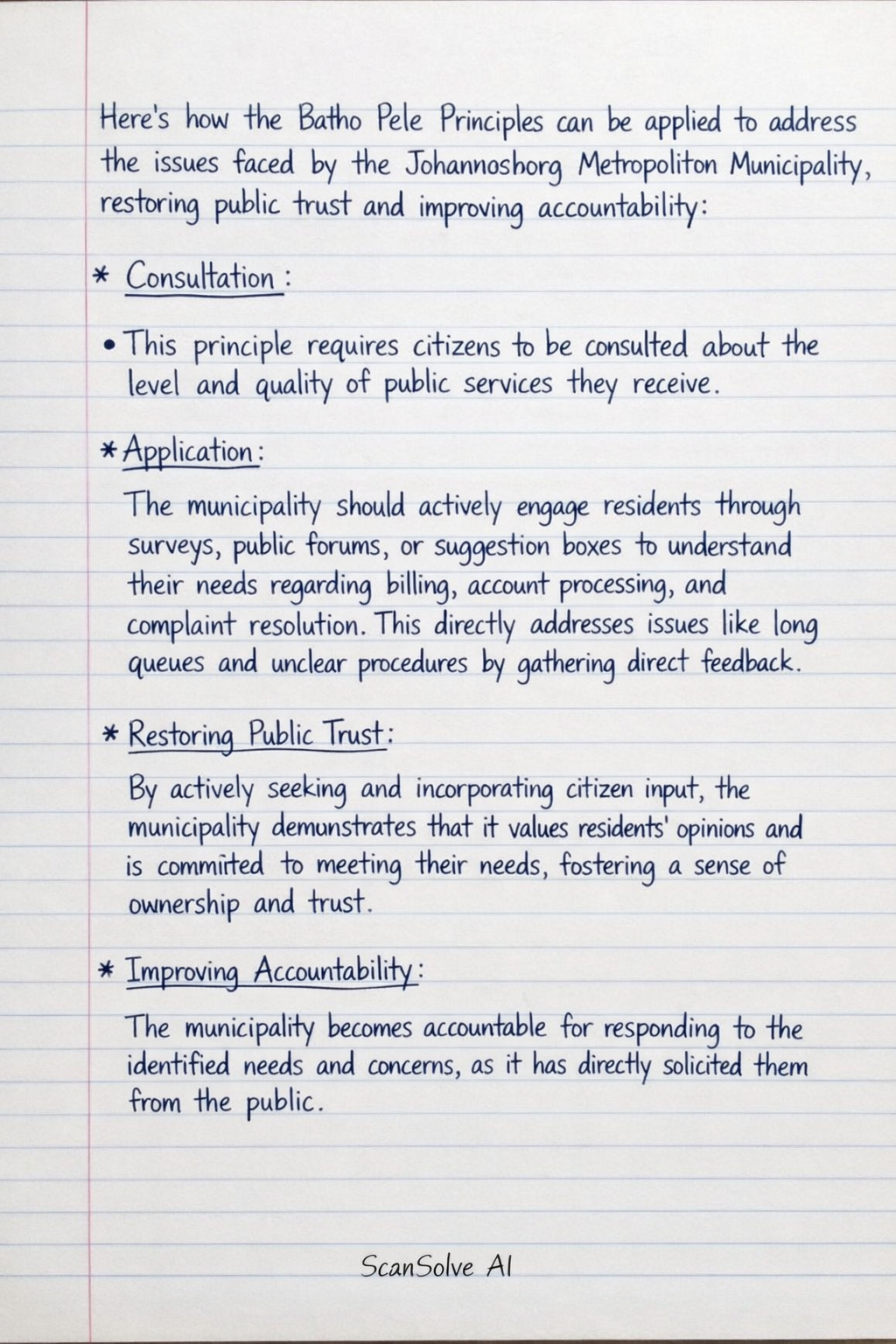
Here's how the Batho Pele Principles can be applied to address the issues faced by the Johannesburg Metropolitan Municipality, restoring public trust and improving accountability:
-
Consultation: This principle requires citizens to be consulted about the level and quality of public services they receive. Application: The municipality should actively engage residents through surveys, public forums, or suggestion boxes to understand their needs regarding billing, account processing, and complaint resolution. This directly addresses issues like long queues and unclear procedures by gathering direct feedback. Restoring Public Trust: By actively seeking and incorporating citizen input, the municipality demonstrates that it values residents' opinions and is committed to meeting their needs, fostering a sense of ownership and trust. Improving Accountability: The municipality becomes accountable for responding to the identified needs and concerns, as it has directly solicited them from the public. Practical Example: Holding regular "Mayor's Open Day" events in different wards where residents can directly voice concerns and suggest improvements, or implementing an online platform for continuous feedback.
-
Service Standards: This principle dictates that citizens should be informed about the level and quality of services they can expect. Application: The municipality must clearly define and display service standards for all operations, including expected waiting times for account processing, complaint resolution timeframes, and billing accuracy. This directly addresses the lack of displayed service standards and residents not being informed about complaint resolution times. Restoring Public Trust: Transparently setting and communicating service standards builds trust by managing expectations and showing a clear commitment to delivering measurable quality. Improving Accountability: The municipality is held accountable to these published standards. Citizens can easily identify and challenge deviations, ensuring the municipality adheres to its commitments. Practical Example: Posting clear signs at municipal offices stating "Billing error resolution within 5 working days" or "Complaint feedback within 48 hours," and publishing these standards prominently on the municipal website.
-
Access: This principle ensures that all citizens have equal access to the services they are entitled to. Application: The municipality needs to improve physical access by establishing a priority desk and providing adequate seating for elderly residents and people with disabilities. Streamlining processes and potentially offering online services can also reduce long queues and improve overall accessibility. Restoring Public Trust: Ensuring equitable access for all, especially vulnerable groups, demonstrates the municipality's commitment to serving all citizens fairly and inclusively, thereby building confidence. Improving Accountability: The municipality is accountable for removing barriers to service access and ensuring that no citizen is unfairly disadvantaged in receiving essential services. Practical Example: Designating a "Priority Service Desk" for elderly and disabled individuals, installing ramps, and developing a user-friendly mobile application for bill payments and complaint logging.
-
Courtesy: This principle emphasizes treating citizens with politeness and consideration. Application: Staff training is crucial to address rude staff behavior and poor communication. Employees should be trained to interact respectfully, provide consistent information, and assist clients effectively, fostering a more positive service experience. Restoring Public Trust: Polite and respectful interactions foster a positive perception of the municipality, making citizens feel valued and respected, which is fundamental to rebuilding trust. Improving Accountability: Staff are held accountable for their conduct and adherence to professional service standards. Training, clear codes of conduct, and performance reviews can reinforce this. Practical Example: Implementing mandatory customer service training for all front-line staff, including modules on empathy, conflict resolution, and clear communication, with regular performance evaluations based on customer feedback.
-
Information: This principle requires providing full, accurate, and up-to-date information about services. Application: The municipality must ensure that all staff provide consistent and accurate information regarding procedures, billing, and complaint processes. Clear communication channels should be established to inform residents about the progress of their complaints, addressing the issue of inconsistent information and lack of feedback. Restoring Public Trust: Providing accurate, consistent, and timely information empowers citizens and builds confidence in the municipality's reliability and honesty. Improving Accountability: The municipality is accountable for the accuracy and consistency of the information it provides. Misinformation can be traced and corrected, and staff can be held responsible for providing incorrect details. Practical Example: Developing a comprehensive, easily accessible FAQ section on the municipal website, implementing a standardized knowledge base for call center agents, and sending automated SMS updates on complaint status.
-
Openness and Transparency: This principle means citizens should be informed about how departments are run and managed. Application: The municipality should make its procedures, complaint handling processes, and service delivery mechanisms transparent. This will help clarify unclear procedures and build trust, ensuring residents understand how their complaints are managed and resolved. Restoring Public Trust: Openness about operations and decision-making processes reduces suspicion and fosters an environment of trust, as citizens can see how services are delivered and issues are addressed. Improving Accountability: The municipality becomes accountable for its processes and decisions when they are publicly visible. This allows for public scrutiny and ensures adherence to established guidelines. Practical Example: Publishing an organizational chart, service delivery charters, and detailed complaint resolution flowcharts on the municipal website, explaining each step of the process.
-
Redress: This principle states that if service standards are not met, citizens should receive an apology, explanation, and a speedy remedy. Application: A robust complaint resolution system must be implemented. When residents lodge complaints, they should receive regular feedback on progress and a clear outcome, preventing repeated returns without a solution. This addresses the problem of residents rarely receiving feedback after being given a reference number. Restoring Public Trust: A fair and effective redress mechanism assures citizens that their grievances will be addressed, and mistakes will be corrected, reinforcing their trust in the system. Improving Accountability: The municipality is directly accountable for resolving complaints and providing satisfactory remedies. Failure to do so can lead to further action or public criticism. Practical Example: Establishing a dedicated ombudsman's office or a specialized complaints unit that provides regular updates (e.g., weekly emails/SMS) on complaint status and ensures a final resolution is communicated to the complainant.
-
Value for Money: This principle focuses on providing public services economically and efficiently. Application: The municipality needs to review and optimize its internal processes to eliminate inefficiencies such as incorrect billing and slow processing of accounts. By improving efficiency, resources are better utilized, leading to better service delivery. Restoring Public Trust: Demonstrating efficient use of public funds and delivering effective services assures citizens that their taxes are being used responsibly, building confidence in the municipality's financial stewardship. Improving Accountability: The municipality is accountable for the efficient and economical use of public resources. Regular audits and performance reviews can ensure that services are delivered cost-effectively and that public funds are not wasted. Practical Example: Implementing an automated billing system to reduce errors and processing time, conducting regular internal audits of service delivery processes to identify and eliminate waste, and training staff on lean management principles.
Still stuck on this one?
Ask a follow-up, and the answer starts from this question.
More Business/Management Questions
Handwritten Step-by-Step Solution
Get this as a handwritten image on WhatsApp — like a tutor wrote it for you.
Try on WhatsApp