
We read your photo as:
Describe the communication plan steps for a formal approach and arranging a meeting, considering literacy levels.
ScanSolve AI Answer
Here are the answers for the communication plan:
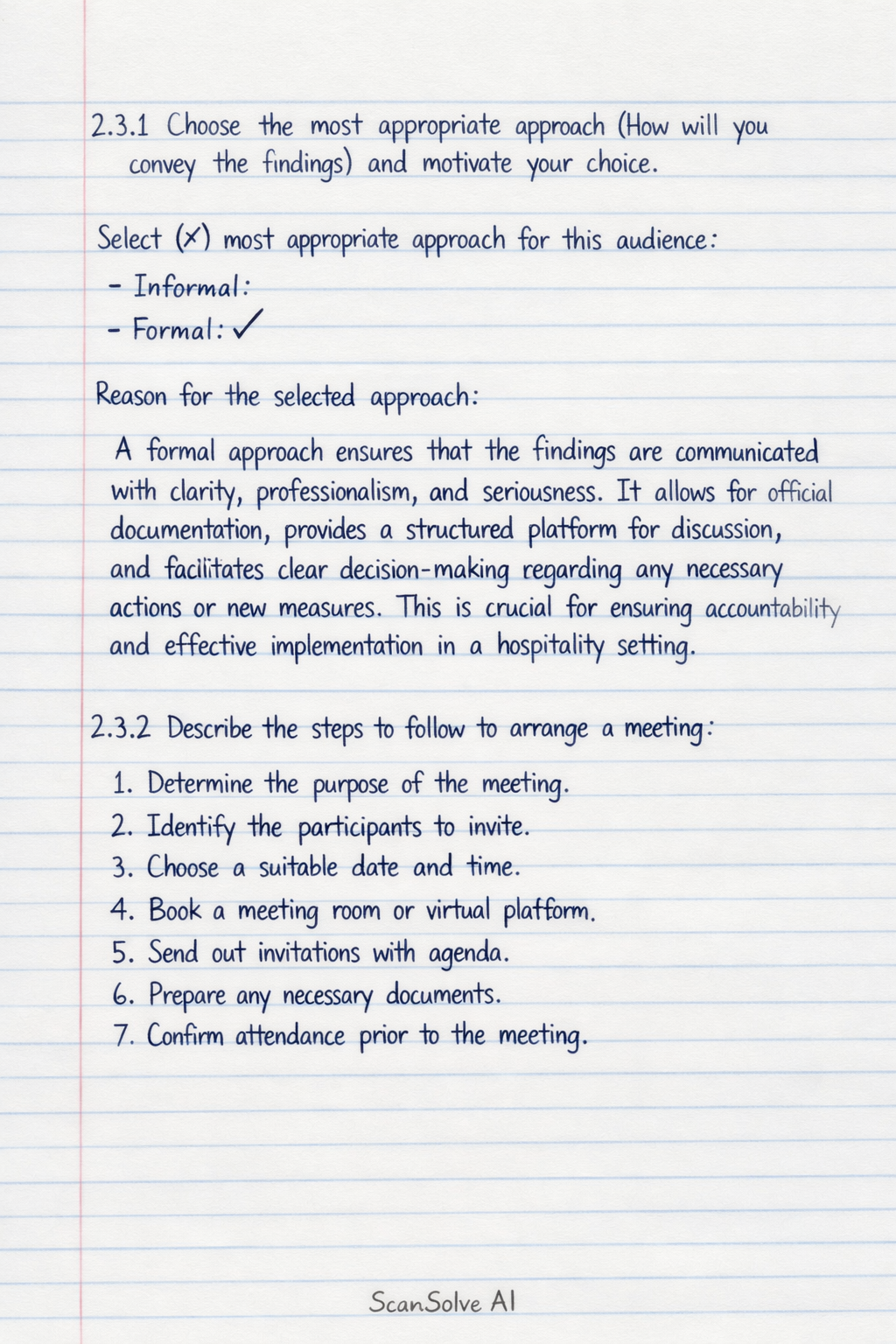
2.3.1 Choose the most appropriate approach (How will you convey the findings) and motivate your choice. Select (✓) most appropriate approach for this audience. Give a reason for the selected approach.
-
Select (✓) most appropriate approach for this audience:
- Informal:
- Formal: ✅
-
Reason for the selected approach: A formal approach ensures that the findings are communicated with clarity, professionalism, and seriousness. It allows for official documentation, provides a structured platform for discussion, and facilitates clear decision-making regarding any necessary actions or new measures. This is crucial for ensuring accountability and effective implementation in a hospitality setting.
2.3.2 Describe the steps to follow to arrange a meeting.
- Determine the purpose and objectives of the meeting.
- Identify the attendees and check their availability.
- Select a suitable date, time, and venue (physical or virtual).
- Prepare a detailed agenda outlining discussion points and time allocations.
- Send out invitations including the agenda, date, time, and location.
- Prepare any necessary materials, presentations, or documents.
- Confirm attendance and make final logistical arrangements.
2.3.3 Which resources can be used to address the literacy levels and level of understanding of the person or group?
- Visual aids: Use diagrams, charts, infographics, and videos to present information.
- Simplified language: Employ plain language, avoiding technical jargon.
- Interactive sessions: Facilitate question-and-answer sessions, group discussions, and practical demonstrations.
- Translated materials: Provide information in multiple languages if there are language barriers.
- One-on-one explanations: Offer individual support for those who require additional clarification.
- Summaries and handouts: Distribute concise summaries or reference materials for key points.
2.3.4 How will you know that the person or group understood and are complying with the new measures?
- Question and Answer sessions: Conduct interactive Q&A sessions to gauge comprehension.
- Direct observation: Observe daily operations to see if new measures are being implemented correctly.
- Feedback mechanisms: Implement surveys, suggestion boxes, or regular informal check-ins.
- Performance reviews: Assess individual or team performance against the new standards.
- Short quizzes or assessments: Administer brief tests to confirm knowledge retention.
- Documentation review: Check records and reports to ensure new procedures are being followed and documented accurately.
Still stuck on this one?
Ask a follow-up, and the answer starts from this question.
More Business/Management Questions
Handwritten Step-by-Step Solution
Get this as a handwritten image on WhatsApp — like a tutor wrote it for you.
Try on WhatsApp