
We read your photo as:
Compare the principles of COBIT®5 and ISO 38500, highlighting two major differences in their governance philosophy.
ScanSolve AI Answer
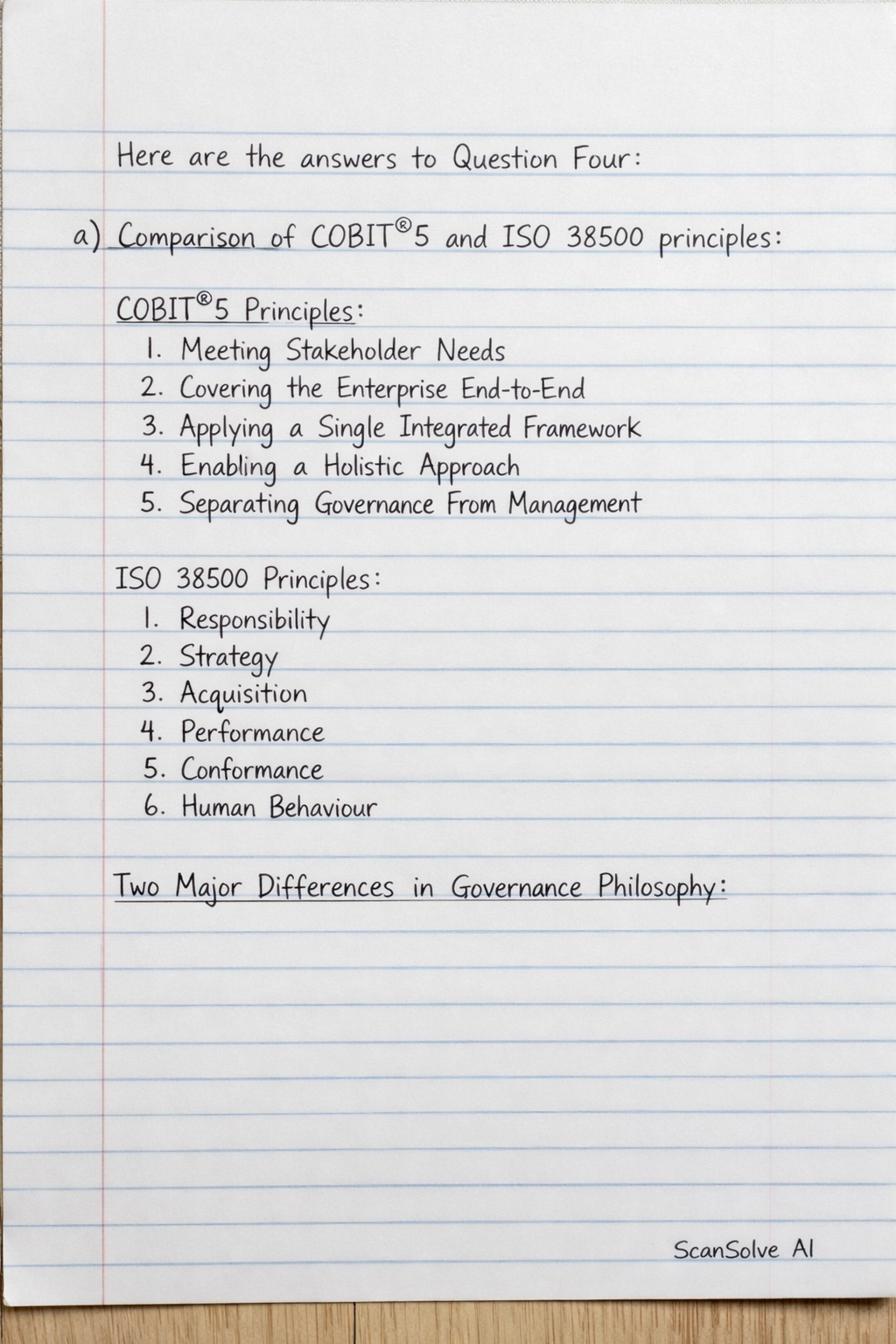
Here are the answers to Question Four:
a) Comparison of COBIT®5 and ISO 38500 principles:
COBIT®5 Principles:
- Meeting Stakeholder Needs
- Covering the Enterprise End-to-End
- Applying a Single Integrated Framework
- Enabling a Holistic Approach
- Separating Governance From Management
ISO 38500 Principles:
- Responsibility
- Strategy
- Acquisition
- Performance
- Conformance
- Human Behaviour
Two Major Differences in Governance Philosophy:
- Scope and Detail: COBIT®5 is a comprehensive framework that provides detailed processes, practices, and enablers for the governance and management of enterprise IT. It is highly prescriptive, offering specific guidance on how to achieve IT objectives. In contrast, ISO 38500 is a high-level standard that provides principles for the governance of IT by the governing body. It is less prescriptive, focusing on what should be governed rather than how, and aims to guide decision-making at the board level.
- Focus on Management vs. Governance: COBIT®5 explicitly separates governance from management, providing distinct objectives and processes for each. It covers both the "direct, evaluate, monitor" aspects of governance and the "plan, build, run, monitor" aspects of management. ISO 38500, while acknowledging management, primarily focuses on the governance aspects, guiding the governing body in its responsibilities to evaluate, direct, and monitor IT use.
Explanation Based on Organizational Origins:
- ISACA (COBIT®5): ISACA is an international professional association focused on IT governance, audit, security, and risk. Its origins lie in providing practical tools and guidance for IT professionals to manage and control IT effectively. This leads to COBIT®5 being a detailed, process-oriented framework designed for implementation by IT practitioners and for assurance by auditors. It addresses the operational realities and control requirements that ISACA's members face.
- ISO (ISO 38500): The International Organization for Standardization (ISO) develops international standards across various industries. Its aim is to provide universally applicable best practices and principles. ISO 38500, therefore, offers a high-level, principles-based standard that can be adopted by any organization, regardless of size or industry. It focuses on the strategic responsibilities of the governing body, reflecting ISO's role in setting broad, foundational guidelines rather than specific implementation methodologies.
b) Analysis of the statement: "Every organization has governance, whether formal or informal."
Logical Components:
- Governance: Refers to the system by which an organization is directed and controlled. It involves setting objectives, making decisions, allocating resources, monitoring performance, and ensuring accountability.
- Formal Governance: Involves explicitly defined structures, policies, procedures, roles, and responsibilities. It is documented, often legally mandated, and typically includes elements like board meetings, audit committees, written policies, and regulatory compliance frameworks.
- Informal Governance: Refers to the unwritten rules, cultural norms, shared values, personal relationships, and implicit understandings that guide decision-making and behavior within an organization. It is often based on trust, common sense, and established practices rather than formal documentation.
Breakdown of the Statement:
The statement implies that governance is an inherent and unavoidable aspect of any collective human endeavor, regardless of its size or complexity. Whenever people work together towards a common goal, there must be some form of direction, decision-making, and control. In smaller or newer organizations, this might manifest as informal agreements or the direct influence of a founder. As organizations grow, the need for clarity, consistency, and accountability typically drives the evolution towards more formal governance structures. Even in highly formalized organizations, informal governance still plays a role, influencing how formal rules are interpreted and applied.
Implications for a Startup Company versus a Multinational Bank:
- Startup Company:
- Initial State: Startups often begin with highly informal governance. Decisions are typically made by the founder(s) or a small core team, often through direct communication and shared understanding. Policies might be unwritten, and roles can be fluid.
- Implications: This informal approach allows for agility, rapid decision-making, and flexibility, which are crucial for innovation and adapting quickly in a dynamic market. However, it can also lead to a lack of clear accountability, inconsistent decision-making, and potential for conflict as the company grows. Without formal structures, scaling becomes challenging, and the organization may struggle with investor relations, regulatory compliance, or attracting experienced talent. As a startup matures, it must gradually introduce more formal governance to ensure sustainability, attract investment, and manage increasing complexity.
- Multinational Bank:
- Initial State: Multinational banks operate with highly formal and complex governance structures. They are subject to extensive regulatory requirements across multiple jurisdictions, necessitating robust frameworks for risk management, compliance, financial reporting, and stakeholder accountability. They have established boards of directors, executive committees, audit committees, detailed policies, and internal control systems.
- Implications: This formal governance ensures stability, transparency, risk mitigation, and compliance with legal and ethical standards, which are paramount for maintaining public trust and avoiding severe penalties. However, it can also lead to bureaucracy, slower decision-making processes, and reduced agility. The challenge for a multinational bank is to maintain effective governance across diverse operations while fostering innovation and responsiveness within its highly structured environment.
Still stuck on this one?
Ask a follow-up, and the answer starts from this question.
More Business/Management Questions
Handwritten Step-by-Step Solution
Get this as a handwritten image on WhatsApp — like a tutor wrote it for you.
Try on WhatsApp