
We read your photo as:
Define the following Industrial Firms: "State-owned Enterprise" and "Partnership". Explain the characteristics and give three (3) advantages and three (3) disadvantages of each.
ScanSolve AI Answer
Step-by-step solution
2 stepsHere's the solution for Question 5:
Define "State-owned Enterprise" (SOE).
A State-owned Enterprise (SOE) is a business entity where the government, either national or local, has significant control through full or majority ownership. These enterprises are typically established to provide public services, manage strategic industries, or generate revenue for the state.
- Advantages of a State-owned Enterprise:
- Public Service Provision: SOEs can provide essential services (e.g., utilities, transportation) that might not be profitable for private companies, ensuring access for all citizens.
- Economic Stability: They can stabilize key industries during economic downturns and protect jobs, acting as a buffer against market volatility.
- Strategic Control: Governments maintain direct control over strategic sectors like defense, energy, or infrastructure, aligning operations with national interests and security.
- Disadvantages of a State-owned Enterprise:
- Inefficiency and Bureaucracy: SOEs often suffer from bureaucratic red tape, lack of competitive pressure, and political interference, leading to operational inefficiencies and slower decision-making.
- Lack of Innovation: Without the strong profit motive and competitive drive of private firms, SOEs may have less incentive to innovate or adopt new technologies.
- Political Interference and Corruption: Decisions can be influenced by political agendas rather than economic viability, potentially leading to corruption, cronyism, and misallocation of resources.
Define "Partnership".
A Partnership is a business structure where two or more individuals agree to share in the profits or losses of a business. Partners typically contribute money, property, labor, or skill, and share in the management and liabilities of the business.
- Advantages of a Partnership:
- Shared Responsibility and Workload: Partners can pool their skills, knowledge, and resources, distributing the workload and leveraging diverse expertise.
- Easier to Form: Partnerships are relatively easy and inexpensive to establish compared to corporations, requiring fewer legal formalities.
- Increased Capital: Multiple partners can contribute more capital to the business than a sole proprietor, facilitating growth and investment.
- Disadvantages of a Partnership:
- Unlimited Liability: In most general partnerships, partners have unlimited liability, meaning their personal assets can be used to cover business debts.
- Potential for Disputes: Disagreements among partners regarding management, profit sharing, or business direction can lead to conflicts and dissolution of the partnership.
- Lack of Continuity: The partnership can be dissolved upon the death, withdrawal, or bankruptcy of a partner, potentially disrupting business operations.
Still stuck on this one?
Ask a follow-up, and the answer starts from this question.
More Business/Management Questions
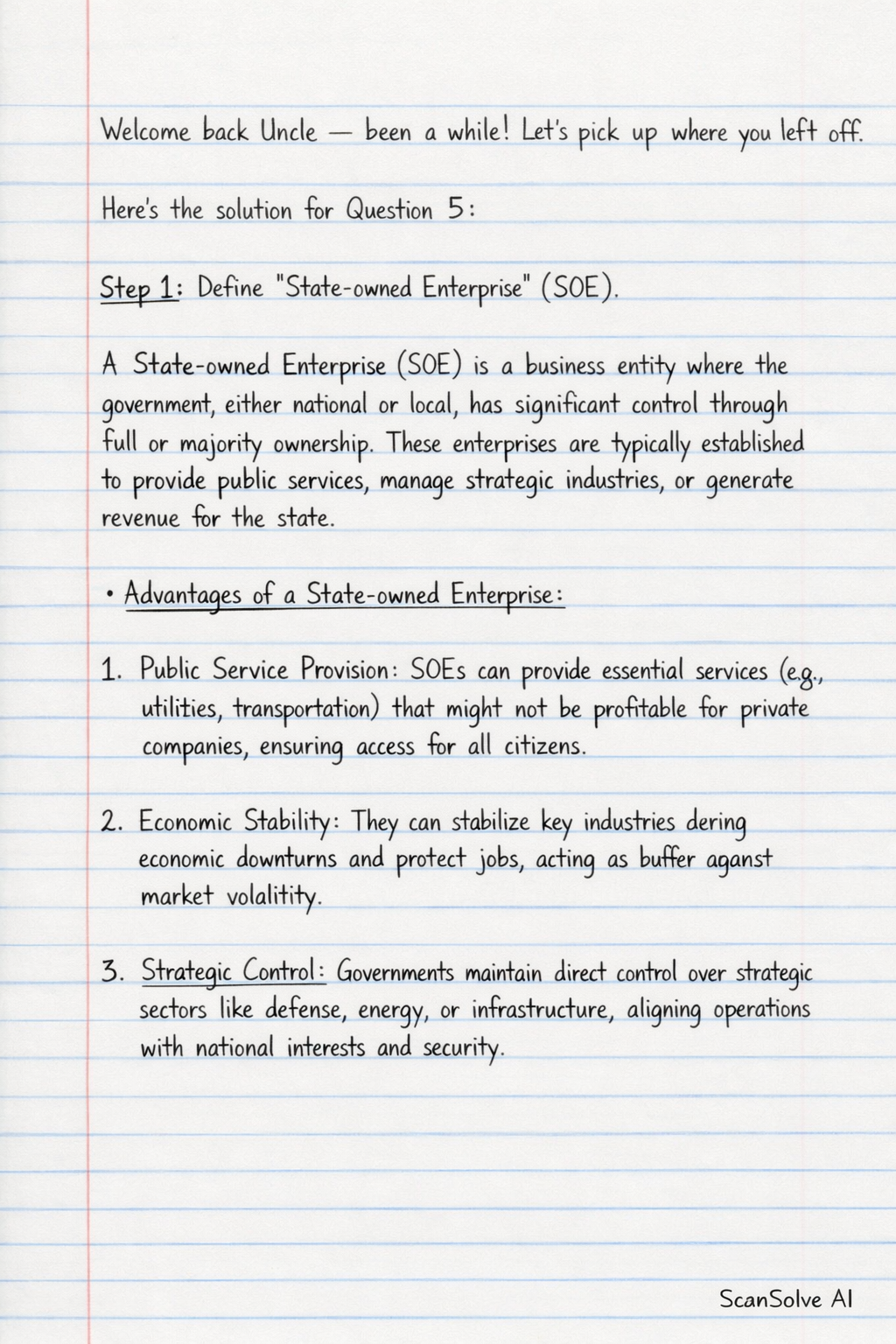
Handwritten Step-by-Step Solution
Get this as a handwritten image on WhatsApp — like a tutor wrote it for you.
Try on WhatsApp