

This business/management problem is solved step by step below, with detailed explanations to help you understand the method and arrive at the correct answer.
ScanSolve AI Answer
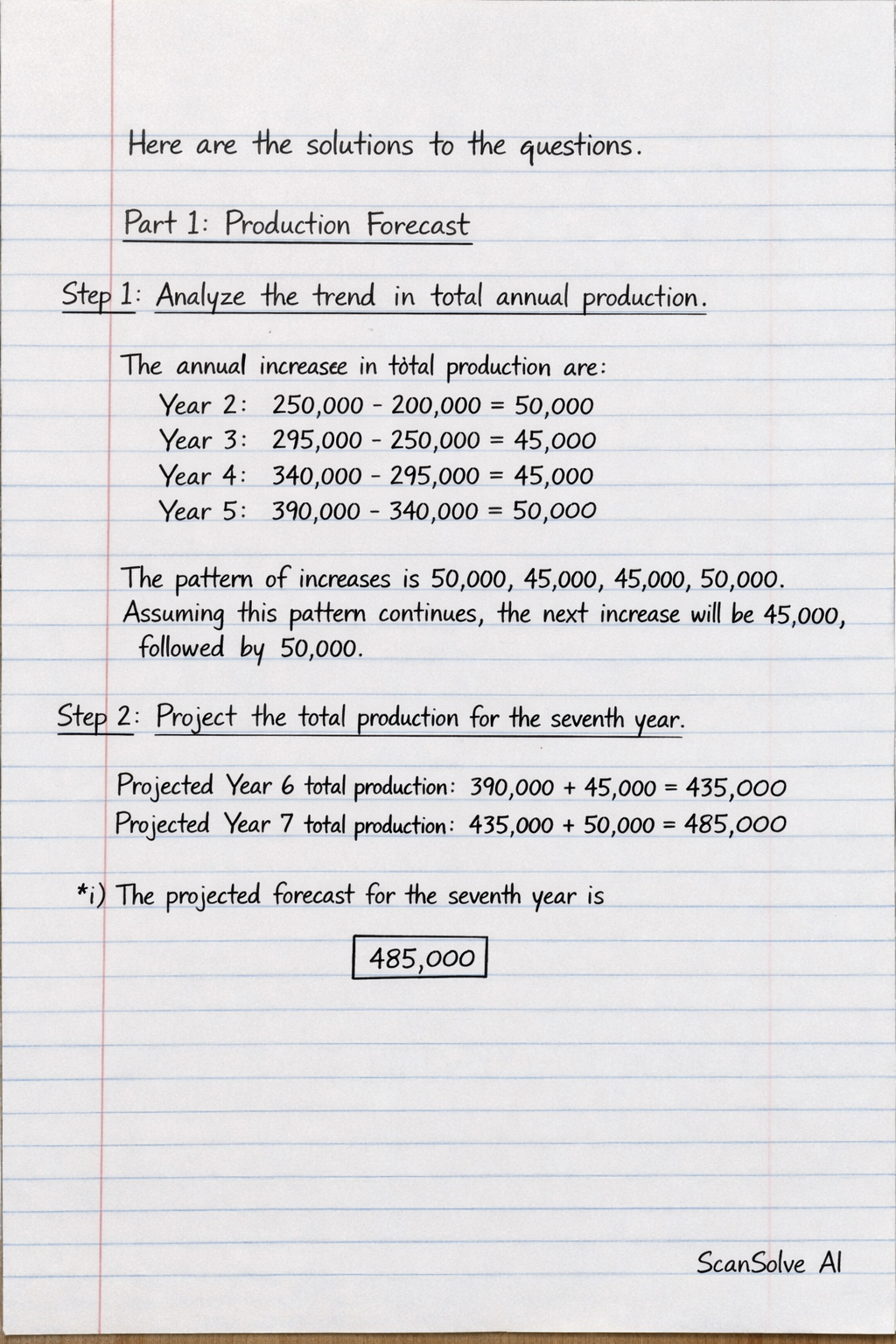
Here are the solutions to the questions. Part 1: Production Forecast Step 1: Analyze the trend in total annual production. The annual increases in total production are: Year 2: 250,000 - 200,000 = 50,000 Year 3: 295,000 - 250,000 = 45,000 Year 4: 340,000 - 295,000 = 45,000 Year 5: 390,000 - 340,000 = 50,000 The pattern of increases is 50,000, 45,000, 45,000, 50,000. Assuming this pattern continues, the next increase will be 45,000, followed by 50,000. Step 2: Project the total production for the seventh year. Projected Year 6 total production: 390,000 + 45,000 = 435,000 Projected Year 7 total production: 435,000 + 50,000 = 485,000 i) The projected forecast for the seventh year is 485,000. Step 3: Analyze the trend in Quarter Two production. The increases in Quarter Two production are: Year 2: 55,000 - 45,000 = 10,000 Year 3: 70,000 - 55,000 = 15,000 Year 4: 80,000 - 70,000 = 10,000 Year 5: 100,000 - 80,000 = 20,000 The average annual increase for Quarter Two is (10,000 + 15,000 + 10,000 + 20,000)/(4) = (55,000)/(4) = 13,750. Step 4: Project Quarter Two production for the seventh year. Projected Year 6 Quarter Two production: 100,000 + 13,750 = 113,750 Projected Year 7 Quarter Two production: 113,750 + 13,750 = 127,500 Step 5: Analyze the trend in Quarter Three production. The increases in Quarter Three production are: Year 2: 80,000 - 65,000 = 15,000 Year 3: 90,000 - 80,000 = 10,000 Year 4: 100,000 - 90,000 = 10,000 Year 5: 95,000 - 100,000 = -5,000 The average annual increase for Quarter Three is (15,000 + 10,000 + 10,000 - 5,000)/(4) = (30,000)/(4) = 7,500. Step 6: Project Quarter Three production for the seventh year. Projected Year 6 Quarter Three production: 95,000 + 7,500 = 102,500 Projected Year 7 Quarter Three production: 102,500 + 7,500 = 110,000 ii) The projected production for the 2nd quarter in the seventh year is 127,500. The projected production for the 3rd quarter in the seventh year is 110,000. Part 4: Define the following appraisal indicators i) Net Present Value (NPV): The difference between the present value of cash inflows and the present value of cash outflows over a period of time. It is used to evaluate the profitability of a project or investment. ii) Payback Period: The length of time required for an investment to recover its initial cost from the cash flows it generates. It is a simple measure of an investment's risk and liquidity. iii) Cash Flow: The total amount of cash or cash equivalents moving into and out of a business. It indicates how well a company manages its cash position, meaning how much cash it generates to pay its debt obligations and fund its operating expenses. Send me the next one 📸