
We read your photo as:
Develop a data collection and implementation plan for three community garden proposals (vegetable, pollinator, fruit).
Business/Management
ScanSolve AI Answer
Step-by-step solution
3 stepsAs a learner in the team of data analysts, here is a data collection and implementation plan to inform the community centre's board of directors on the three garden proposals:
Define Data Collection Objectives
The primary objective is to gather comprehensive data on community needs, preferences, resource availability, and the feasibility of each garden proposal (vegetable, pollinator, fruit) to enable an informed decision.
Data Collection Methods
- Community Surveys: Design and distribute surveys (online and paper-based, translated into local languages if necessary) to a representative sample of community members. Questions will gauge interest in each garden type, perceived benefits (e.g., addressing food insecurity, supporting local ecology, providing fresh produce), willingness to volunteer, and preferred location.
- Focus Groups and Interviews: Conduct focus groups with diverse community segments (e.g., families, seniors, local businesses, environmental groups) to gather qualitative insights into their priorities, concerns, and expectations for a community garden. Conduct one-on-one interviews with key stakeholders such as local food bank managers, beekeepers, and community leaders.
- Site Assessments: Perform detailed assessments of the three potential land plots. This includes soil testing, sunlight exposure analysis, water access evaluation, and identification of existing flora and fauna. This data will inform the practical feasibility of each garden type.
- Resource Inventory: Document available community resources, including potential volunteer labor, tools, materials, and potential funding sources (e.g., grants, local donations).
Implementation Plan
- Phase 1: Planning (1 week)
- Develop survey questionnaires and interview guides.
- Identify target demographics for surveys and focus groups.
- Secure necessary permissions for site access and community engagement activities.
- Phase 2: Data Gathering (3-4 weeks)
- Distribute and collect surveys from the community.
- Organize and conduct focus group sessions and stakeholder interviews.
- Carry out on-site environmental assessments of the proposed plots.
- Compile information on available resources.
- Phase 3: Data Analysis (2-3 weeks)
- Analyze quantitative data from surveys to identify statistical trends in preferences and needs.
- Synthesize qualitative data from focus groups and interviews to understand underlying community sentiments and priorities.
- Integrate site assessment findings with garden type requirements to determine feasibility.
- Compare the findings against the three garden proposals.
- Phase 4: Reporting and Recommendation (1 week)
- Prepare a comprehensive report summarizing all findings, including community preferences, resource availability, and the feasibility of each garden type.
- Formulate clear, data-driven recommendations for the community centre's board of directors, outlining which garden type best aligns with community needs and available resources.
- Present the report and recommendations to the board for their informed decision.
- Phase 1: Planning (1 week)
Was this helpful?
Still stuck on this one?
Ask a follow-up, and the answer starts from this question.
Got a different question?Ask your own question
More Business/Management Questions
QWrite a report to submit a proposal to the SMT, motivating the need for sustainable and environment…QHow can a community garden project uphold the principle of reciprocity?QCreate a research plan for a community economic development project, including identifying economic…QCreate a portfolio for a kitchen garden, detailing its purpose, learning outcomes, and steps for…QThis document outlines a Grade 12 research task to investigate factors influencing crop production…
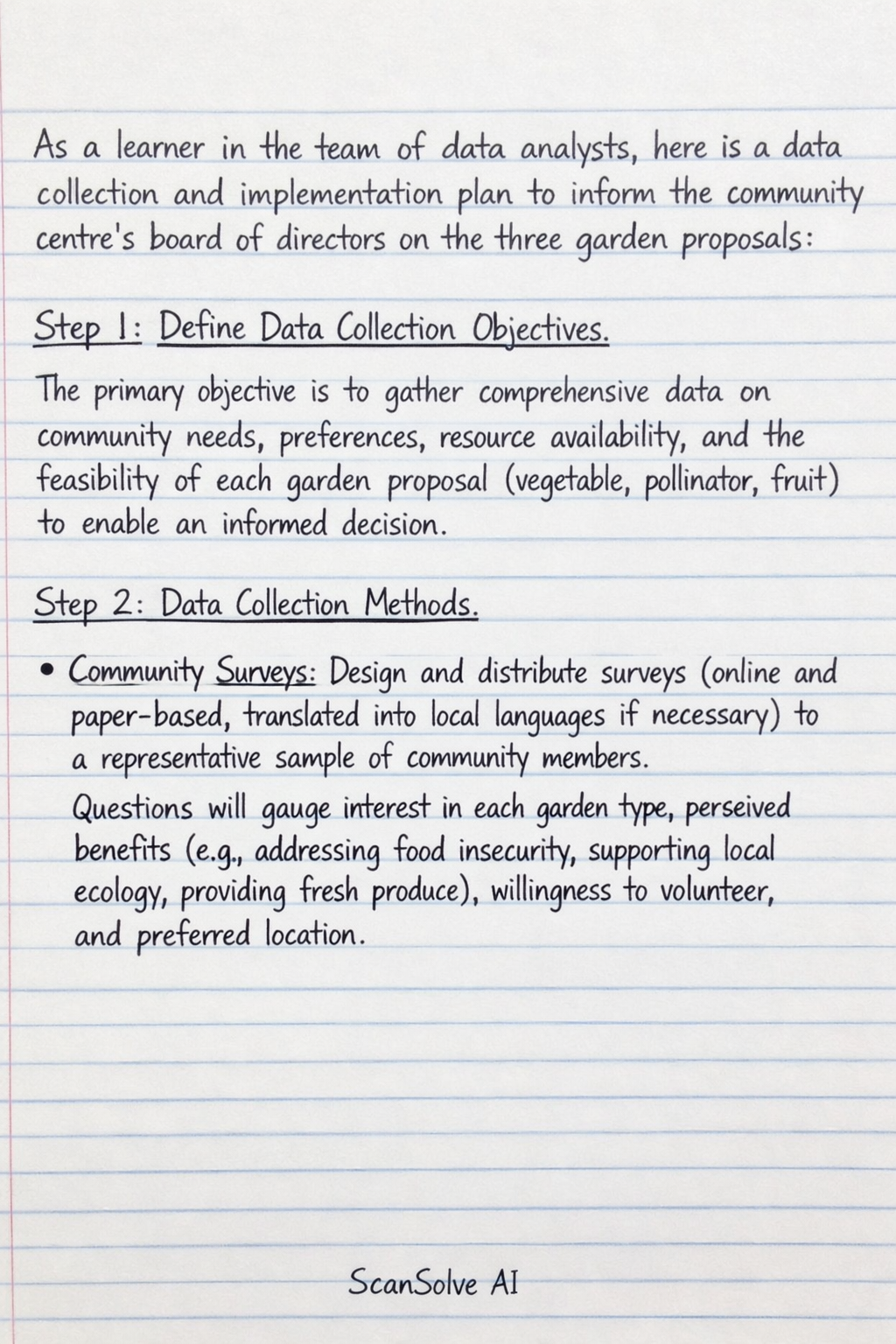
Handwritten Step-by-Step Solution
Get this as a handwritten image on WhatsApp — like a tutor wrote it for you.
Try on WhatsApp