
We read your photo as:
Explain the differences between daily and weekly markets, the necessity of wholesale traders, and the concept of a market chain.
ScanSolve AI Answer
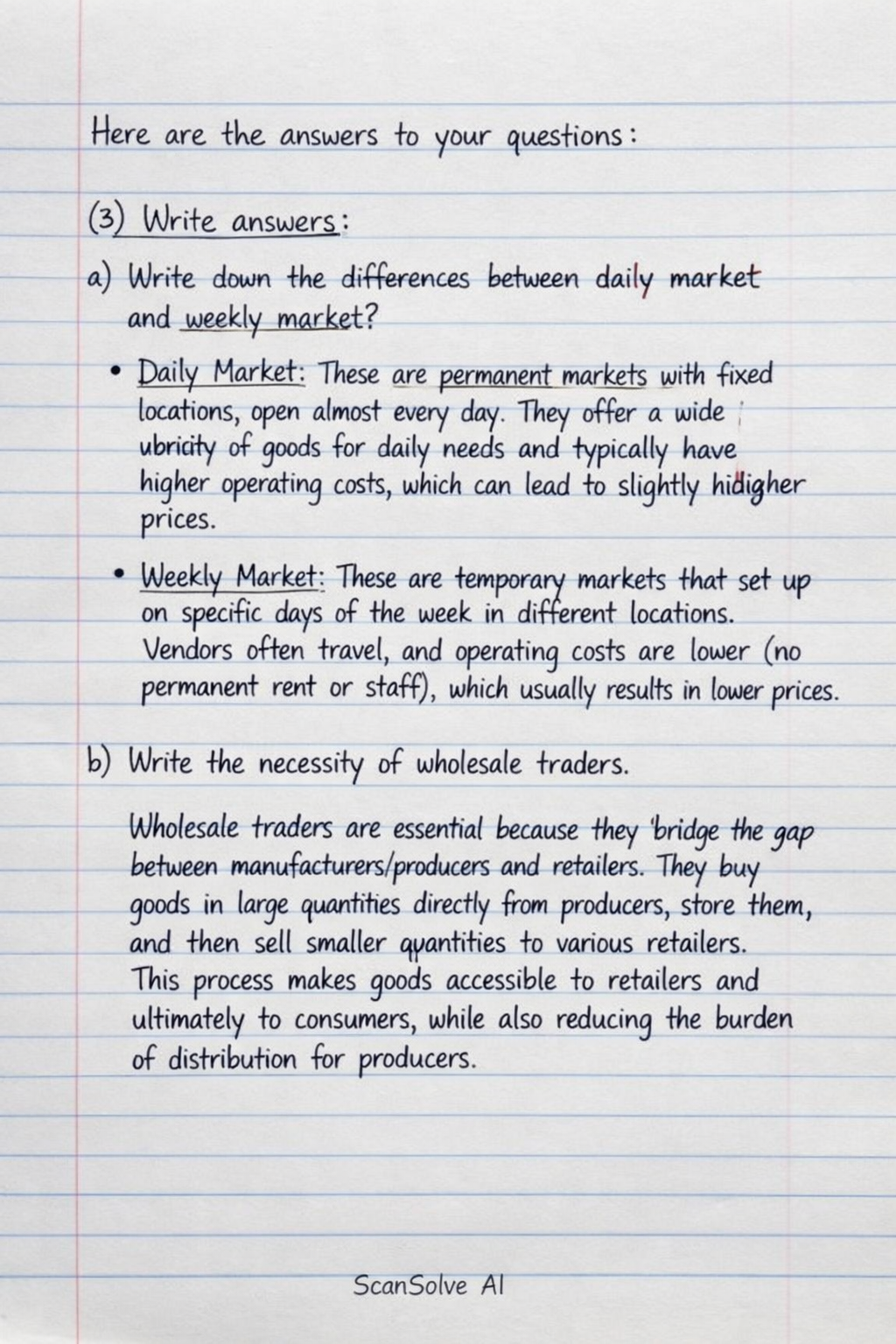
Here are the answers to your questions:
3. Write answers:
-
(a) Write down the differences between daily market and weekly market?
- Daily Market: These are permanent markets with fixed locations, open almost every day. They offer a wide variety of goods for daily needs and typically have higher operating costs, which can lead to slightly higher prices.
- Weekly Market: These are temporary markets that set up on specific days of the week in different locations. Vendors often travel, and operating costs are lower (no permanent rent or staff), which usually results in lower prices for goods.
-
(b) Write the necessity of wholesale traders. Wholesale traders are essential because they bridge the gap between manufacturers/producers and retailers. They buy goods in large quantities directly from producers, store them, and then sell smaller quantities to various retailers. This process makes goods accessible to retailers and ultimately to consumers, while also reducing the burden of distribution for producers.
-
(c) Write what do you understand by market chain. A market chain, also known as a supply chain, refers to the sequence of intermediaries involved in moving a product from its point of origin (producer/manufacturer) to the final consumer. A typical market chain involves producers selling to wholesalers, who then sell to retailers, and finally, retailers sell to consumers.
4. Fill in the blanks:
- (a) With the help of money we purchase our essential commodities from market.
- (b) Wholesale price is less than retail price.
- (c) Barter market an old system.
- (d) Wholesaler purchases goods on a large scale from manufacturer.
- (e) Market is a medium for buying and selling goods.
- (f) If the cost price is less than selling price than there is profit.
5. Project:
To complete this project, you need to:
- List locally produced saleable commodities: Think about what is grown, made, or produced in your immediate area. Examples could include specific fruits, vegetables, grains, handicrafts, dairy products, or baked goods.
- Describe where they are sent for sale: For each commodity, explain which type of market it typically goes to.
- Are they sold directly to consumers in a daily market or a weekly market?
- Are they sold to wholesalers who then distribute them further?
- Are they sold in shopping complexes or malls?
- Are they sold through online platforms or direct farm sales?
For example:
- Commodity: Fresh vegetables (e.g., tomatoes, spinach)
- Market Type: Often sold in local daily markets or weekly markets directly by farmers or small vendors. Some might go to wholesale markets first before reaching larger retailers.
- Commodity: Handmade pottery
- Market Type: Could be sold in weekly craft markets, local daily shops, or directly from the artisan's workshop.
Still stuck on this one?
Ask a follow-up, and the answer starts from this question.
More Business/Management Questions
Handwritten Step-by-Step Solution
Get this as a handwritten image on WhatsApp — like a tutor wrote it for you.
Try on WhatsApp