
We read your photo as:
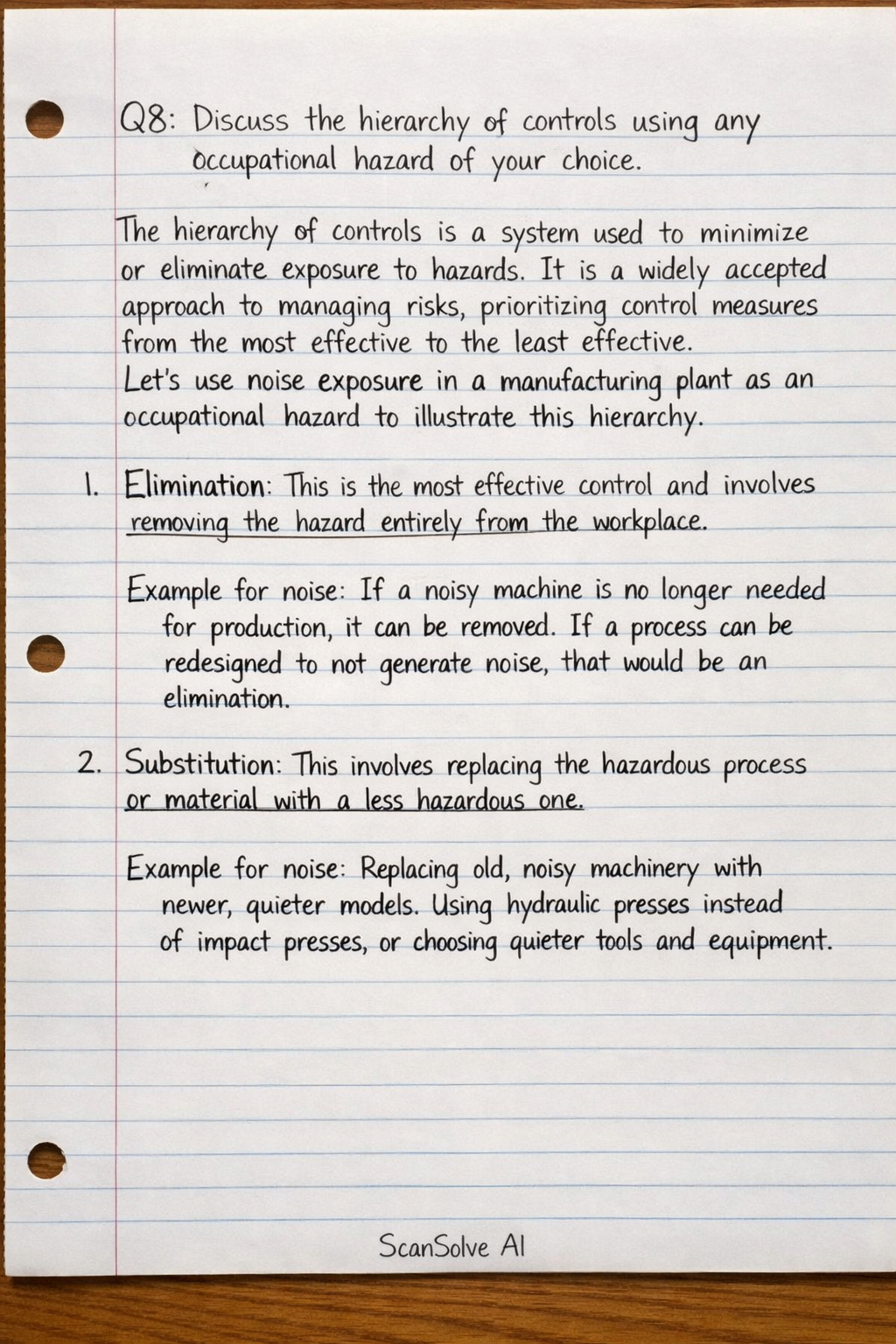
Discuss the hierarchy of controls using any occupational hazard of your choice.
ScanSolve AI Answer
Q8: Discuss the hierarchy of controls using any occupational hazard of your choice.
The hierarchy of controls is a system used to minimize or eliminate exposure to hazards. It is a widely accepted approach to managing risks, prioritizing control measures from the most effective to the least effective. Let's use noise exposure in a manufacturing plant as an occupational hazard to illustrate this hierarchy.
-
Elimination: This is the most effective control and involves removing the hazard entirely from the workplace.
- Example for noise: If a noisy machine is no longer needed for production, it can be removed. If a process can be redesigned to not generate noise, that would be an elimination.
-
Substitution: This involves replacing the hazardous process or material with a less hazardous one.
- Example for noise: Replacing old, noisy machinery with newer, quieter models. Using hydraulic presses instead of impact presses, or choosing quieter tools and equipment.
-
Engineering Controls: These are physical changes to the workplace that isolate people from the hazard or reduce the hazard at its source. They are built into the design of the plant, equipment, or process.
- Example for noise: Installing sound-absorbing materials on walls and ceilings, enclosing noisy machinery with sound-proof barriers, using vibration dampeners on equipment, or relocating noisy operations to isolated areas.
-
Administrative Controls: These are changes to work procedures or policies that reduce or prevent exposure to the hazard. They do not eliminate the hazard itself but limit exposure.
- Example for noise: Implementing a job rotation schedule to limit the time individual workers spend in noisy areas, scheduling noisy operations during off-peak hours, posting warning signs in noisy areas, or establishing "quiet zones" for breaks.
-
Personal Protective Equipment (PPE): This is the least effective control and involves providing workers with equipment to protect them from the hazard. It should only be used as a last resort or as a temporary measure while higher-level controls are being implemented.
- Example for noise: Providing workers with earplugs or earmuffs to wear in noisy environments. This requires proper selection, fitting, maintenance, and consistent use by workers.
Q9: Discuss Kenya's legal and regulatory framework for occupational health and safety.
Kenya's legal and regulatory framework for occupational health and safety is primarily governed by the Occupational Safety and Health Act (OSHA), 2007, and the Work Injury Benefits Act (WIBA), 2007. These acts, along with various subsidiary legislations and regulations, aim to ensure the safety, health, and welfare of all persons lawfully present at workplaces.
-
Occupational Safety and Health Act (OSHA), 2007: This is the principal legislation for OHS in Kenya. Its main objective is to secure the safety, health, and welfare of persons at work and to protect other persons against risks to safety and health arising from the activities of persons at work.
- Key provisions: It outlines the general duties of employers to ensure the safety and health of their employees and others who may be affected by their work activities. It also specifies duties for employees, manufacturers, and suppliers. OSHA mandates risk assessments, provision of safe plant and systems of work, safe handling of articles and substances, provision of information, instruction, training, and supervision, and the provision of adequate welfare facilities. It also covers specific hazards like machinery, fire, chemicals, and noise, and requires the reporting of accidents and occupational diseases. The Act establishes the Directorate of Occupational Safety and Health Services (DOSHS) as the primary regulatory body responsible for enforcing its provisions, conducting inspections, and promoting OHS.
-
Work Injury Benefits Act (WIBA), 2007: This Act provides for compensation to employees for injuries, diseases, or death sustained or suffered in the course of their employment.
- Key provisions: WIBA establishes a no-fault compensation system, meaning an employee is entitled to compensation regardless of who was at fault, as long as the injury or disease arose out of and in the course of employment. It outlines the procedures for reporting injuries, calculating compensation for temporary or permanent disablement, and providing for medical expenses and funeral costs. Employers are required to take out and maintain an insurance policy with an insurer approved by the Minister to cover their liabilities under WIBA.
-
Subsidiary Legislations and Regulations: Complementing these acts are various specific regulations that address particular hazards or industries, such as:
- The Factories and Other Places of Work (Medical Examination) Rules.
- The Factories and Other Places of Work (Noise Prevention and Control) Rules.
- The Factories and Other Places of Work (Fire Risk Reduction) Rules.
- These regulations provide detailed requirements for managing specific risks and ensuring compliance.
In summary, Kenya's OHS framework provides a comprehensive legal structure that places responsibilities on employers and employees, mandates risk management, ensures compensation for work-related injuries, and establishes regulatory oversight to promote a safe and healthy working environment.
Q10: Discuss five functions of occupational health and safety professionals.
Occupational health and safety (OHS) professionals play a crucial role in protecting workers and promoting a healthy work environment. Their functions are diverse and integral to an effective OHS management system.
-
Risk Assessment and Management: OHS professionals are responsible for identifying, assessing, and evaluating workplace hazards and risks. This involves conducting systematic inspections, analyzing incident data, and using various tools to determine the likelihood and severity of potential harm. They then develop and implement control measures following the hierarchy of controls to eliminate or reduce these risks to an acceptable level.
-
Policy and Procedure Development: They are instrumental in developing, implementing, and reviewing OHS policies, procedures, and programs that comply with legal requirements and industry best practices. This includes creating safety manuals, emergency response plans, safe work procedures, and health surveillance protocols tailored to the specific needs of the organization.
-
Training and Education: OHS professionals design and deliver training programs to educate employees, supervisors, and management on OHS policies, safe work practices, hazard recognition, emergency procedures, and the proper use of personal protective equipment (PPE). Their goal is to foster a strong safety culture and ensure that all personnel have the necessary knowledge and skills to work safely.
-
Incident Investigation and Reporting: When accidents, near misses, or occupational diseases occur, OHS professionals lead or participate in investigations to determine the root causes. They analyze data, interview witnesses, and identify contributing factors to prevent recurrence. They are also responsible for ensuring that incidents are reported to relevant authorities as required by law.
-
Compliance and Auditing: OHS professionals ensure that the organization complies with all relevant national and international OHS legislation, standards, and regulations. They conduct internal audits and inspections to verify the effectiveness of OHS management systems, identify areas for improvement, and prepare the organization for external regulatory audits. They also advise management on legal obligations and changes in OHS laws.
Still stuck on this one?
Ask a follow-up, and the answer starts from this question.
More Business/Management Questions
Handwritten Step-by-Step Solution
Get this as a handwritten image on WhatsApp — like a tutor wrote it for you.
Try on WhatsApp