
We read your photo as:
Discuss the importance of occupational pension schemes for both employers and employees, outlining specific advantages for each.
ScanSolve AI Answer
-
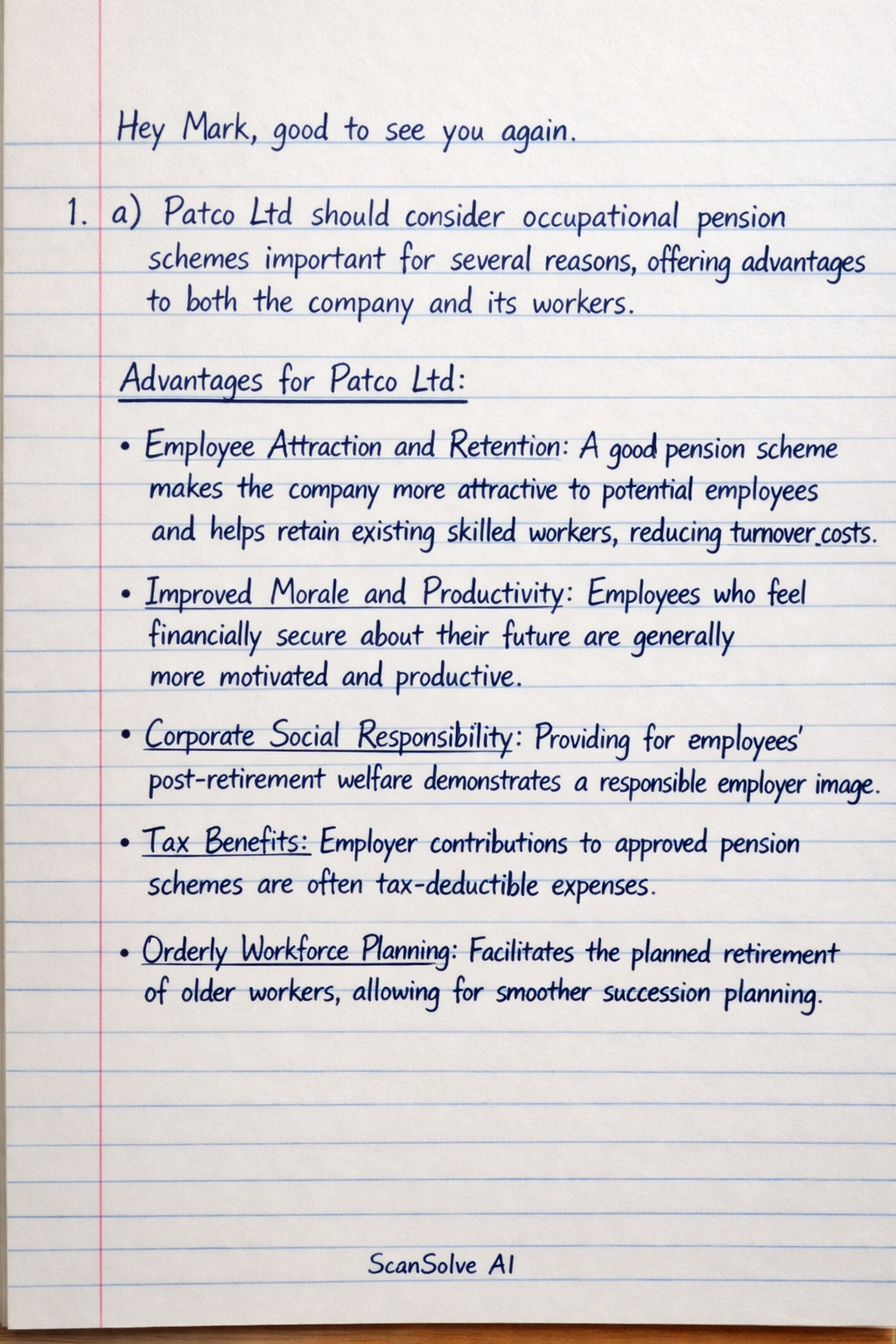
a) Patco Ltd should consider occupational pension schemes important for several reasons, offering advantages to both the company and its workers.
-
Advantages for Patco Ltd:
- Employee Attraction and Retention: A good pension scheme makes the company more attractive to potential employees and helps retain existing skilled workers, reducing turnover costs.
- Improved Morale and Productivity: Employees who feel financially secure about their future are generally more motivated and productive.
- Corporate Social Responsibility: Providing for employees' post-retirement welfare demonstrates a responsible employer image.
- Tax Benefits: Employer contributions to approved pension schemes are often tax-deductible expenses.
- Orderly Workforce Planning: Facilitates the planned retirement of older workers, allowing for smoother succession planning.
-
Advantages for Workers:
- Financial Security in Retirement: Provides a regular income stream after active employment, ensuring a dignified retirement.
- Forced Savings: Encourages disciplined saving for the long term, which many individuals might struggle to do independently.
- Tax Efficiency: Employee contributions often receive tax relief, and investment growth within the scheme is typically tax-deferred.
- Peace of Mind: Reduces financial anxiety about old age, allowing employees to focus better on their work.
-
-
b) As a Human Resource consultant, I would advise Patco Ltd to implement a Defined Contribution (DC) scheme for both its permanent and casual workers.
- For Permanent Workers: A DC scheme offers flexibility and portability. Contributions are fixed, making budgeting predictable for the company. Employees benefit from investment growth and can often choose investment options. This type of scheme is generally less risky for the employer compared to a Defined Benefit scheme.
- For Casual Workers: While casual workers are often excluded from traditional schemes, a DC scheme can be adapted. Patco Ltd could make contributions for casual workers for the duration of their contracts. This provides some retirement savings for these workers, enhancing their financial well-being and potentially making Patco Ltd a more attractive employer for short-term engagements. The portability of DC schemes means casual workers can take their accumulated benefits with them if they move to another employer or leave the workforce.
-
a) A Defined Contribution (DC) plan is a retirement scheme where the contributions made by the employer, employee, or both are fixed, usually as a percentage of salary. The final retirement benefit depends on the total contributions made and the investment performance of those contributions over time. The investment risk is borne by the employee.
A Defined Benefit (DB) plan is a retirement scheme where the retirement benefit is predetermined by a formula, often based on the employee's salary history, years of service, and age. The employer is responsible for ensuring there are sufficient funds to pay the promised benefits, meaning the employer bears the investment risk. Contributions vary to meet the promised benefit.
-
b) An individual retirement annuity is a contract between an individual and an insurance company. The individual makes payments (premiums) to the insurance company, either as a lump sum or a series of payments. In return, the insurance company promises to make regular payments back to the individual at a future date, typically during retirement, for a specified period or for the rest of their life. Its primary use is to provide a guaranteed income stream in retirement, helping to protect against the risk of outliving one's savings.
Still stuck on this one?
Ask a follow-up, and the answer starts from this question.
More Business/Management Questions
Handwritten Step-by-Step Solution
Get this as a handwritten image on WhatsApp — like a tutor wrote it for you.
Try on WhatsApp