
We read your photo as:
Discuss the qualities of a good manager and explain three leadership styles with their pros and cons.
Business/Management
ScanSolve AI Answer
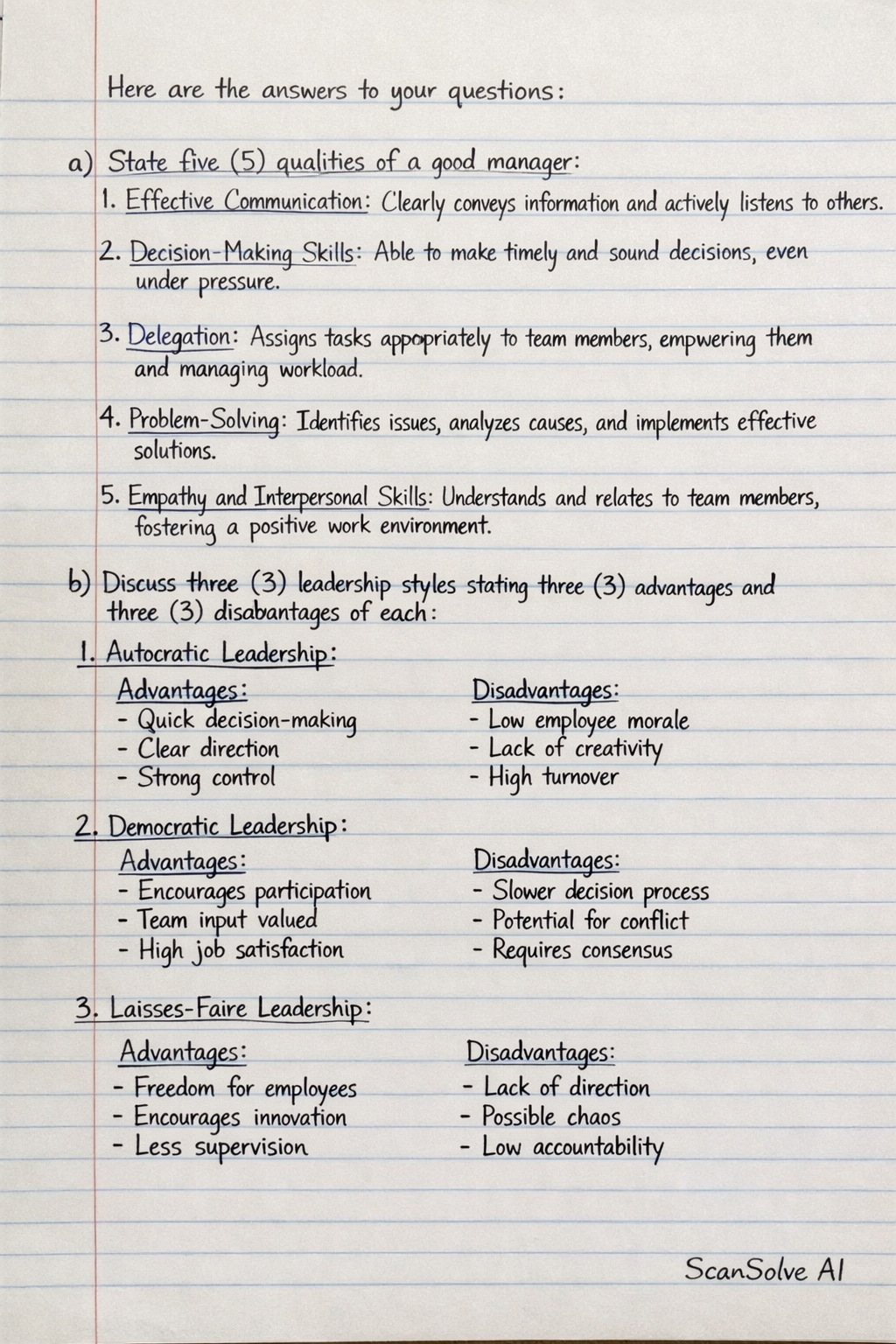
Here are the answers to your questions:
a) State five (5) qualities of a good manager
- Effective Communication: Clearly conveys information and actively listens to others.
- Decision-Making Skills: Able to make timely and sound decisions, even under pressure.
- Delegation: Assigns tasks appropriately to team members, empowering them and managing workload.
- Problem-Solving: Identifies issues, analyzes causes, and implements effective solutions.
- Empathy and Interpersonal Skills: Understands and relates to team members, fostering a positive work environment.
b) Discuss three (3) leadership styles stating three (3) advantages and three (3) disadvantages of each
-
Autocratic Leadership
- Description: The leader makes decisions independently with little to no input from team members.
- Advantages:
- Quick decision-making.
- Clear chain of command.
- Effective in crisis situations.
- Disadvantages:
- Can lead to low morale and resentment.
- Stifles creativity and innovation.
- Over-reliance on the leader.
-
Democratic Leadership
- Description: The leader involves team members in the decision-making process, valuing their input.
- Advantages:
- Increases team morale and engagement.
- Fosters creativity and diverse ideas.
- Develops team members' skills.
- Disadvantages:
- Decision-making can be slow.
- Can lead to indecision if consensus is difficult.
- Less effective in urgent situations.
-
Laissez-Faire Leadership
- Description: The leader provides minimal guidance and allows team members to make most decisions and manage their own work.
- Advantages:
- Promotes autonomy and independence.
- Encourages innovation and self-management.
- Suitable for highly skilled and motivated teams.
- Disadvantages:
- Lack of direction can lead to confusion.
- Poor performance if team members lack self-discipline.
- Can result in missed deadlines or low productivity.
c) Explain five (5) barriers to communication
- Language Barriers: Differences in language, jargon, or accents can lead to misunderstandings.
- Physical Barriers: Distance, noise, or environmental distractions can impede message transmission.
- Psychological Barriers: Emotions, attitudes, prejudices, or stress can distort how messages are sent or received.
- Cultural Barriers: Different cultural norms, values, and beliefs can affect interpretation of messages.
- Information Overload: Too much information at once can make it difficult for the receiver to process and understand the key message.
d) Discuss five (5) functions of management
- Planning: Involves setting goals, developing strategies, and outlining actions to achieve organizational objectives.
- Organizing: Arranging resources, tasks, and people into a structured framework to implement plans efficiently.
- Staffing: Recruiting, selecting, training, developing, and compensating employees to fill various roles within the organization.
- Directing (Leading): Motivating, guiding, and influencing employees to work towards organizational goals, including communication and leadership.
- Controlling: Monitoring performance, comparing it against established standards, and taking corrective actions to ensure goals are met.
Was this helpful?
Still stuck on this one?
Ask a follow-up, and the answer starts from this question.
Got a different question?Ask your own question
More Business/Management Questions
QDiscuss any two leadership styles.use examples to support your answerQIndicate and give a brief discussion of the three skills of management and a relevant example with…QDiscuss two (2) short term issues and three (3) long term benefits of the new Leone. Two managers…QHow would you describe your current leadership style? What would your team, colleagues and manager…QWhat are 5 qualities of a good leader?
Browse by topic:Management
Handwritten Step-by-Step Solution
Get this as a handwritten image on WhatsApp — like a tutor wrote it for you.
Try on WhatsApp