

This business/management problem is solved step by step below, with detailed explanations to help you understand the method and arrive at the correct answer.
ScanSolve AI Answer
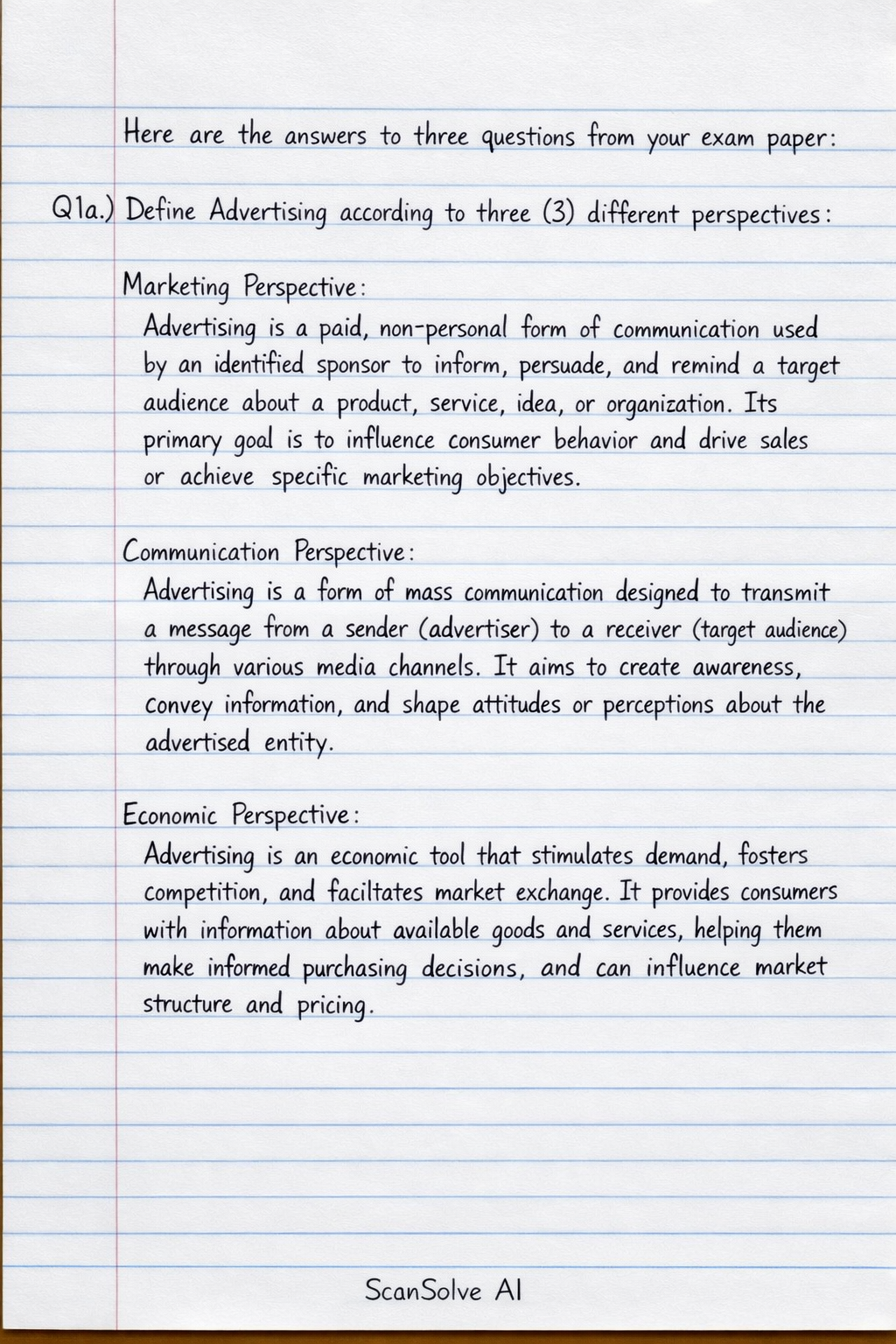
Here are the answers to three questions from your exam paper: Q1a.) Define Advertising according to three (3) different perspectives. Marketing Perspective: Advertising is a paid, non-personal form of communication used by an identified sponsor to inform, persuade, and remind a target audience about a product, service, idea, or organization. Its primary goal is to influence consumer behavior and drive sales or achieve specific marketing objectives. Communication Perspective: Advertising is a form of mass communication designed to transmit a message from a sender (advertiser) to a receiver (target audience) through various media channels. It aims to create awareness, convey information, and shape attitudes or perceptions about the advertised entity. Economic Perspective: Advertising is an economic tool that stimulates demand, fosters competition, and facilitates market exchange. It provides consumers with information about available goods and services, helping them make informed purchasing decisions, and can influence market structure and pricing. Q1b.) List five (5) visionaries that shaped advertising activities in the World. 1. David Ogilvy: Known as the "Father of Advertising," he emphasized research, big ideas, and brand building. 2. Leo Burnett: Advocated for inherent drama in products and created memorable brand icons. 3. Bill Bernbach: Revolutionized advertising with creative teams (copywriter and art director) and emphasized honesty and simplicity. 4. Rosser Reeves: Developed the Unique Selling Proposition (USP) concept, focusing on a single, compelling benefit. 5. Mary Wells Lawrence: A pioneering female executive who founded Wells Rich Greene, known for bold and innovative campaigns. --- Q3a.) Mention Ten (10) functions of Advertising. 1. To inform consumers about products, services, or ideas. 2. To persuade consumers to purchase or adopt a particular viewpoint. 3. To remind consumers about existing products or brands. 4. To build and maintain a strong brand image and identity. 5. To increase sales and market share. 6. To introduce new products or services to the market. 7. To counter competitive claims or actions. 8. To support the sales force by generating leads and pre-selling. 9. To create or stimulate demand for a product category. 10. To enhance public relations and corporate reputation. Q3b.) Pal (2022) submitted many objectives of advertising; mention and explain 5 of them. Assuming "Pal (2022)" refers to common, widely accepted advertising objectives, here are five: 1. To Create Awareness: This objective aims to make the target audience aware of a new product, service, or brand, or to increase the level of awareness for an existing one. It's crucial for initial market entry or for products with low recognition. 2. To Persuade: The goal here is to convince consumers to try a product, switch brands, or adopt a specific behavior. Persuasive advertising often highlights product benefits, features, or competitive advantages to influence purchasing decisions. 3. To Remind: This objective focuses on keeping the brand or product top-of-mind for consumers, especially for mature products or those with frequent purchase cycles. It helps reinforce previous learning and maintain brand loyalty. 4. To Build Brand Image/Equity: This objective seeks to develop a positive and distinct perception of the brand in the minds of consumers. It involves creating associations, values, and an overall personality for the brand that resonates with the target audience, thereby increasing its value. 5. To Stimulate Demand: This objective aims to encourage consumers to seek out and purchase the advertised product or service. It can involve creating a desire for the product, highlighting its utility, or offering incentives to prompt immediate action. --- Q5.) Write Short Note on any five (5) of the following: a. Theories of Persuasion in Advertising. Theories of persuasion in advertising explain how messages influence consumer attitudes and behaviors. One prominent theory is the Elaboration Likelihood Model (ELM), which posits two routes to persuasion: the central route (when consumers are motivated and able to process information, focusing on message content) and the peripheral route (when consumers are less involved, relying on cues like source attractiveness or emotional appeals). Other theories include the Social Learning Theory, where consumers learn by observing others' responses to advertising, and theories focusing on emotional appeals versus rational appeals. b. Below-the-line and Above-the-line Advertising. Above-the-line (ATL) advertising refers to mass media campaigns that are non-targeted and aim to build brand awareness and image over a broad audience. Examples include TV, radio, newspaper, and magazine advertisements. It's typically less measurable in terms of direct response. Below-the-line (BTL) advertising involves highly targeted, direct, and measurable marketing activities focused on specific consumer segments. Examples include direct mail, email marketing, sales promotions, public relations, and sponsorships. BTL aims for immediate response and sales. Through-the-line (TTL) advertising* combines both ATL and BTL strategies for an integrated approach. c. Advertising in the Marketing Mix. The marketing mix, often referred to as the "4 Ps," consists of Product, Price, Place (distribution), and Promotion. Advertising is a crucial component of the Promotion element. It serves to communicate the value proposition of the product or service to the target market, inform them about its features and benefits, persuade them to purchase, and remind them of its existence. Effective advertising supports the other Ps by creating demand for the product, justifying its price, and driving traffic to places where it can be purchased. f. APCON. APCON stands for the Advertising Practitioners Council of Nigeria. It is the statutory regulatory body for advertising practice in Nigeria, established by Act No. 55 of 1988 (now CAP A7, Laws of Federation of Nigeria 2004). APCON's mandate includes regulating and controlling the practice of advertising, setting standards of professional conduct, promoting ethical practices, and ensuring the training and development of advertising professionals in the country. It plays a vital role in maintaining integrity and responsibility within the Nigerian advertising industry. h. Advertising Regulation. Advertising regulation refers to the rules and guidelines governing the content, placement, and conduct of advertising. Its primary purposes are to protect consumers from misleading or harmful advertisements, ensure fair competition among businesses, and maintain ethical standards in the industry. Regulation can be governmental (e.g., consumer protection laws, specific industry regulations) or self-regulatory (e.g., industry codes of conduct, bodies like APCON). These regulations often cover aspects such as truthfulness, decency, substantiation of claims, and protection of vulnerable groups.