
We read your photo as:
How effective Procurement impact on organisation? How effective Procurement impact on Profitability? How to create saving and improve efficiency?
ScanSolve AI Answer
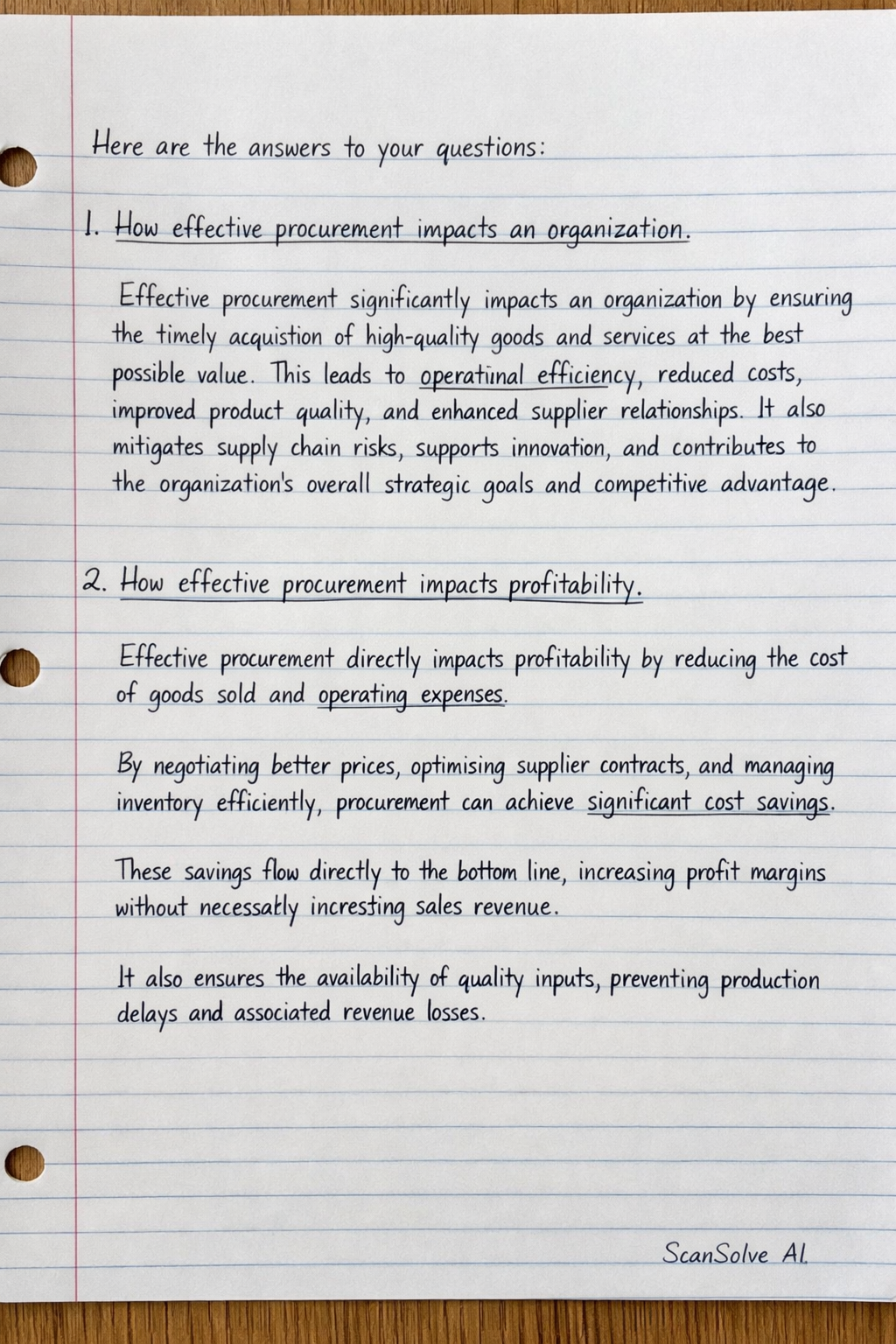
Here are the answers to your questions:
-
How effective procurement impacts an organization. Effective procurement significantly impacts an organization by ensuring the timely acquisition of high-quality goods and services at the best possible value. This leads to operational efficiency, reduced costs, improved product quality, and enhanced supplier relationships. It also mitigates supply chain risks, supports innovation, and contributes to the organization's overall strategic goals and competitive advantage.
-
How effective procurement impacts profitability. Effective procurement directly impacts profitability by reducing the cost of goods sold and operating expenses. By negotiating better prices, optimizing supplier contracts, and managing inventory efficiently, procurement can achieve significant cost savings. These savings flow directly to the bottom line, increasing profit margins without necessarily increasing sales revenue. It also ensures the availability of quality inputs, preventing production delays and associated revenue losses.
-
How to create savings and improve efficiency. Savings and efficiency can be created through effective procurement by:
- Strategic Sourcing: Identifying and selecting the best suppliers based on total cost, quality, and reliability.
- Negotiation: Securing favorable terms, prices, and discounts with suppliers.
- Demand Management: Consolidating purchases, standardizing specifications, and reducing unnecessary spending.
- Process Automation: Streamlining purchasing processes through e-procurement systems to reduce administrative overhead and errors.
- Inventory Optimization: Minimizing holding costs and preventing stockouts through efficient inventory management.
- Supplier Relationship Management: Collaborating with suppliers to drive innovation, improve quality, and reduce lead times.
- Total Cost of Ownership (TCO) Analysis: Considering all costs over an asset's lifecycle, not just the initial purchase price, to make more informed decisions.
Still stuck on this one?
Ask a follow-up, and the answer starts from this question.
More Business/Management Questions
Handwritten Step-by-Step Solution
Get this as a handwritten image on WhatsApp — like a tutor wrote it for you.
Try on WhatsApp