
We read your photo as:
Q1. What is meant by the term "Sustainable Procurement"? To what extent might it be possible for your organization or any organization of your choice to build sustainability criteria into its procur
ScanSolve AI Answer
Here are the answers to your questions.
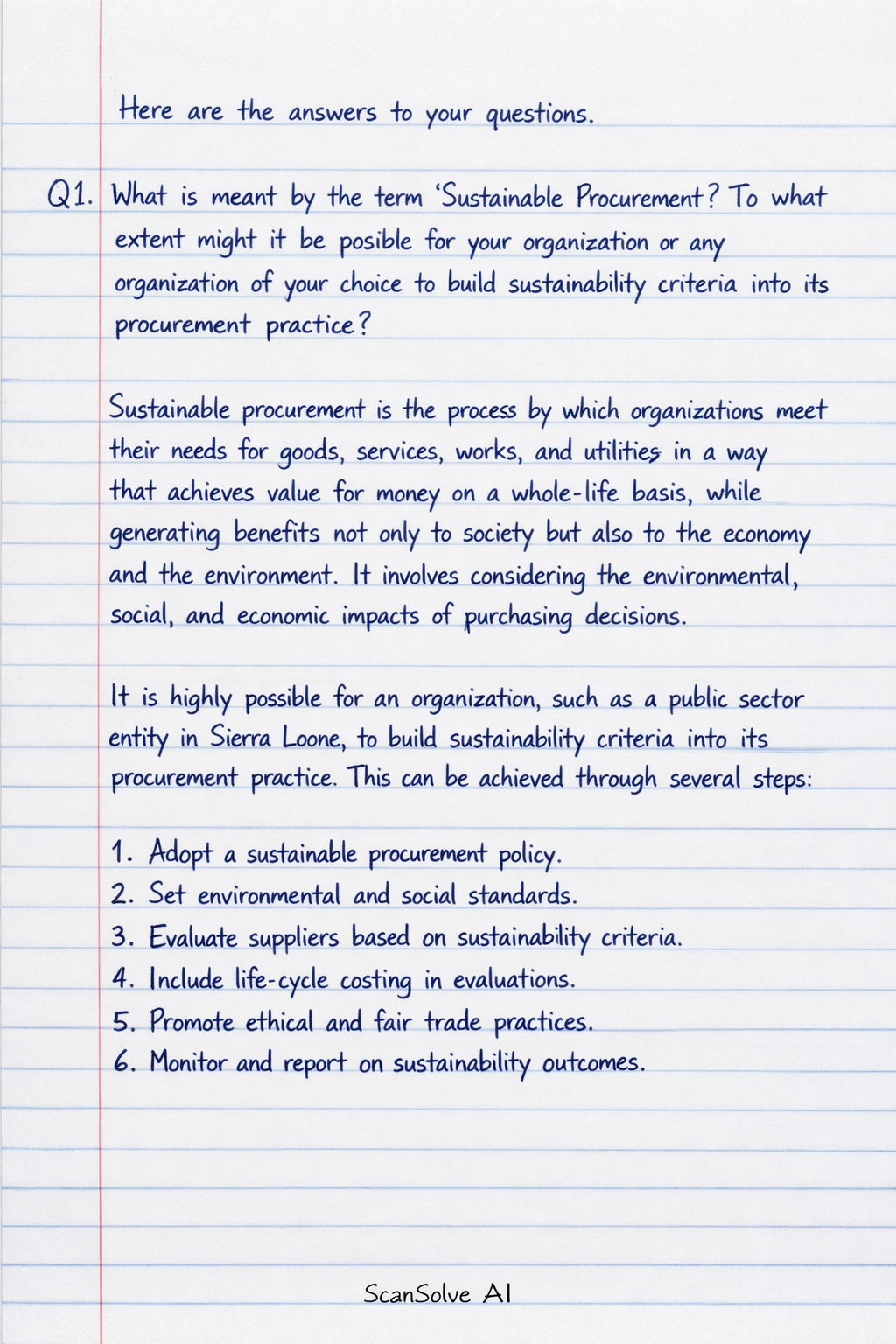
Q1. What is meant by the term "Sustainable Procurement"? To what extent might it be possible for your organization or any organization of your choice to build sustainability criteria into its procurement practice?
Sustainable procurement is the process by which organizations meet their needs for goods, services, works, and utilities in a way that achieves value for money on a whole-life basis, while generating benefits not only to society but also to the economy and the environment. It involves considering the environmental, social, and economic impacts of purchasing decisions.
It is highly possible for an organization, such as a public sector entity in Sierra Leone, to build sustainability criteria into its procurement practice. This can be achieved through several steps:
- Policy Integration: The organization must embed sustainability goals directly into its procurement policies, strategies, and legal frameworks. This provides a mandate for sustainable purchasing.
- Supplier Assessment: Beyond financial capability, suppliers should be evaluated on their environmental performance (e.g., waste management, energy efficiency), social practices (e.g., fair labor, human rights, local community impact), and ethical conduct.
- Product and Service Specifications: Tender documents and specifications should include clear sustainability requirements. For example, requiring energy-efficient appliances, products made from recycled materials, or services delivered with minimal environmental impact.
- Life-Cycle Costing: Procurement decisions should consider the total cost of ownership, including environmental costs (e.g., waste disposal, energy consumption) and social costs, rather than just the initial purchase price. This encourages selection of more durable and environmentally friendly options.
- Monitoring and Reporting: Establish systems to monitor the sustainability performance of suppliers and the impact of procurement decisions. Regular reporting helps track progress and identify areas for improvement.
- Capacity Building: Provide training and awareness programs for procurement staff and other stakeholders on sustainable procurement principles and practices.
Q2. State and discuss the steps and processes involved in enhancing value for money (VFM) in the public procurement cycle in the public sector of Sierra Leone.
Enhancing Value for Money (VFM) in public procurement means achieving the optimal combination of whole-life cost and quality to meet the user's requirements. It is not simply about selecting the lowest price but about securing the best possible outcome given the resources available. The public procurement cycle in Sierra Leone can enhance VFM through the following steps and processes:
-
Procurement Planning:
- Needs Assessment: Clearly define the actual needs and requirements, ensuring that only necessary goods, services, or works are procured.
- Market Research: Conduct thorough market analysis to understand available options, pricing, and supplier capabilities.
- Specification Development: Develop clear, non-restrictive, and performance-based specifications that allow for innovation and competition.
- How it enhances VFM: Ensures that the right items are procured at the right time, preventing over-specification or under-specification, and identifying potential cost savings early.
-
Tender Preparation and Solicitation:
- Method Selection: Choose the most appropriate procurement method (e.g., Open Competitive Bidding, Restricted Bidding, Request for Quotations) based on the value, complexity, and nature of the procurement, as per Sierra Leone's Public Procurement Act. Open bidding generally maximizes competition and VFM.
- Tender Documents: Prepare comprehensive and unambiguous tender documents that clearly state evaluation criteria, terms, and conditions.
- Advertising: Ensure wide and transparent advertisement of tender opportunities to attract a broad range of qualified bidders.
- How it enhances VFM: Fosters fair competition, attracts competitive bids, and ensures transparency, leading to better pricing and quality offers.
-
Bid Evaluation and Award:
- Evaluation Criteria: Establish clear, objective, and quantifiable evaluation criteria that consider not only price but also technical quality, delivery time, experience, and sustainability aspects.
- Evaluation Committee: Utilize an impartial and competent evaluation committee to assess bids against the predetermined criteria.
- Negotiation (where applicable): For certain methods, negotiations can be used to refine offers and secure better terms.
- How it enhances VFM: Ensures that the contract is awarded to the bidder offering the most advantageous solution, balancing cost with quality and long-term benefits, rather than just the lowest initial price.
-
Contract Management:
- Performance Monitoring: Continuously monitor the contractor's performance against the agreed terms, specifications, and timelines.
- Quality Assurance: Implement mechanisms to ensure the quality of goods, services, or works delivered.
- Risk Management: Proactively identify and manage contract risks to prevent delays, cost overruns, or disputes.
- How it enhances VFM: Ensures that the organization receives what it paid for, on time and to the required standard, maximizing the utility and benefits derived from the procurement.
-
Payment and Contract Close-out:
- Timely Payments: Process payments promptly upon satisfactory delivery to maintain good supplier relationships and avoid potential penalties.
- Post-Contract Review: Conduct a review after contract completion to assess overall performance, identify lessons learned, and inform future procurement strategies.
- How it enhances VFM: Ensures financial integrity, provides valuable feedback for continuous improvement, and helps optimize future procurement decisions.
Still stuck on this one?
Ask a follow-up, and the answer starts from this question.
More Geography Questions
Handwritten Step-by-Step Solution
Get this as a handwritten image on WhatsApp — like a tutor wrote it for you.
Try on WhatsApp