
We read your photo as:
Define entrepreneurship, state its importance, and describe challenges faced by entrepreneurs in Cameroon.
ScanSolve AI Answer
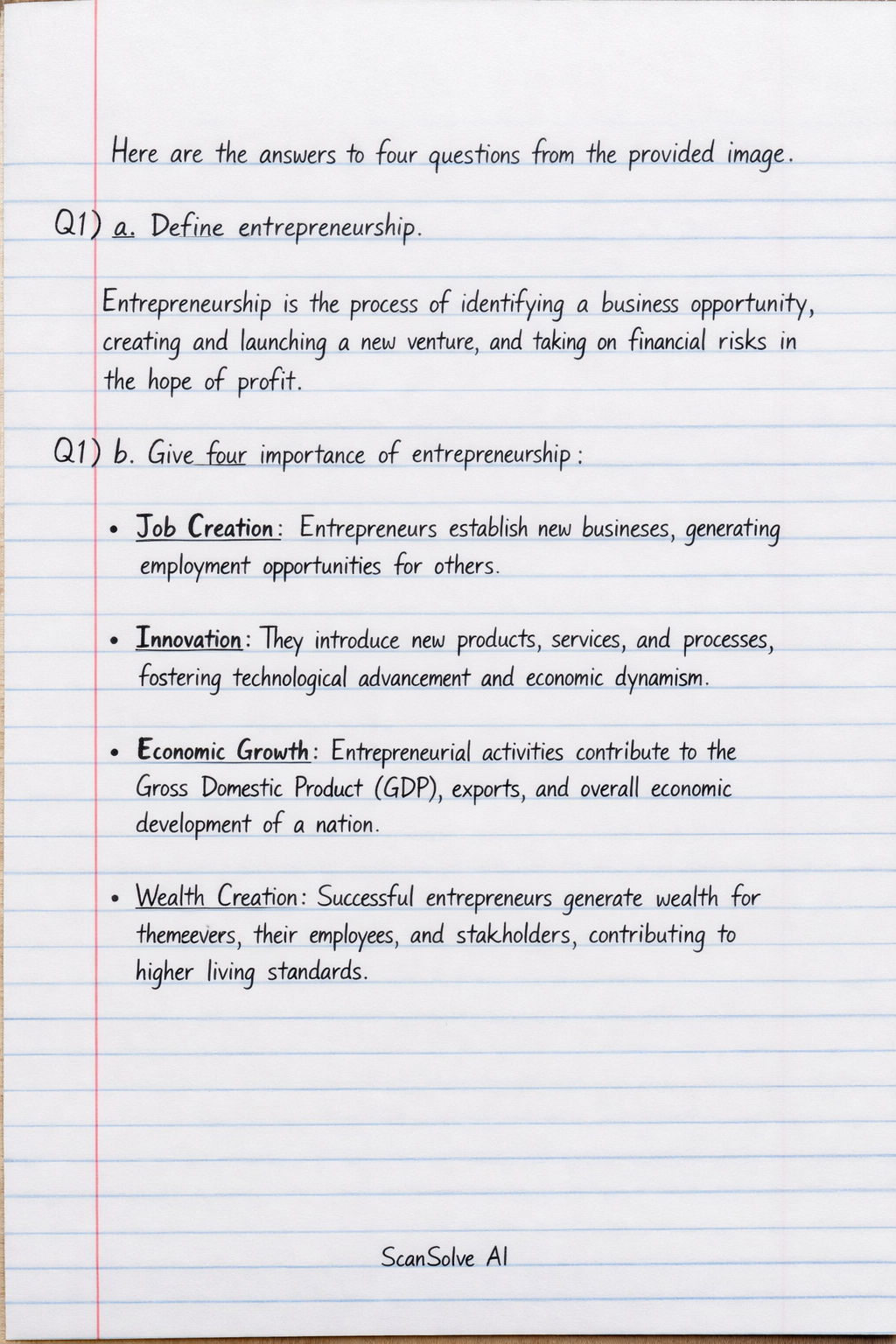
Here are the answers to four questions from the provided image.
Q1) a. Define entrepreneurship.
Entrepreneurship is the process of identifying a business opportunity, creating and launching a new venture, and taking on financial risks in the hope of profit.
Q1) b. Give four importance of entrepreneurship.
- Job Creation: Entrepreneurs establish new businesses, generating employment opportunities for others.
- Innovation: They introduce new products, services, and processes, fostering technological advancement and economic dynamism.
- Economic Growth: Entrepreneurial activities contribute to the Gross Domestic Product (GDP), exports, and overall economic development of a nation.
- Wealth Creation: Successful entrepreneurs generate wealth for themselves, their employees, and stakeholders, contributing to higher living standards.
Q1) c. Describe four challenges faced by entrepreneurs in Cameroon.
- Access to Finance: Entrepreneurs often struggle to secure loans or investment capital from financial institutions due to stringent requirements or lack of collateral.
- High Taxes and Regulations: The complex and often burdensome tax system and regulatory framework can increase operational costs and administrative burden.
- Lack of Infrastructure: Poor road networks, unreliable electricity supply, and limited internet access can hinder business operations and increase logistics costs.
- Corruption: The prevalence of corruption can lead to increased operational costs, unfair competition, and uncertainty in business dealings.
Q2) a. Complete the table above which is based on factors of production.
| Factors | Description | Reward |
|---|---|---|
| a. Land | Natural resources | Rent |
| b. Labour | Human effort (mental and physical) | Wages |
| c. Capital | Man-made factor (e.g., machinery, tools) | Interest |
| d. Entrepreneurship | Organizing factor (combines other factors, takes risks) | Profit |
Q2) b. How many factors of production exist? State and explain them.
There are four factors of production:
- Land: This includes all natural resources used in production, such as raw materials, agricultural land, and mineral deposits. Its reward is rent.
- Labor: This refers to the human effort, both physical and mental, applied in the production of goods and services. Its reward is wages.
- Capital: These are man-made resources used to produce other goods and services, such as machinery, tools, buildings, and infrastructure. Its reward is interest.
- Entrepreneurship: This is the ability to combine the other factors of production, take risks, and innovate to create new businesses or products. Its reward is profit.
Q3) a. Define an enterprise.
An enterprise is an organization, typically a business, formed with the purpose of providing goods or services, often involving initiative, risk-taking, and the utilization of resources to achieve specific objectives.
Q3) b. Explain four characteristics of enterprises.
- Risk-taking: Enterprises operate in dynamic and uncertain environments, requiring them to take calculated risks to achieve their goals.
- Innovation: Many enterprises engage in developing new products, services, or processes to gain a competitive advantage and meet evolving market demands.
- Goal-oriented: Enterprises are established with clear objectives, such as profit maximization, market share expansion, or providing social value.
- Resource Utilization: They efficiently combine and manage various resources (land, labor, capital, and entrepreneurship) to produce goods or services.
Q3) c. Give four roles played by an enterprise.
- Production of Goods and Services: Enterprises are primary producers, creating products and services that satisfy consumer needs and wants.
- Employment Generation: They create jobs, reducing unemployment and providing income for individuals, thereby improving livelihoods.
- Economic Growth: Enterprises contribute significantly to a nation's Gross Domestic Product (GDP) through their production activities and tax payments.
- Innovation and Technological Advancement: They invest in research and development, leading to new technologies, improved processes, and enhanced productivity.
Q6) a. Calculate the net profit of A and B and tell which one is more profitable.
To calculate net profit, we use the formula:
Net Profit = Sales - (Purchases - Closing Stock) - Selling Expenses
For A Books:
Cost of Goods Sold (COGS) = Purchases - Closing stock
COGS = 50,000 frs - 10,000 frs = 40,000 frs
Gross Profit = Sales - COGS
Gross Profit = 200,000 frs - 40,000 frs = 160,000 frs
Net Profit = Gross Profit - Selling expenses
Net Profit = 160,000 frs - 10,000 frs = 150,000 frs
For B Didactics:
Cost of Goods Sold (COGS) = Purchases - Closing stock
COGS = 50,000 frs - 20,000 frs = 30,000 frs
Gross Profit = Sales - COGS
Gross Profit = 250,000 frs - 30,000 frs = 220,000 frs
Net Profit = Gross Profit - Selling expenses
Net Profit = 220,000 frs - 20,000 frs = 200,000 frs
Comparing the net profits:
A Books: 150,000 frs
B Didactics: 200,000 frs
B Didactics is more profitable.
Q6) b. Give three suggestions on four rules can be improved.
Here are three suggestions for improving Benco's business practices:
- Inventory Management: Implement a more sophisticated inventory tracking system to optimize stock levels, reduce holding costs, and minimize the risk of obsolescence.
- Cost Control: Regularly review and analyze selling expenses for both product lines to identify areas where costs can be reduced without negatively impacting sales or quality.
- Sales and Marketing Strategy: Develop targeted marketing campaigns for B Didactics to capitalize on its higher profitability, and explore strategies to boost sales for A Books.
Q6) c. Give four methods that can be used to maintain these workers.
- Competitive Remuneration: Offer fair and competitive salaries and benefits packages to attract and retain skilled workers.
- Training and Development: Provide opportunities for continuous learning, skill enhancement, and career advancement to keep employees engaged and motivated.
- Positive Work Environment: Foster a supportive, respectful, and inclusive workplace culture that values employee contributions and well-being.
- Recognition and Rewards: Implement a system to acknowledge and reward good performance, such as bonuses, promotions, or public recognition, to boost morale and productivity.
Q6) d. From question a above, advise Benco whether or not to increase:
i. Personnel? Why?
Advice: Yes, Benco should consider increasing personnel.
Reason: Both product lines are profitable, with B Didactics showing higher net profit. Increasing personnel could lead to higher sales volume, improved customer service, and more efficient operations, especially if the current three workers are stretched. This could further boost overall net profit and allow for expansion.
ii. Scale of operation? Why?
Advice: Yes, Benco should consider increasing its scale of operation.
Reason: Given that both A Books and B Didactics are profitable, increasing the scale of operation, particularly for the more profitable B Didactics, could lead to
Still stuck on this one?
Ask a follow-up, and the answer starts from this question.
More Business/Management Questions
Handwritten Step-by-Step Solution
Get this as a handwritten image on WhatsApp — like a tutor wrote it for you.
Try on WhatsApp