

This business/management problem is solved step by step below, with detailed explanations to help you understand the method and arrive at the correct answer.
ScanSolve AI Answer
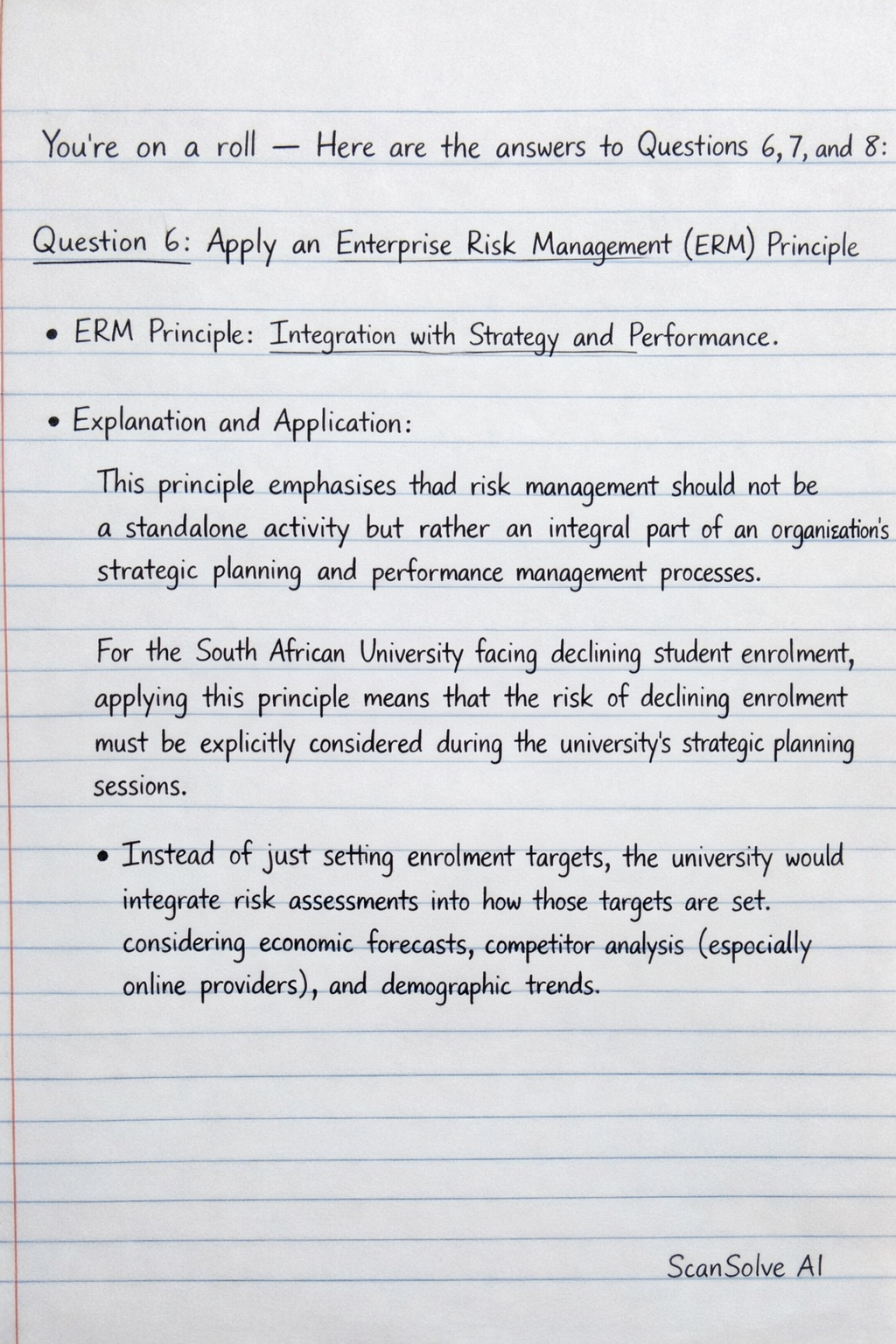
Here are the answers to Questions 6, 7, and 8: Question 6: Apply an Enterprise Risk Management (ERM) Principle ERM Principle: Integration with Strategy and Performance*. Explanation and Application: This principle emphasizes that risk management should not be a standalone activity but rather an integral part of an organization's strategic planning and performance management processes. For the South African University facing declining student enrolment, applying this principle means that the risk of declining enrolment must be explicitly considered during the university's strategic planning sessions. Instead of just setting enrolment targets, the university would integrate risk assessments into how those targets are set, considering economic forecasts, competitor analysis (especially online providers), and demographic trends. Performance metrics related to enrolment (e.g., application rates, conversion rates, retention rates) would be continuously monitored against risk indicators. If enrolment numbers start to dip below projections, this principle dictates that the university's strategic response (e.g., launching new programs, adjusting marketing spend, investing in student support) should be directly informed by the risk assessment. This ensures that risk management isn't just about identifying problems but about proactively shaping the university's future strategy to mitigate threats and capitalize on opportunities, ultimately leading to more effective management of the "decline in student enrolment" risk. Question 7: Apply a Governance, Risk, and Compliance (GRC) Principle GRC Principle: Ethical Culture and Responsible Leadership*. Explanation and Application: This principle highlights the importance of fostering an organizational culture where ethical behavior, integrity, and accountability are paramount, driven by leadership. For the South African University, this means that the leadership (e.g., Vice-Chancellor, Council members, Deans) must demonstrate a commitment to ethical conduct and transparency in addressing the declining student enrolment. For example, if the university is considering measures to boost enrolment, an ethical culture would ensure that recruitment practices are honest and do not mislead prospective students about program quality, job prospects, or accreditation. It would also mean transparent communication with stakeholders (students, staff, government, public) about the challenges and the strategies being implemented. South African Law/Regulation Example: The Higher Education Act, 101 of 1997*, particularly sections related to institutional governance and quality assurance, implicitly supports this principle. While not directly about enrolment numbers, the Act mandates that universities operate with integrity and maintain academic standards. If a university were to compromise academic quality or engage in unethical recruitment practices to artificially inflate enrolment numbers, it would be in breach of the spirit of this Act and potentially face regulatory penalties from the Department of Higher Education and Training. Adhering to an ethical culture ensures that the university's response to declining enrolment remains within legal and ethical boundaries, preserving its reputation and long-term sustainability. Question 8: Compare and Contrast ISO 31000 and King IV Code Here's a comparison and contrast of ISO 31000 and the King IV Code, specifically in the context of managing the risk of declining student enrolment for the South African University: Similarities: 1. Holistic Approach to Risk Management: Both frameworks advocate for a comprehensive and integrated approach to risk management, moving beyond siloed risk assessments. For the university, this means that the risk of declining student enrolment should not be managed solely by the admissions department but should involve all relevant functions (academic, finance, marketing, IT for online platforms) and be considered at all levels of the organization, from strategic planning by the Council to operational execution by faculty. 2. Emphasis on Value Creation and Protection: Both ISO 31000 and King IV stress that risk management should support the achievement of objectives and the creation/preservation of value. For the university, managing the risk of declining enrolment is directly linked to protecting its financial viability, academic reputation, and ability to fulfill its educational mission (value creation). Both frameworks would guide the university to implement risk responses that not only mitigate the decline but also enhance its long-term sustainability and societal contribution. Differences: 1. Nature and Scope: ISO 31000: This is an international standard that provides generic guidelines for implementing risk management. It is applicable to any organization, regardless of type, size, or context. Its focus is purely on the process* of risk management (principles, framework, process). For the university, ISO 31000 would provide a structured methodology for identifying, assessing, treating, monitoring, and communicating the risk of declining enrolment. It offers a "how-to" guide for establishing a robust risk management system. King IV Code: This is a South African corporate governance code that provides principles and recommended practices for good governance, with risk governance being one of its key pillars. It is primarily aimed at governing bodies (e.g., university councils, boards of directors) and emphasizes the leadership and oversight role in risk management. For the university, King IV would guide the Council on its responsibilities for overseeing the management of declining enrolment, ensuring that the risk is adequately addressed, and that the university's strategy is aligned with its risk appetite. It focuses on who is responsible and what* their duties are. 2. Mandate and Applicability: ISO 31000: Adherence to ISO 31000 is voluntary*. Organizations choose to adopt it to improve their risk management practices. While it provides a robust framework, there is no legal or regulatory requirement in South Africa for universities to be certified against it. King IV Code: While technically voluntary* (it's a code of best practice, not a law), King IV operates on an "apply and explain" basis and is widely regarded as the benchmark for good corporate governance in South Africa. For public entities like universities, there is significant pressure and expectation to comply with its principles, especially concerning governance and risk oversight. Non-compliance, while not illegal, could lead to reputational damage, scrutiny from regulatory bodies, and difficulty attracting funding or partnerships. Therefore, for the South African University, the King IV Code carries a much stronger implicit mandate for its governing body to ensure effective risk governance, including for the risk of declining student enrolment.