
We read your photo as:
Explain five ways wholesalers' warehousing services benefit customers and five ways commercial banks aid business development.
Business/Management
ScanSolve AI Answer
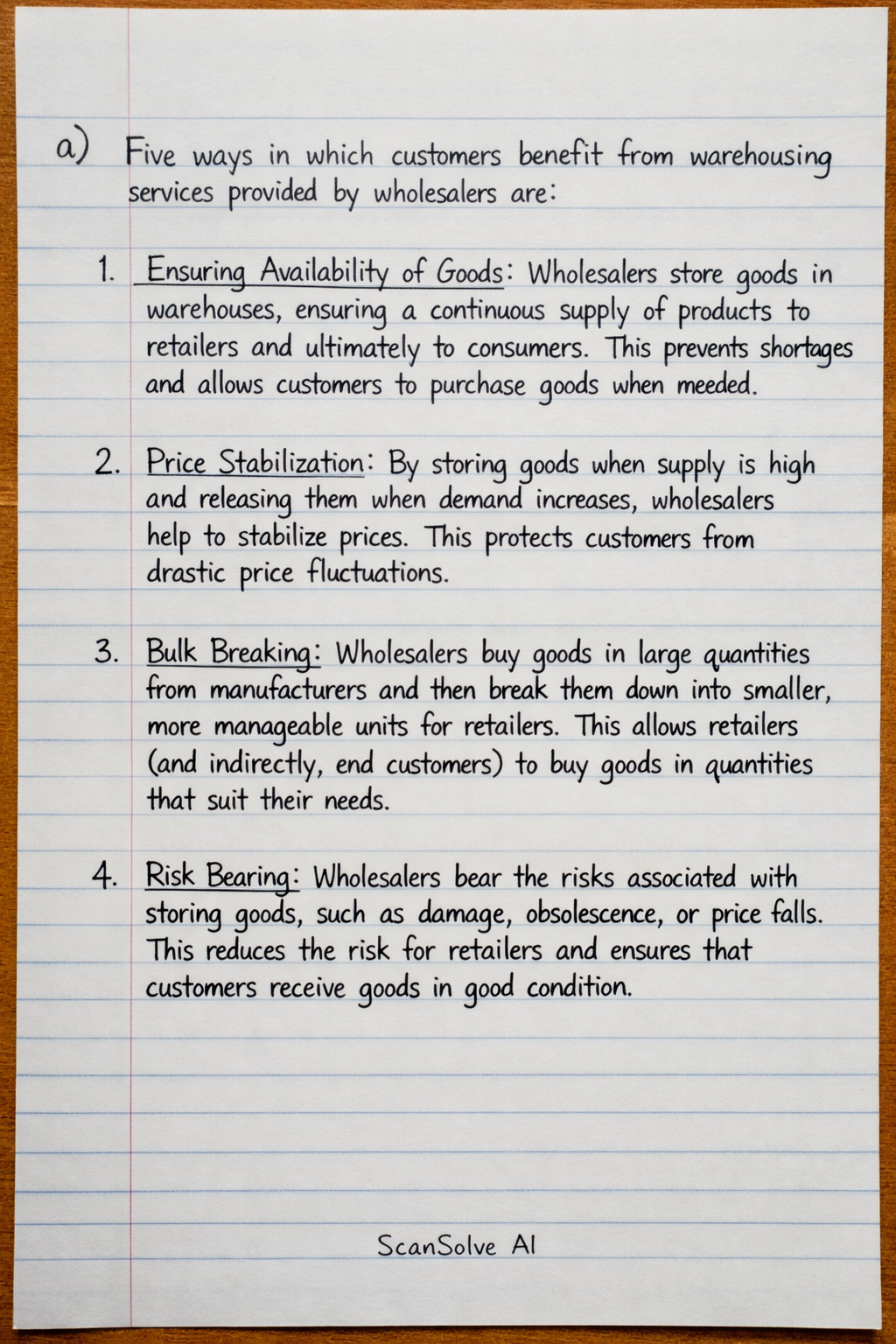
a) Five ways in which customers benefit from warehousing services provided by wholesalers are:
- Ensuring Availability of Goods: Wholesalers store goods in warehouses, ensuring a continuous supply of products to retailers and ultimately to consumers. This prevents shortages and allows customers to purchase goods when needed.
- Price Stabilization: By storing goods when supply is high and releasing them when demand increases, wholesalers help to stabilize prices. This protects customers from drastic price fluctuations.
- Bulk Breaking: Wholesalers purchase goods in large quantities from manufacturers and then break them down into smaller, more manageable units for retailers. This allows retailers (and indirectly, end customers) to buy goods in quantities that suit their needs.
- Risk Bearing: Wholesalers bear the risks associated with storing goods, such as damage, obsolescence, or price falls. This reduces the risk for retailers and ensures that customers receive goods in good condition.
- Facilitating Credit: Wholesalers often extend credit facilities to retailers, allowing them to stock goods without immediate full payment. This helps retailers manage their cash flow and ensures a wider variety of goods are available to customers.
b) Five ways in which commercial banks enhance the development of business activities in a country are:
- Provision of Credit Facilities: Commercial banks offer various types of loans and overdrafts to businesses for working capital, expansion, and investment in new projects. This provides the necessary capital for businesses to grow and operate.
- Safekeeping of Valuables and Deposits: Banks provide secure facilities for businesses to deposit their cash and other valuable assets. This ensures the safety of funds and allows businesses to manage their finances efficiently.
- Facilitating Payments and Transactions: Banks offer services like cheque clearing, electronic funds transfers, mobile banking, and debit/credit cards, which enable businesses to make and receive payments quickly and securely, both domestically and internationally.
- Foreign Exchange Services: For businesses involved in international trade, commercial banks provide foreign currency exchange services, letters of credit, and other trade finance instruments, facilitating imports and exports.
- Encouraging Savings and Investment: By offering interest on deposits, banks encourage individuals and businesses to save. These accumulated savings are then channeled by the banks into productive investments and loans for other businesses, stimulating economic growth.
Was this helpful?
Still stuck on this one?
Ask a follow-up, and the answer starts from this question.
Got a different question?Ask your own question
More Business/Management Questions
QExplain the following aids to trade banking,warehousing, transport, insurance, advertising and how…QClassify items under department stores, sales promotion, transport, and warehousing. State four…QAnswer question 3(a) by outlining three importance of a warehouse to a retail firm.QFive types of warehouseQSuggest any five Way by which the central bank of your country control's the activities of the…
Handwritten Step-by-Step Solution
Get this as a handwritten image on WhatsApp — like a tutor wrote it for you.
Try on WhatsApp