

This business/management problem is solved step by step below, with detailed explanations to help you understand the method and arrive at the correct answer.
ScanSolve AI Answer
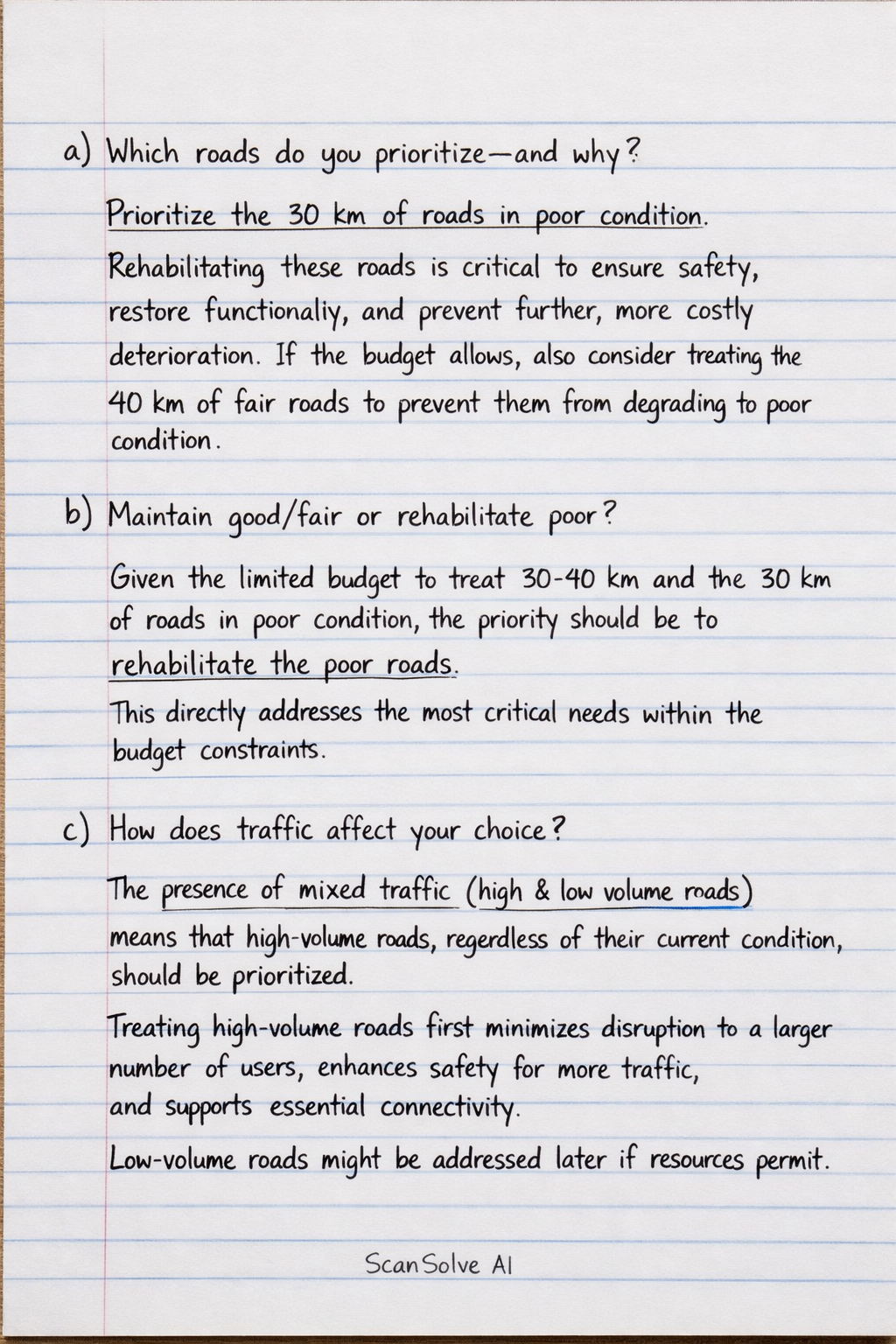
a) Which roads do you prioritize—and why? Prioritize the 30 km of roads in poor condition. Rehabilitating these roads is critical to ensure safety, restore functionality, and prevent further, more costly deterioration. If the budget allows, also consider treating the 40 km of fair roads to prevent them from degrading to poor condition. b) Maintain good/fair or rehabilitate poor? Given the limited budget to treat 30-40 km and the 30 km of roads in poor condition, the priority should be to rehabilitate the poor roads. This directly addresses the most critical needs within the budget constraints. c) How does traffic affect your choice? The presence of mixed traffic (high & low volume roads) means that high-volume roads, regardless of their current condition, should be prioritized. Treating high-volume roads first minimizes disruption to a larger number of users, enhances safety for more traffic, and supports essential connectivity. Low-volume roads might be addressed later if resources permit. d) Do you trust the data? The data is described as "visual + partial automated." Visual data can be subjective and inconsistent, while partial automated data is more reliable but not comprehensive. Therefore, the data should be used with caution and potentially verified, as there is a degree of uncertainty regarding its completeness and objectivity. e) What treatment will you apply? For the 30 km of poor roads, rehabilitation treatments such as structural overlays, reconstruction, or major patching and base repairs would be applied. For the 40 km of fair roads, if budget allows, preventive maintenance like crack sealing, thin overlays, or surface treatments would be used to extend their lifespan. f) What if maintenance is delayed? If maintenance is delayed, roads, especially those in poor or fair condition, will continue to deteriorate rapidly. This will lead to significantly higher repair costs in the future, as rehabilitation might become full reconstruction. Delayed maintenance also increases safety risks for users and causes greater inconvenience. The mention of heavy rainfall further suggests that delays could accelerate degradation.