
This business/management problem is solved step by step below, with detailed explanations to help you understand the method and arrive at the correct answer.
ScanSolve AI Answer
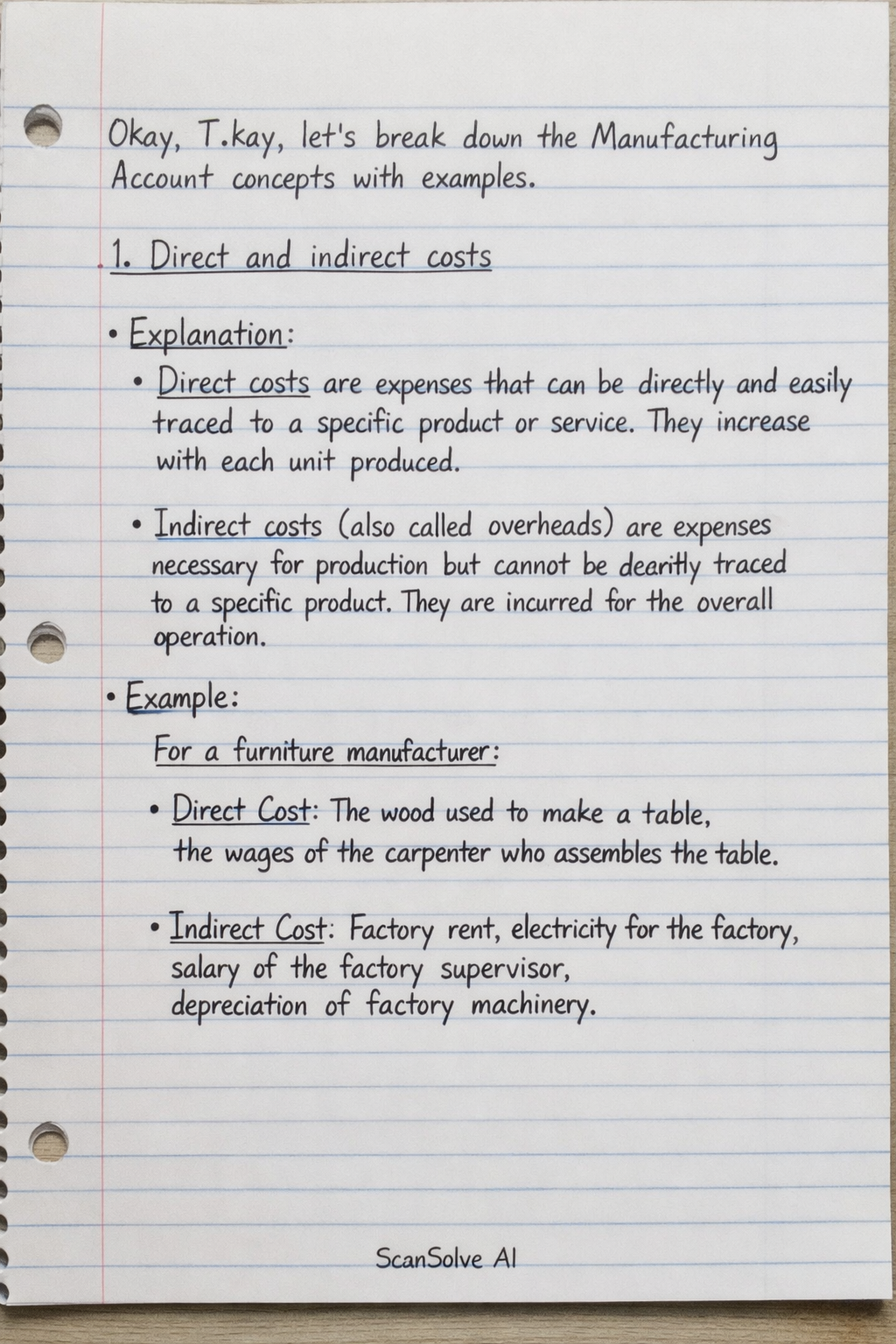
Okay, T.kay, let's break down the Manufacturing Account concepts with examples. 1. Direct and indirect costs Explanation: Direct costs* are expenses that can be directly and easily traced to a specific product or service. They increase with each unit produced. Indirect costs* (also called overheads) are expenses necessary for production but cannot be directly traced to a specific product. They are incurred for the overall operation. Example: For a furniture manufacturer: Direct Cost:* The wood used to make a table, the wages of the carpenter who assembles the table. Indirect Cost:* Factory rent, electricity for the factory, salary of the factory supervisor, depreciation of factory machinery. 2. Direct Material, Direct Labour, Direct Expenses Explanation: These are the components of direct costs. Direct Material:* Raw materials that become a physical part of the finished product. Direct Labour:* Wages paid to workers directly involved in converting raw materials into finished goods. Direct Expenses:* Other expenses directly attributable to a specific product or job, apart from direct materials and direct labor (e.g., royalties paid per unit produced, cost of a special design for a specific product). Example: For a bakery making a custom cake: Direct Material:* Flour, sugar, eggs, specific decorative items for that cake. Direct Labour:* Wages of the baker who bakes and decorates that specific cake. Direct Expenses:* A special license fee paid for a unique character design on that cake. 3. Prime costs, factory overheads and product cost Explanation: These terms categorize the total cost of production. Prime Costs:* The fundamental direct costs of production. Factory Overheads:* All indirect costs incurred within the factory. Product Cost:* The total cost of manufacturing a product. Formulas: Prime Costs = Direct Material + Direct Labour + Direct Expenses Product Cost = Prime Costs + Factory Overheads Example: If a company has: Direct Material: \10,000 Direct Labour: \5,000 Direct Expenses: \1,000 Factory Overheads: \3,000 Prime Costs* = \10,000 + \5,000 + \1,000 = \16,000 Product Cost* = \16,000 + \3,000 = \19,000 4. Work in progress Explanation: This refers to goods that are partially completed at the end of an accounting period. They have had some direct materials, direct labor, and factory overheads applied, but are not yet finished goods ready for sale. Example: At the end of the month, a car manufacturer has several car bodies that have been painted and had engines installed, but are still waiting for interiors and wheels. These partially assembled cars are work in progress*. 5. Income statement (for a manufacturing business) Explanation: This financial statement summarizes a company's revenues, costs, and expenses over a period to show its net profit or loss. For a manufacturing business, it includes the Cost of Goods Sold*, which is calculated using information from the manufacturing account (finished goods inventory). Example: Sales Revenue: \100,000 Less: Cost of Goods Sold (calculated from manufacturing costs): \60,000 Gross Profit: \40,000 Less: Operating Expenses (e.g., selling, administrative): \20,000 Net Profit: \20,000 6. Statement of financial position (for a manufacturing business) Explanation: This statement provides a snapshot of a company's assets, liabilities, and owner's equity at a specific point in time. For a manufacturing business, it will typically show three types of inventory: raw materials, work in progress, and finished goods. Example: Assets:* Current Assets: Cash, Accounts Receivable, and importantly: Raw Materials Inventory (e.g., \5,000) Work in Progress Inventory (e.g., \8,000) Finished Goods Inventory (e.g., \12,000$) Non-Current Assets: Factory building, machinery. Liabilities:* Accounts Payable, Loans. Owner's Equity:* Capital, Retained Earnings.