
We read your photo as:
Explain the Hierarchy of Controls, detailing each level from most effective to least effective.
Business/Management
ScanSolve AI Answer
Answer
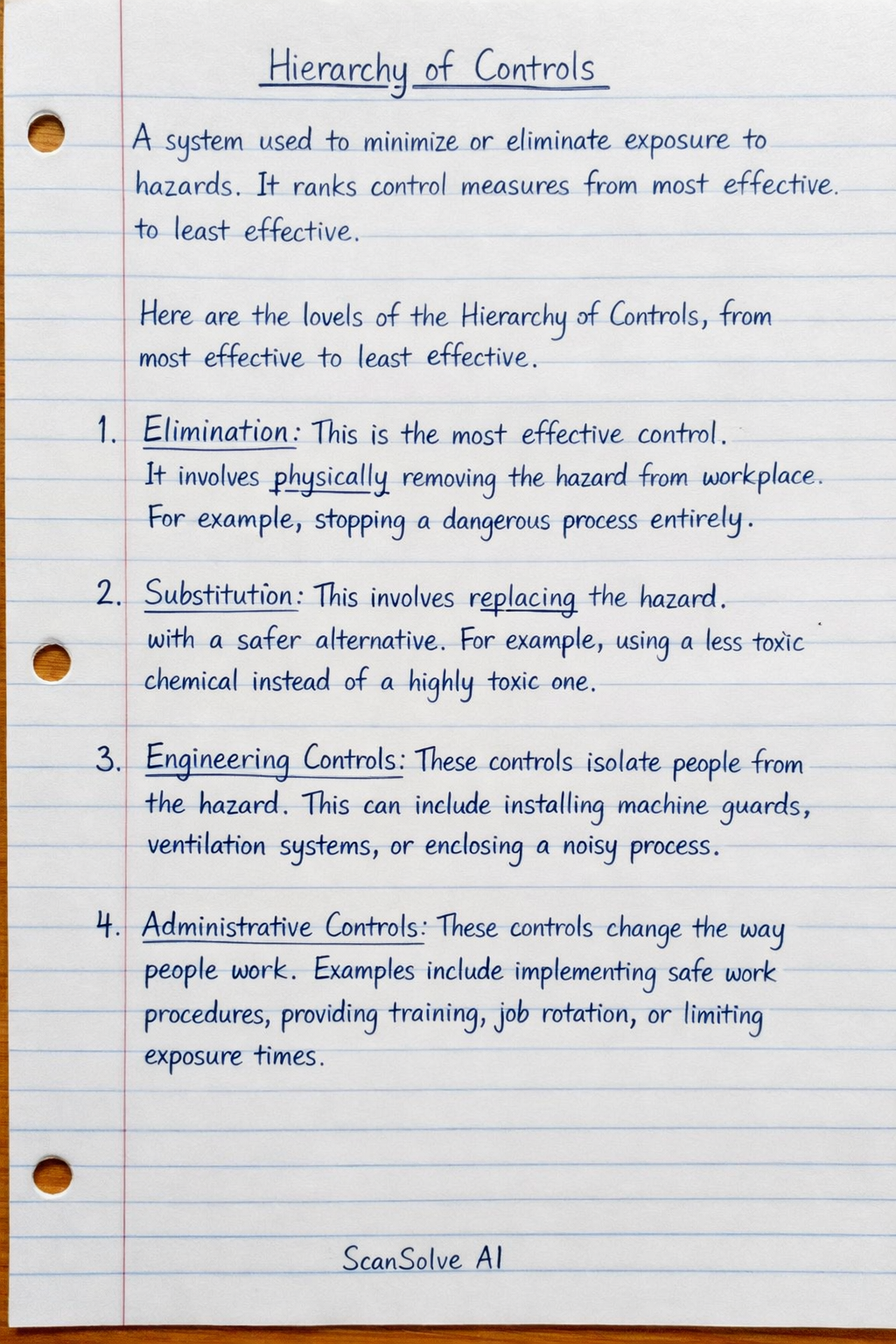
This image illustrates the Hierarchy of Controls, a system used to minimize or eliminate exposure to hazards. It ranks control measures from most effective to least effective.
Here are the levels of the Hierarchy of Controls, from most effective to least effective:
- Elimination: This is the most effective control. It involves physically removing the hazard from the workplace. For example, stopping a dangerous process entirely.
- Substitution: This involves replacing the hazard with a safer alternative. For example, using a less toxic chemical instead of a highly toxic one.
- Engineering Controls: These controls isolate people from the hazard. This can include installing machine guards, ventilation systems, or enclosing a noisy process.
- Administrative Controls: These controls change the way people work. Examples include implementing safe work procedures, providing training, job rotation, or limiting exposure times.
- PPE (Personal Protective Equipment): This is the least effective control and should be used as a last resort or in conjunction with other controls. It involves protecting workers with personal protection equipment such as gloves, safety glasses, hard hats, or respirators.
Was this helpful?
Still stuck on this one?
Ask a follow-up, and the answer starts from this question.
Got a different question?Ask your own question
More Business/Management Questions
QDiscuss the hierarchy of controls using any occupational hazard of your choice.QWhat are the two main types of control methods and provide an example for each?QMatch each physical hazard control with the correct type of control: Administrative, Engineering, or…QDescribe the two main levels of management and provide an example for each.QAll companies have to follow certain steps to apply control. Give an illustration (diagram) of these…
Handwritten Step-by-Step Solution
Get this as a handwritten image on WhatsApp — like a tutor wrote it for you.
Try on WhatsApp