
We read your photo as:
Identify and explain five components of the general environment affecting EcoTech Solutions, providing an example and discussing the influence of each.
Business/Management
ScanSolve AI Answer
Step-by-step solution
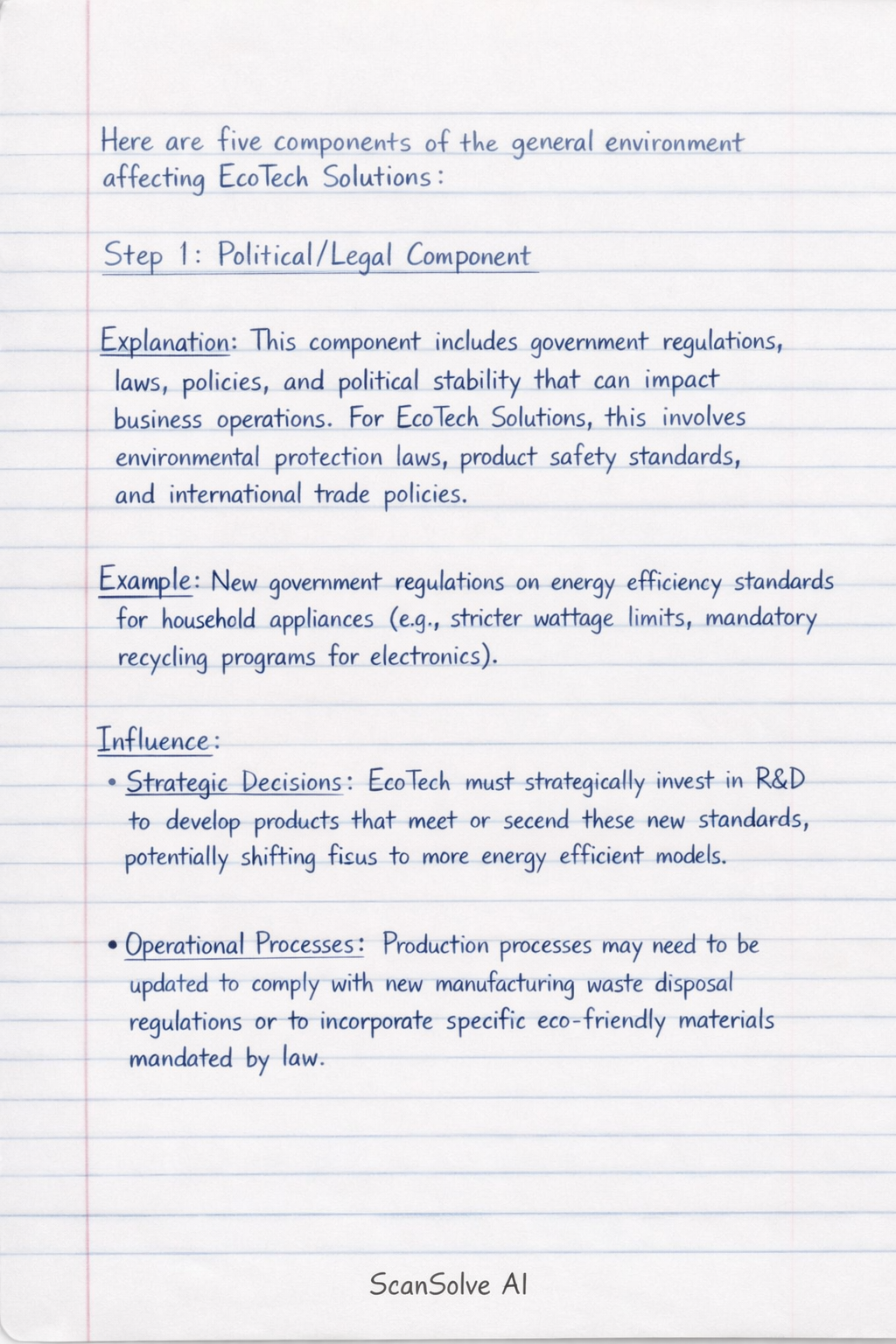
5 stepsHere are five components of the general environment affecting EcoTech Solutions:
Political/Legal Component
- Explanation: This component includes government regulations, laws, policies, and political stability that can impact business operations. For EcoTech Solutions, this involves environmental protection laws, product safety standards, and international trade policies.
- Example: New government regulations on energy efficiency standards for household appliances (e.g., stricter wattage limits, mandatory recycling programs for electronics).
- Influence:
- Strategic Decisions: EcoTech must strategically invest in R&D to develop products that meet or exceed these new standards, potentially shifting focus to more energy-efficient models.
- Operational Processes: Production processes may need to be updated to comply with new manufacturing waste disposal regulations or to incorporate specific eco-friendly materials mandated by law.
- Competitive Position: Companies that adapt quickly to new regulations can gain a competitive advantage by being first to market with compliant products, while those that lag may face fines or lose market share.
Economic Component
- Explanation: This refers to the overall health and direction of the economy, including factors like inflation, interest rates, unemployment rates, consumer purchasing power, and economic growth.
- Example: A period of high inflation leading to increased raw material costs (e.g., for sustainable plastics or recycled metals) and reduced consumer disposable income.
- Influence:
- Strategic Decisions: EcoTech might need to re-evaluate its pricing strategies, explore new, more affordable sustainable materials, or target different market segments if consumer spending power declines.
- Operational Processes: Rising material costs could force EcoTech to optimize supply chain management, seek new suppliers, or improve production efficiency to maintain profit margins.
- Competitive Position: During economic downturns, consumers may prioritize lower-cost alternatives, potentially challenging EcoTech's premium eco-friendly positioning unless it can demonstrate superior long-term value or cost savings.
Sociocultural Component
- Explanation: This involves societal values, attitudes, trends, lifestyles, and demographic characteristics that influence consumer preferences and behavior. For EcoTech, this includes the growing public awareness and demand for sustainable and ethical products.
- Example: An increasing consumer preference for products made from recycled materials and a willingness to pay a premium for brands with strong environmental credentials.
- Influence:
- Strategic Decisions: EcoTech can strategically reinforce its brand identity as a leader in eco-friendly appliances, investing in marketing campaigns that highlight its sustainability efforts and product benefits.
- Operational Processes: The company might need to adapt its product design and sourcing to meet demands for specific sustainable features or certifications, such as using only fair-trade components.
- Competitive Position: By aligning with evolving societal values, EcoTech can strengthen its brand loyalty and differentiate itself from competitors who do not prioritize sustainability, attracting a growing segment of environmentally conscious consumers.
Technological Component
- Explanation: This includes innovations, advancements, and changes in technology that can create new products, production methods, and market opportunities or render existing ones obsolete.
- Example: Development of new, more efficient battery technologies for cordless appliances or advancements in smart home integration for household devices.
- Influence:
- Strategic Decisions: EcoTech must strategically invest in R&D to incorporate cutting-edge green technologies into its appliances, such as more energy-efficient motors or advanced recycling processes for end-of-life products.
- Operational Processes: Production lines may need to be upgraded to accommodate new manufacturing techniques required for advanced materials or smart components, potentially requiring employee retraining.
- Competitive Position: Companies that quickly adopt and integrate new green technologies can gain a significant competitive edge by offering superior, innovative, and more sustainable products, potentially disrupting the market.
Environmental Component
- Explanation: This refers to the natural environment and concerns related to climate change, resource depletion, pollution, and ecological sustainability. It directly impacts companies dealing with natural resources or environmental impact.
- Example: Increased public and scientific concern over plastic waste in oceans, leading to calls for reduced plastic use in products and packaging.
- Influence:
- Strategic Decisions: EcoTech might strategically commit to eliminating single-use plastics from its packaging or developing appliances with fully biodegradable components, aligning with its eco-friendly mission.
- Operational Processes: The company may need to overhaul its packaging and material sourcing processes to reduce its environmental footprint, potentially investing in new machinery for alternative packaging materials.
- Competitive Position: Proactive measures to address environmental concerns can enhance EcoTech's reputation, attract environmentally conscious investors, and solidify its position as a responsible and sustainable brand in a market increasingly valuing ecological stewardship.
Was this helpful?
Still stuck on this one?
Ask a follow-up, and the answer starts from this question.
Got a different question?Ask your own question
More Business/Management Questions
QDiscuss five ways a business interacts with its external environment to improve operations. Identify…QCritically analyze the concept and components of the business environment. Further, assess the role…QExplain the term environmental challenges and list four eg of environmental challenges.QExplain four ways businesses can ethically uphold a healthy environment, four external factors that…QFrom The passage, what is environmental? provide, at tes least, two examples.
Handwritten Step-by-Step Solution
Get this as a handwritten image on WhatsApp — like a tutor wrote it for you.
Try on WhatsApp