
We read your photo as:
Discuss five ways a business interacts with its external environment to improve operations. Identify five elements of effective communication in business.
Business/Management
ScanSolve AI Answer
here are the answers to the questions from the image.
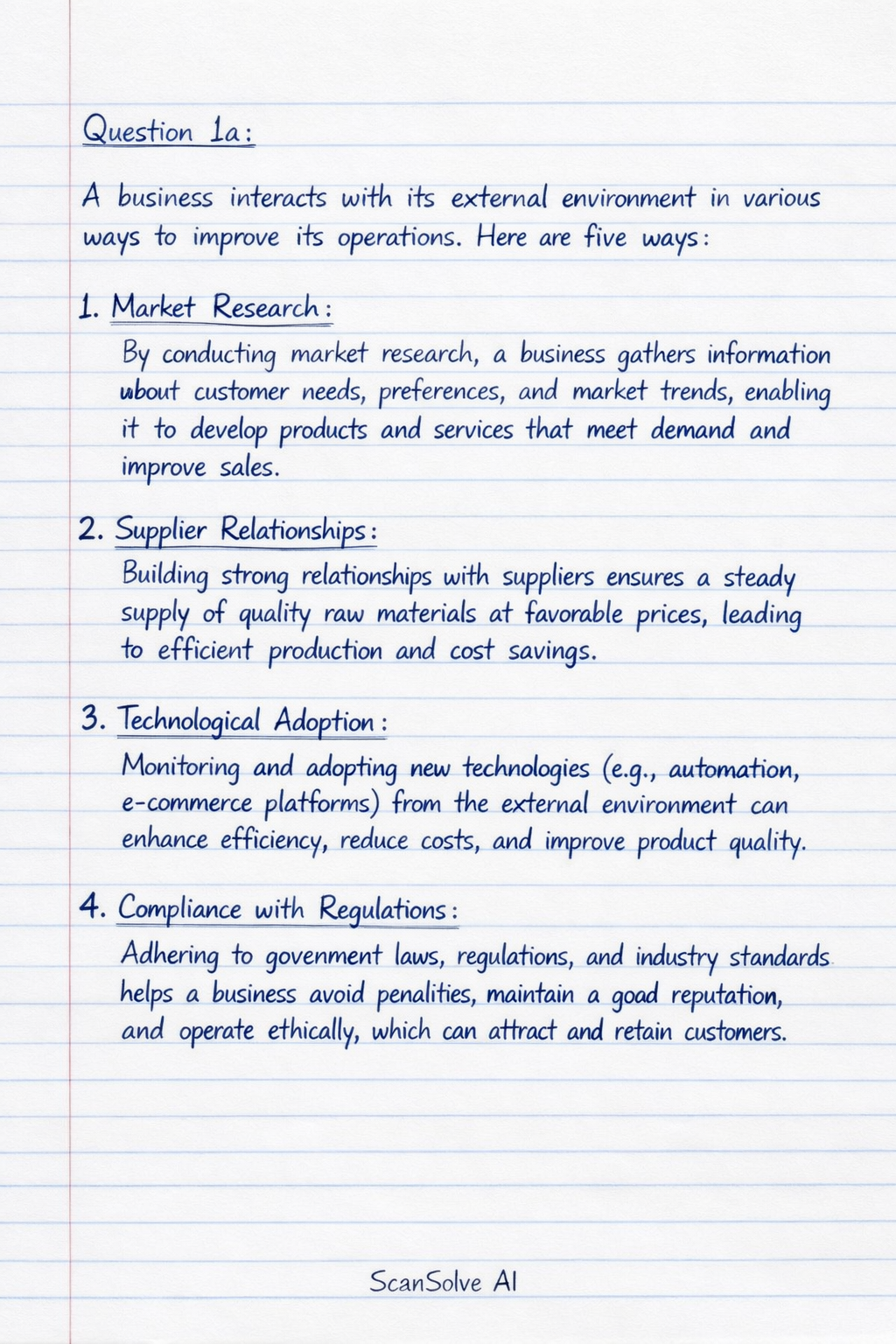
Question 1a:
A business interacts with its external environment in various ways to improve its operations. Here are five ways:
- Market Research: By conducting market research, a business gathers information about customer needs, preferences, and market trends, enabling it to develop products and services that meet demand and improve sales.
- Supplier Relationships: Building strong relationships with suppliers ensures a steady supply of quality raw materials at favorable prices, leading to efficient production and cost savings.
- Technological Adoption: Monitoring and adopting new technologies (e.g., automation, e-commerce platforms) from the external environment can enhance efficiency, reduce costs, and improve product quality.
- Compliance with Regulations: Adhering to government laws, regulations, and industry standards helps a business avoid penalties, maintain a good reputation, and operate ethically, which can attract and retain customers.
- Competitor Analysis: Studying competitors' strategies, products, and pricing allows a business to identify opportunities, differentiate itself, and develop competitive advantages to improve its market position.
Question 2a:
Effective communication is crucial for a business's success. Here are five elements of effective communication:
- Clarity: The message should be clear, concise, and easy to understand, avoiding jargon or ambiguity to prevent misinterpretation.
- Completeness: The message must contain all necessary information to ensure the receiver fully understands the context and can act appropriately.
- Conciseness: The message should be brief and to the point, conveying information efficiently without unnecessary words or details.
- Correctness: The information conveyed must be accurate, factual, and free from grammatical or factual errors to maintain credibility.
- Consideration: The sender should consider the receiver's background, knowledge, and emotional state, tailoring the message to be appropriate and respectful.
Question 2b:
Using a public warehouse can present several disadvantages for a business. Here are five demerits:
- Lack of Control: A business has less control over its inventory and storage conditions compared to a private warehouse, as it shares space and management with other users.
- Limited Customization: Public warehouses offer standardized services, which may not cater to specific or unique storage, handling, or packaging requirements of a particular business.
- Potential for Damage/Loss: With multiple users and shared handling equipment, there might be a higher risk of damage, misplacement, or loss of goods due to less personalized attention.
- Higher Costs for Long-Term Storage: While flexible for short-term needs, public warehousing can become more expensive than owning or leasing a private warehouse for long-term or high-volume storage.
- Confidentiality Concerns: Storing goods in a public facility might raise concerns about the confidentiality of inventory levels, product types, or other sensitive business information.
Was this helpful?
Still stuck on this one?
Ask a follow-up, and the answer starts from this question.
Got a different question?Ask your own question
More Business/Management Questions
QCritically analyze the concept and components of the business environment. Further, assess the role…QExplain four ways businesses can ethically uphold a healthy environment, four external factors that…QIdentify and explain five components of the general environment affecting EcoTech Solutions…QSelect a business, identify two challenges it faces, and discuss the business environments and…QState four benefits of communication to a business.
Handwritten Step-by-Step Solution
Get this as a handwritten image on WhatsApp — like a tutor wrote it for you.
Try on WhatsApp