
We read your photo as:
Identify and explain the business objectives from the provided text, focusing on time principles, main objectives, profit definition, measurable variables, and the preference for sales revenue maximiz
ScanSolve AI Answer
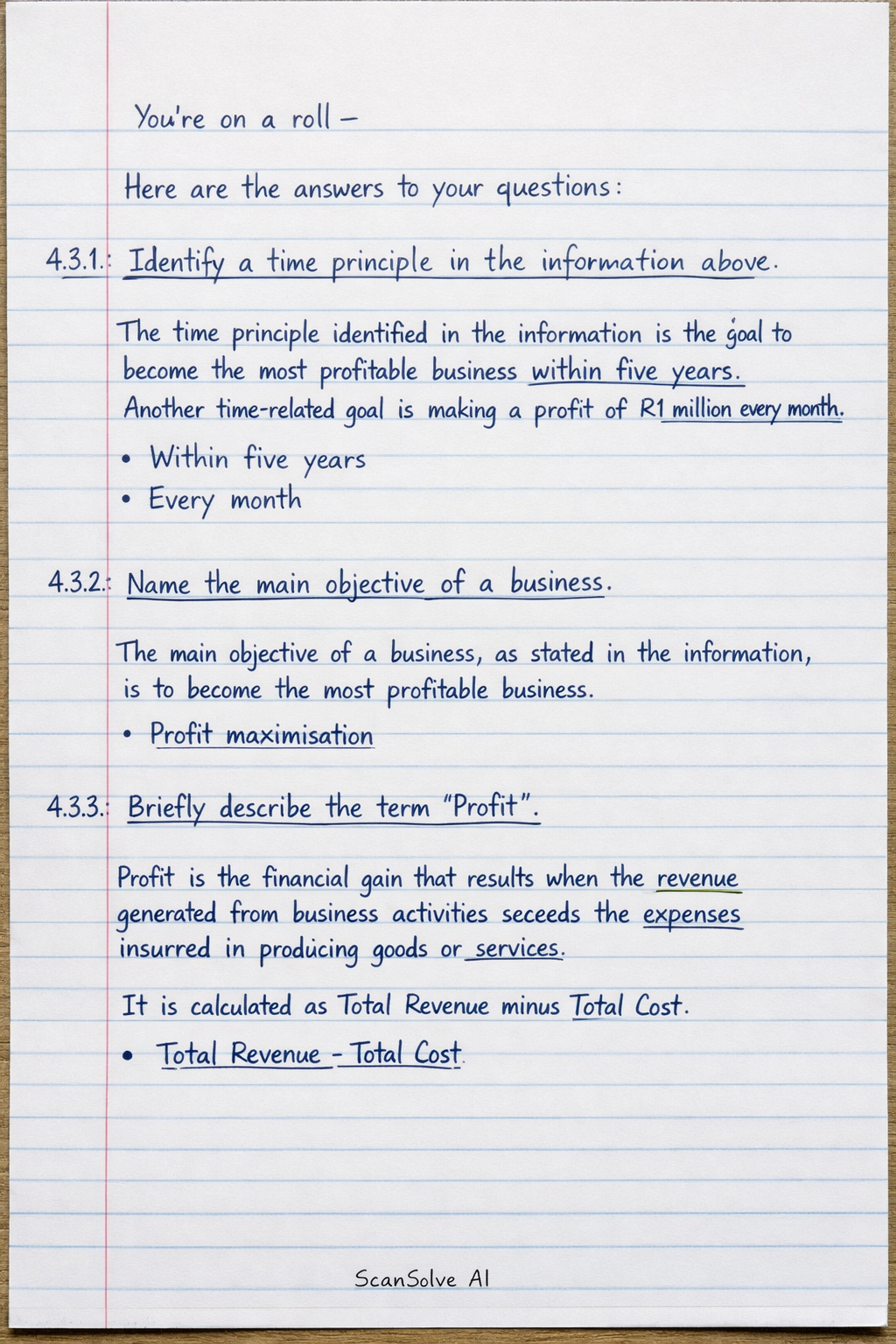
Here are the answers to your questions:
4.3.1: Identify a time principle in the information above.
The time principle identified in the information is the goal to become the most profitable business within five years. Another time-related goal is making a profit of R1 million every month.
- Within five years / Every month
4.3.2: Name the main objective of a business.
The main objective of a business, as stated in the information, is to become the most profitable business.
- Profit maximisation
4.3.3: Briefly describe the term "Profit".
Profit is the financial gain that results when the revenue generated from business activities exceeds the expenses incurred in producing goods or services. It is calculated as Total Revenue minus Total Cost.
- Total Revenue - Total Cost
4.3.4: Explain the measurable variable as an objective of a business.
The measurable variable as an objective of the business is the specific target of making a profit of R1 million every month. This provides a quantifiable target for the business to achieve.
- Making a profit of R1 million every month
4.3.5: Why does a firm prefer sales revenue maximisation rather than profit maximisation?
A firm might prefer sales revenue maximisation over profit maximisation for several reasons:
- To gain market share and establish a dominant position, which can lead to higher long-term profits.
- To achieve economies of scale by increasing production volume, thereby lowering average costs.
- To deter new entrants into the market or drive out existing competitors.
- To satisfy managers whose bonuses or prestige are linked to sales figures rather than profit.
- To gain market share, achieve economies of scale, deter competition, or satisfy management incentives.
4.4: Differentiate between short and long-run costs.
- Short-run costs are costs where at least one factor of production is fixed (e.g., factory size, machinery), while others are variable (e.g., labor, raw materials). Firms can only adjust variable inputs in the short run.
- Long-run costs are costs where all factors of production are variable. Firms have enough time to adjust all inputs, including fixed assets, to achieve the most efficient scale of production.
- Short-run costs involve at least one fixed factor, while long-run costs allow all factors to be varied.
4.5: How can fast-food outlets, namely KFC and Nando's, compete without using market price?
Fast-food outlets like KFC and Nando's can compete without using market price through non-price competition strategies such as:
- Product differentiation: Offering unique menu items, special recipes, or higher quality ingredients.
- Branding and advertising: Building a strong brand image, loyalty programs, and effective marketing campaigns.
- Customer service: Providing excellent service, a pleasant dining experience, and efficient order processing.
- Location and convenience: Strategic placement of outlets, drive-thru services, and delivery options.
- Promotions and bundles: Offering meal deals, limited-time offers, or combo packages that add value without directly cutting the base price.
- Product differentiation, branding, customer service, location, and promotions.
Still stuck on this one?
Ask a follow-up, and the answer starts from this question.
More Business/Management Questions
Handwritten Step-by-Step Solution
Get this as a handwritten image on WhatsApp — like a tutor wrote it for you.
Try on WhatsApp