
We read your photo as:
Identify the most suitable measuring tool for woodworking and the appropriate tool for cutting bricks. Also, define 'improved properties' of materials, considering options like compliant, modern, resi
ScanSolve AI Answer
Answer
Step-by-step solution
18 stepsHere are the solutions to the questions:
28.
Consider the precision required for furniture construction.
To avoid wastage, a woodworker needs to measure accurately.
Evaluate the suitability of each measuring tool.
- A folding rule is less precise for fine work.
- A steel rule provides accurate and consistent measurements for woodworking.
- A surveyor's tape is for long distances, not furniture.
- A vernier caliper is for very small, precise measurements, not general workpiece dimensions. The correct option is B.
29.
Identify the tools used for cutting bricks.
Cutting bricks typically involves a bolster (a wide chisel) and a striking tool.
Determine the appropriate striking tool.
A brick hammer is specifically designed for brickwork, including striking a bolster to cut bricks.
The correct option is A.
30.
Understand the term "improved properties" in materials.
Materials with improved properties often refer to advanced materials that exhibit enhanced performance or unique functionalities.
Evaluate the types of materials listed.
- Compliant materials deform easily.
- Modern materials is a broad term.
- Resistant materials have specific resistance.
- Smart materials are designed to respond to external stimuli (like temperature, light, or electricity) by changing their properties, representing a significant improvement in functionality. The correct option is D.
31.
Analyze strategies for attracting customers for a new company.
A company needs to make its products or services appealing and accessible.
Evaluate each approach.
- Employing inexperienced staff (A) is unlikely to attract customers.
- Seeking loans (B) is about financing, not direct customer attraction.
- Branding and packaging products well (C) makes them attractive and recognizable to potential customers.
- Setting up business at the outskirts (D) might reduce visibility and accessibility. The correct option is C.
32.
Consider the requirements for flexible wristbands for fitness tracking.
The material needs to be flexible, compliant, durable, and comfortable for skin contact.
Evaluate the given materials.
- Mild steel (A) and solid wood (C) are rigid and not suitable.
- Polyvinyl chloride (B) can be flexible but may not be as comfortable or durable for prolonged skin contact as silicone.
- Silicone rubber (D) is highly flexible, durable, water-resistant, and hypoallergenic, making it ideal for wristbands. The correct option is D.
33.
Examine the joint labeled 'Z' in Figure 1, where the chair leg meets the front rail.
This is a structural joint in furniture construction.
Recall common woodworking joints for such applications.
- A dovetail joint is typically for drawers.
- A cross halving joint is for crossing pieces.
- A mortise and tenon joint is a strong, traditional joint used for connecting rails to legs in chairs and tables, providing excellent strength and stability.
- A tongue and groove joint is for joining boards edge-to-edge. The correct option is C.
34.
Consider what makes a wooden chair strong and durable.
Strong joints are crucial, often reinforced with fasteners and adhesives.
Evaluate the fastener combinations.
- Bolts and nuts (A) can be strong but are often visible and can loosen.
- Contact glue and rivets (B) are not suitable; rivets are for metal.
- Screws and rivets (C) are not suitable; rivets are for metal.
- White glue (PVA wood glue) provides a very strong bond in wood joints, and nails can provide initial clamping force and some additional strength. This combination is commonly used for durable wooden furniture. The correct option is D.
35.
Understand the role of aggregates in concrete.
Aggregates are granular materials mixed with cement and water to form concrete.
Identify which aggregate helps reduce shrinkage.
- Cement (A) is the binder.
- Sand (B) is fine aggregate.
- Stones (C), or coarse aggregate, are essential for concrete strength and significantly reduce drying shrinkage by providing bulk and stability to the mix.
- Water (D) is for hydration. The correct option is C.
36.
Analyze the desired movement for the toy
rhythmic pattern for head and arms.
This requires a mechanism that can convert continuous rotation into oscillating or reciprocating motion with a specific pattern.Evaluate the suitability of each mechanism.
- A cam (A) is specifically designed to transform rotary motion into a desired, often rhythmic, reciprocating or oscillating motion, making it ideal for creating patterned movements in toys.
- A gear (B) transmits rotation.
- A pulley (C) transmits power or changes direction.
- A screw (D) converts rotary to linear motion. The correct option is A.
Try one yourself
A new problem that tests the same skill.
Still stuck on this one?
Ask a follow-up, and the answer starts from this question.
More Business/Management Questions
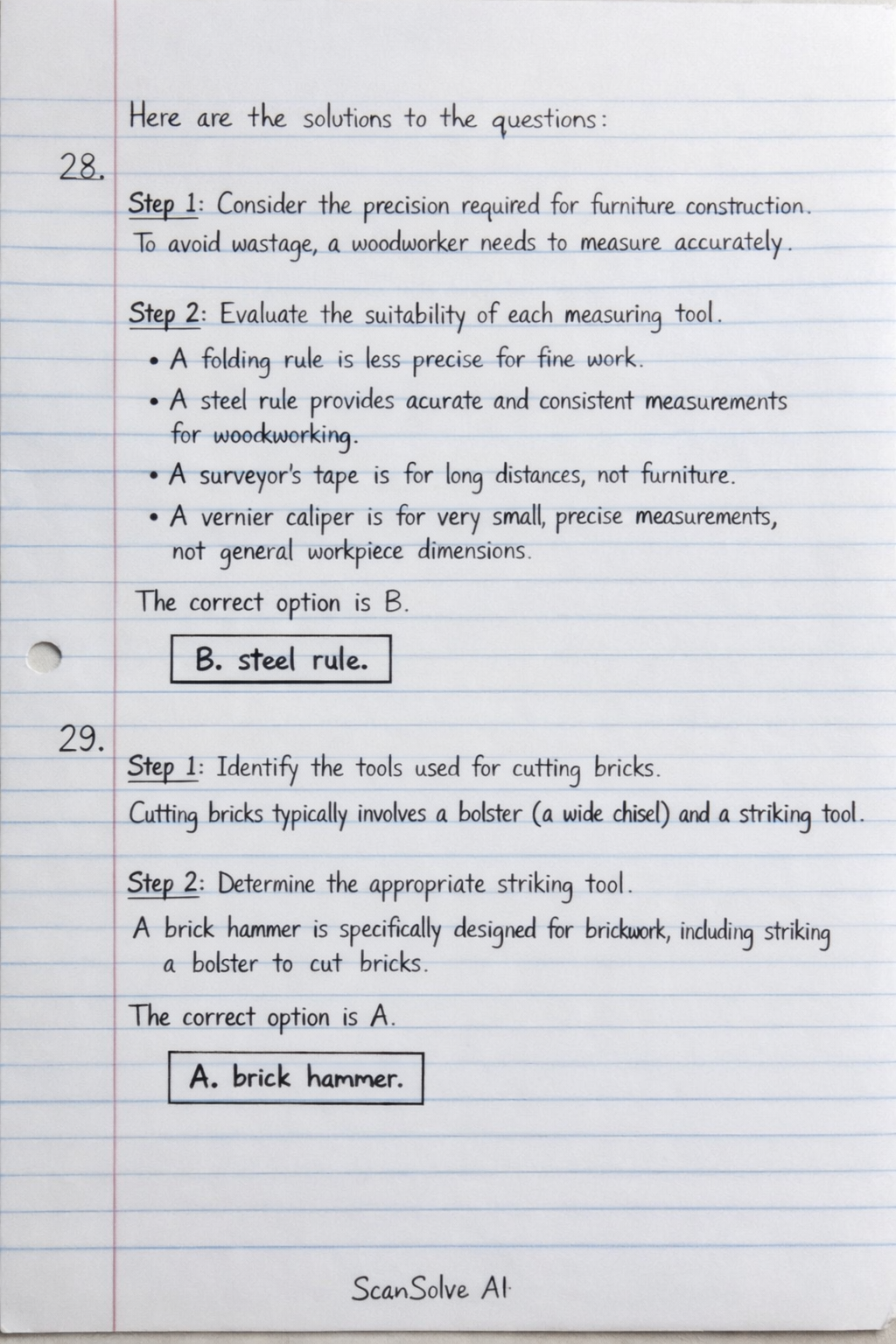
Handwritten Step-by-Step Solution
Get this as a handwritten image on WhatsApp — like a tutor wrote it for you.
Try on WhatsApp