
We read your photo as:
What factors do we consider when selecting measuring and marking tools, and how should we care for measuring tools?
ScanSolve AI Answer
Here are the answers to the questions from the image:
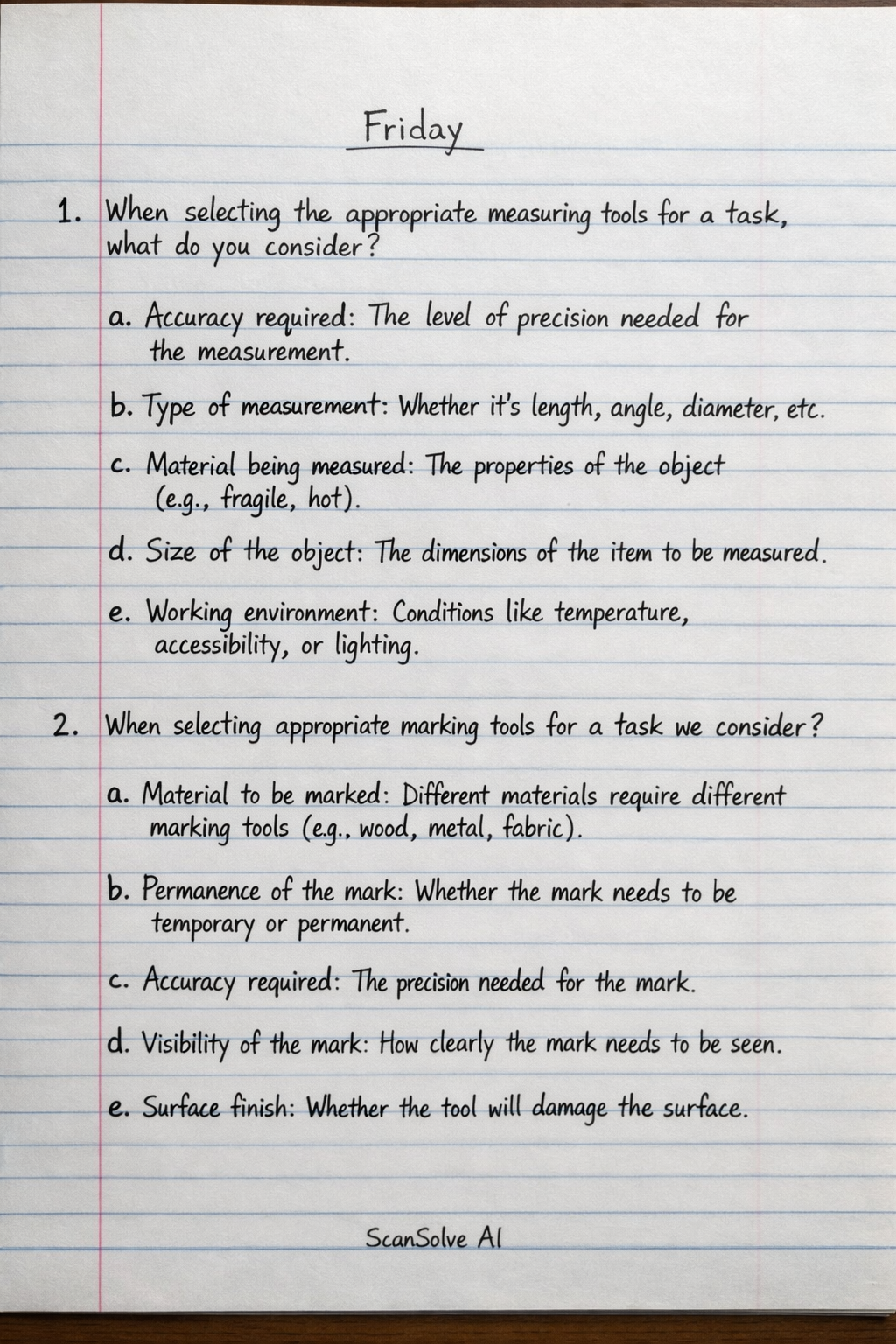
Friday
1. When selecting the appropriate measuring tools for a task, what do you consider?
a. Accuracy required: The level of precision needed for the measurement.
b. Type of measurement: Whether it's length, angle, diameter, etc.
c. Material being measured: The properties of the object (e.g., fragile, hot).
d. Size of the object: The dimensions of the item to be measured.
e. Working environment: Conditions like temperature, accessibility, or lighting.
2. When selecting appropriate marking tools for a task we consider?
a. Material to be marked: Different materials require different marking tools (e.g., wood, metal, fabric).
b. Permanence of the mark: Whether the mark needs to be temporary or permanent.
c. Accuracy required: The precision needed for the mark.
d. Visibility of the mark: How clearly the mark needs to be seen.
e. Surface finish: Whether the tool will damage the surface.
3. How do we take care of measuring tools?
a. Clean them regularly: Remove dirt, dust, and debris after use.
b. Store them properly: Keep them in protective cases or designated areas to prevent damage.
c. Avoid dropping them: Impact can affect their accuracy and calibration.
d. Keep them dry: Prevent rust and corrosion, especially for metal tools.
e. Calibrate them periodically: Ensure they maintain their accuracy over time.
4. State the importance of measuring tools
a. Ensuring accuracy: They provide precise dimensions, crucial for quality and fit.
b. Facilitating standardization: Allow for consistent production and assembly of parts.
c. Preventing waste: Help avoid errors that lead to material waste and rework.
d. Ensuring safety: Critical in engineering and construction to meet safety standards.
e. Supporting design and innovation: Enable precise prototyping and development of new products.
5. Name five marking tools
a. Pencil
b. Chalk
c. Scribe
d. Awl
e. Marking gauge
WEEK 4 Monday
1. Define computer hardware
Computer hardware refers to the physical components of a computer system that you can see and touch. These are the tangible parts that enable the computer to function, such as the processor, memory, storage devices, and input/output devices.
2. State the categories of computer hardware
a. Input devices
b. Output devices
c. Processing devices
d. Storage devices
e. Communication devices
3. Write examples of
a. Keying devices
i. Keyboard
ii. Keypad
b. Pointing devices
i. Mouse
ii. Touchpad
iii. Trackball
iv. Joystick
4. Name types of output devices
a. Monitors/Displays
b. Printers
c. Speakers
d. Projectors
e. Headphones
5. State three types of printers
a. Inkjet printers
b. Laser printers
c. Dot matrix printers
Tuesday
1. Name examples of soft copy output devices
a. Monitor/Display screen
b. Projector
c. Speakers
d. Headphones
e. Virtual reality headsets
2. List two examples hardcopy output devices
a. Printer
b. Plotter
3. State two types of storage devices
a. Primary storage (e.g., RAM)
b. Secondary storage (e.g., Hard Drive, SSD)
4. Give examples of fixed storage devices
a. Hard Disk Drive (HDD)
b. Solid State Drive (SSD)
c. Internal flash memory
5. Write examples of removable storage devices
a. USB flash drive
b. External hard drive
c. SD card
d. CD/DVD
e. Blu-ray disc
Still stuck on this one?
Ask a follow-up, and the answer starts from this question.
More Business/Management Questions
Handwritten Step-by-Step Solution
Get this as a handwritten image on WhatsApp — like a tutor wrote it for you.
Try on WhatsApp