
We read your photo as:
Identify the operations in the flow diagram.
Business/Management
ScanSolve AI Answer
Step-by-step solution
5 steps2.2.1
Identify the operations in the flow diagram.
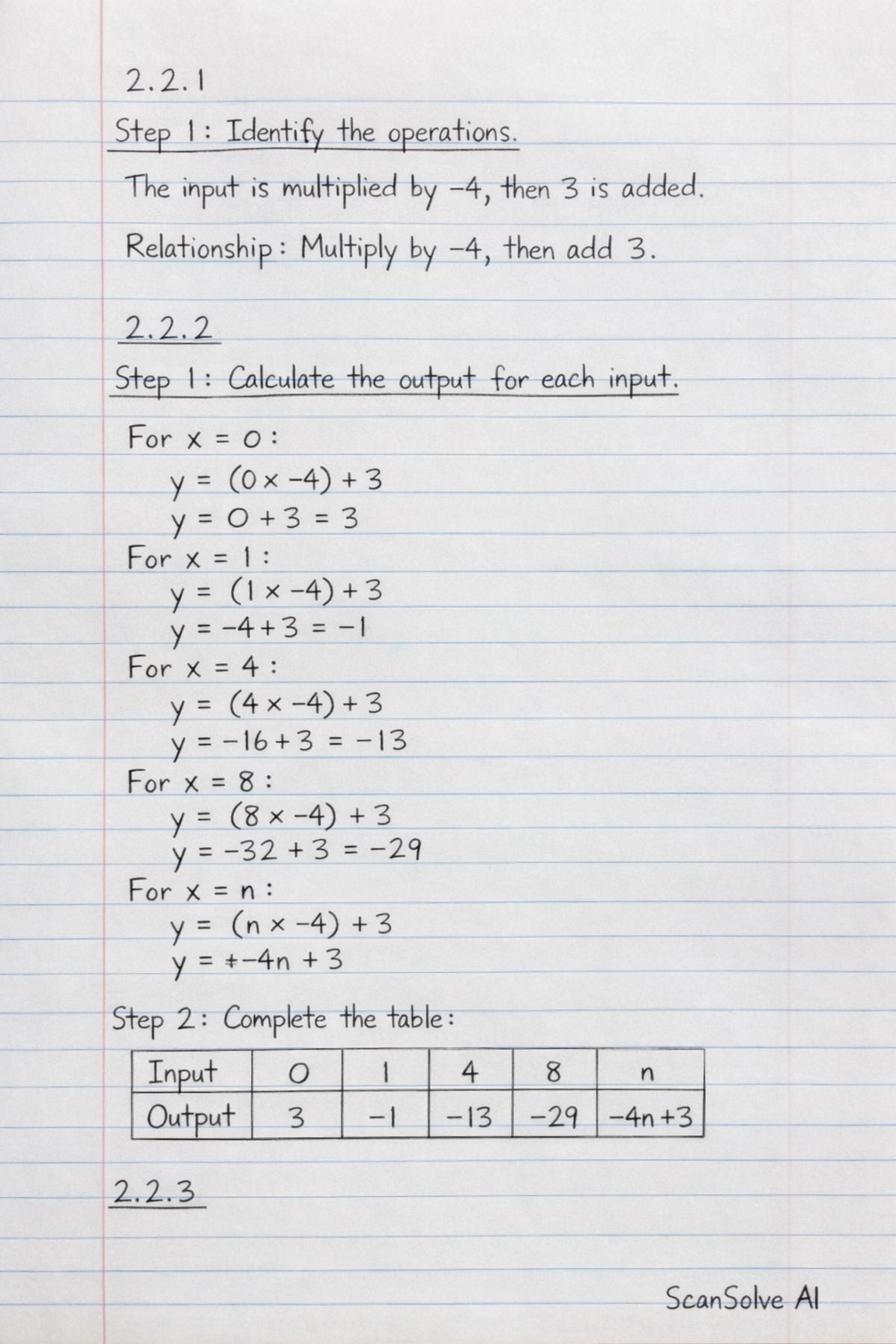
The diagram shows an input value is first multiplied by , and then 3 is added to the result.
The relationship is: Multiply the input by , then add 3 to the result.
2.2.2
Use the relationship to calculate the output for each input.
- For input :
- For input :
- For input :
- For input :
- For input :
Complete the table with the calculated output values.
Input 0 1 2 4 8 n output 3 -1 -5 -13 -29 -4n + 3 2.2.3
To find the input value from a given output, reverse the operations in the flow diagram.
The original operations are: 1. Multiply by . 2. Add 3.
To reverse these, we perform the inverse operations in reverse order: 1. Subtract 3. 2. Divide by .Apply the reversed steps to the output value of .
- Start with the output value: .
- Subtract 3 from the output: .
- Divide the result by : .
The steps to calculate the input value for an output of are:
- Start with the output value, which is .
- Subtract 3 from this value.
- Divide the result by .
Was this helpful?
Still stuck on this one?
Ask a follow-up, and the answer starts from this question.
Got a different question?Ask your own question
More Business/Management Questions
QComplete the flow diagrams.QComplete the flow diagram and tables below.QStudy the flow chart below and use it to answer the questions that follow.QIdentify a) Control structure, b) Output, and c) Pseudocode from the given flowchart.QSolve the following mathematical problems based on the provided flow diagram and table.
Handwritten Step-by-Step Solution
Get this as a handwritten image on WhatsApp — like a tutor wrote it for you.
Try on WhatsApp