
We read your photo as:
If IBM decided to increase their profitability by looking at the return on assets, which one of the following options would be an appropriate suggestion?
ScanSolve AI Answer
Answer
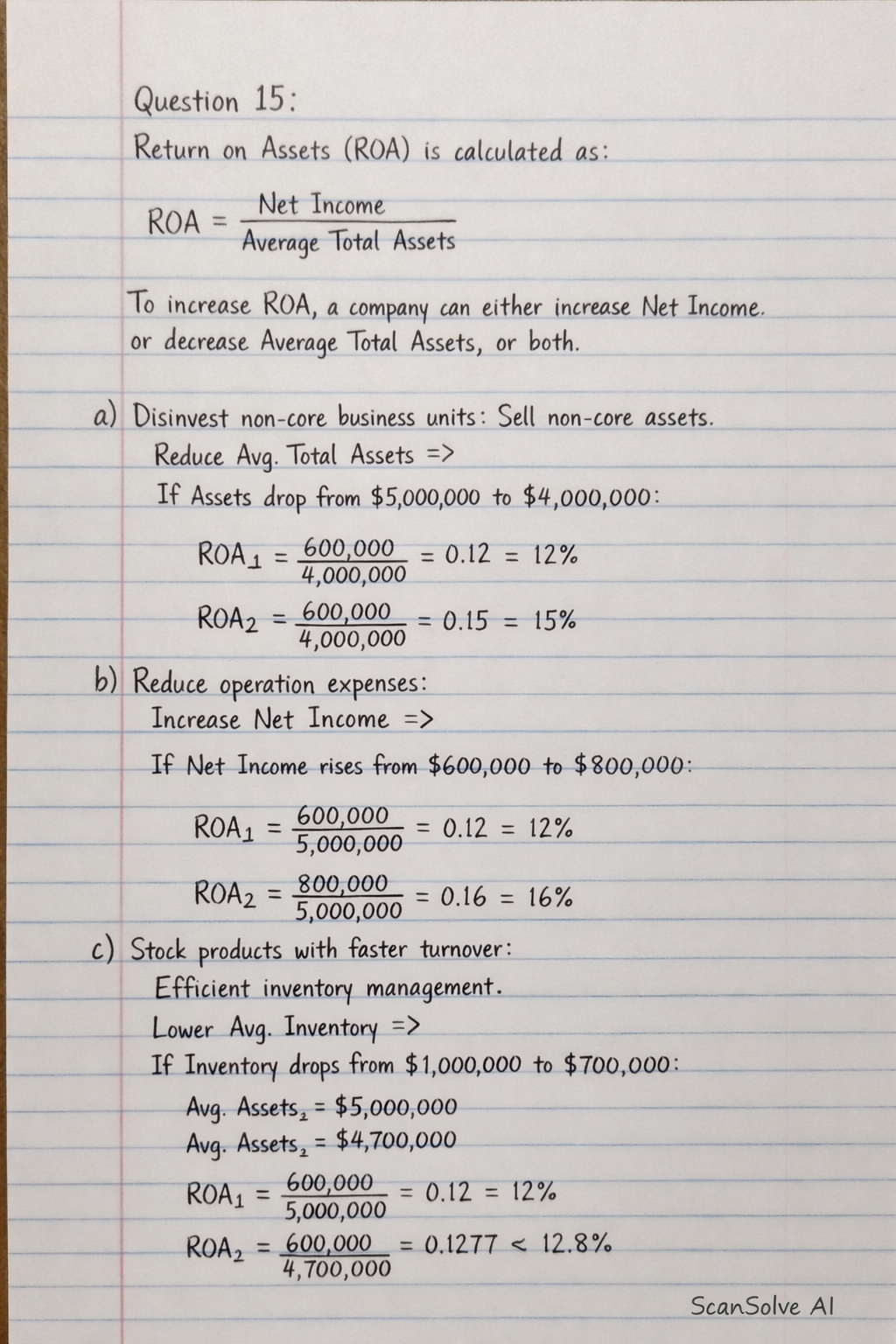
Question 15:
Return on Assets (ROA) is calculated as:
To increase ROA, a company can either increase Net Income (the numerator) or decrease Average Total Assets (the denominator), or both.
- a. Disinvest non-core business units: This involves selling off assets that are not central to the business. By reducing the total asset base, the denominator of the ROA formula decreases. If these divested units were generating low or negative returns, their removal would directly improve the overall ROA. This is a strategic move to optimize the asset base.
- b. Reduce operation expenses: This would increase Net Income, the numerator of the ROA formula, thereby increasing ROA.
- c. Stock products with a faster turnover rate: This implies more efficient use of inventory (an asset). Faster turnover can lead to higher sales and potentially higher net income, and also potentially lower average inventory levels, which would decrease assets and increase ROA.
- d. Buy back shares: This primarily impacts earnings per share (EPS) and capital structure, not directly ROA in a consistently positive way.
While options a, b, and c can all increase ROA, "disinvest non-core business units" is a direct strategic action to optimize the asset component of the ratio by removing underperforming or non-strategic assets, which is a common approach for companies like IBM to improve asset efficiency.
The correct option is a.
An appropriate suggestion would be a. Disinvest non-core business units.
Question 16:
The question emphasizes Toyota's goal of "cost leadership" and the benefits of "standardisation" for "cost-savings advantages."
- a. A centralised purchasing and supply structure: This structure consolidates purchasing decisions and activities under a single department or entity. This allows for bulk purchasing, stronger negotiation power with suppliers, consistent quality control, and easier implementation of standardized components and processes across the entire organization. These factors directly contribute to cost savings and support standardization, aligning with cost leadership.
- b. A decentralised purchasing and supply structure: This structure allows individual departments or business units to make their own purchasing decisions. This often leads to fragmented purchasing, higher costs due to a lack of economies of scale, and difficulty in enforcing standardization.
- c. A combination of centralisation and decentralisation: While many large companies use a hybrid approach, the strong emphasis on "cost leadership" and "standardisation" points towards the maximum benefits of centralization for these specific goals.
- d. A matrix purchasing and supply structure: A matrix structure is about reporting relationships and project management, not primarily about the fundamental structure for purchasing and supply to achieve cost leadership through standardization.
Given the focus on cost leadership and standardization for cost savings, a centralized purchasing and supply structure is the most effective.
The correct option is a.
The most appropriate purchasing and supply structure would be a. A centralised purchasing and supply structure.
Try one yourself
A new problem that tests the same skill.
Still stuck on this one?
Ask a follow-up, and the answer starts from this question.
More Business/Management Questions
Handwritten Step-by-Step Solution
Get this as a handwritten image on WhatsApp — like a tutor wrote it for you.
Try on WhatsApp