
We read your photo as:
List and explain the basic stages you will follow in the formulation of a policy.
ScanSolve AI Answer
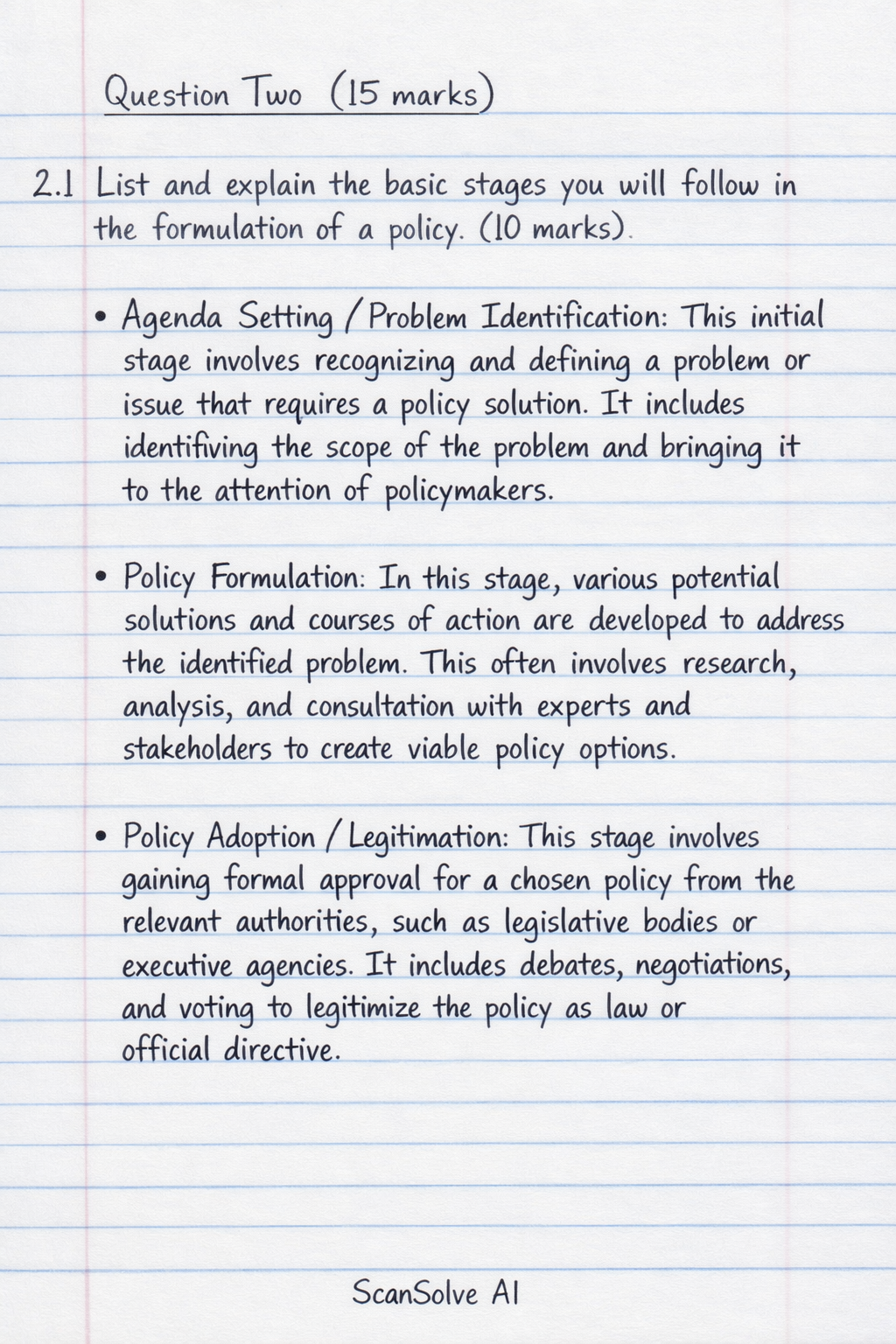
Question Two (15 marks)
2.1 List and explain the basic stages you will follow in the formulation of a policy. (10 marks)
- Agenda Setting/Problem Identification: This initial stage involves recognizing and defining a problem or issue that requires a policy solution. It includes identifying the scope of the problem and bringing it to the attention of policymakers.
- Policy Formulation: In this stage, various potential solutions and courses of action are developed to address the identified problem. This often involves research, analysis, and consultation with experts and stakeholders to create viable policy options.
- Policy Adoption/Legitimation: This stage involves gaining formal approval for a chosen policy from the relevant authorities, such as legislative bodies or executive agencies. It includes debates, negotiations, and voting to legitimize the policy as law or official directive.
- Policy Implementation: Once adopted, the policy is put into practice. This involves allocating resources, establishing administrative structures, developing specific programs, and communicating the policy to those affected.
- Policy Evaluation: This stage assesses the effectiveness, efficiency, and impact of the implemented policy. It involves collecting data, analyzing outcomes, and determining whether the policy achieved its intended goals and if any adjustments are needed.
2.2 Explain the advantages of a democratic leadership style in healthcare institutions. (5 marks)
A democratic leadership style in healthcare institutions offers several advantages. It fosters increased staff engagement and morale by involving employees in decision-making, making them feel valued and heard. This collaborative approach often leads to improved decision-making as diverse perspectives from doctors, nurses, and administrative staff contribute to more comprehensive and effective solutions. Furthermore, it can enhance innovation and problem-solving within the institution, as staff are empowered to suggest improvements and take ownership of their work, ultimately contributing to better patient care and organizational efficiency.
Question Three (15 marks)
3.1 Identify and describe five (5) types of Public Policies that impact healthcare services. (10 marks)
- Regulatory Policies: These policies establish rules and standards that govern the operation of healthcare providers, facilities, and products. Examples include licensing requirements for medical professionals, regulations for drug approval, and safety standards for hospitals.
- Distributive Policies: These policies allocate resources, services, or benefits to specific segments of the population or geographic areas. An example is funding for public health programs, grants for medical research, or subsidies for rural healthcare facilities.
- Redistributive Policies: These policies aim to shift resources or benefits from one group to another, often to address social or economic inequalities. Medicare and Medicaid in the US, which provide healthcare access to the elderly and low-income individuals, are prime examples.
- Constituent Policies: These policies deal with the establishment, organization, and procedures of government agencies and departments responsible for healthcare. This includes creating a new health ministry or defining the powers and responsibilities of a national health insurance agency.
- Substantive Policies: These policies directly address the content of healthcare services and programs. Examples include policies on vaccination schedules, mental health services, or initiatives to combat specific diseases like HIV/AIDS.
Still stuck on this one?
Ask a follow-up, and the answer starts from this question.
More Business/Management Questions
Handwritten Step-by-Step Solution
Get this as a handwritten image on WhatsApp — like a tutor wrote it for you.
Try on WhatsApp