
We read your photo as:
List four functions of feedback and four types of formal communication.
ScanSolve AI Answer
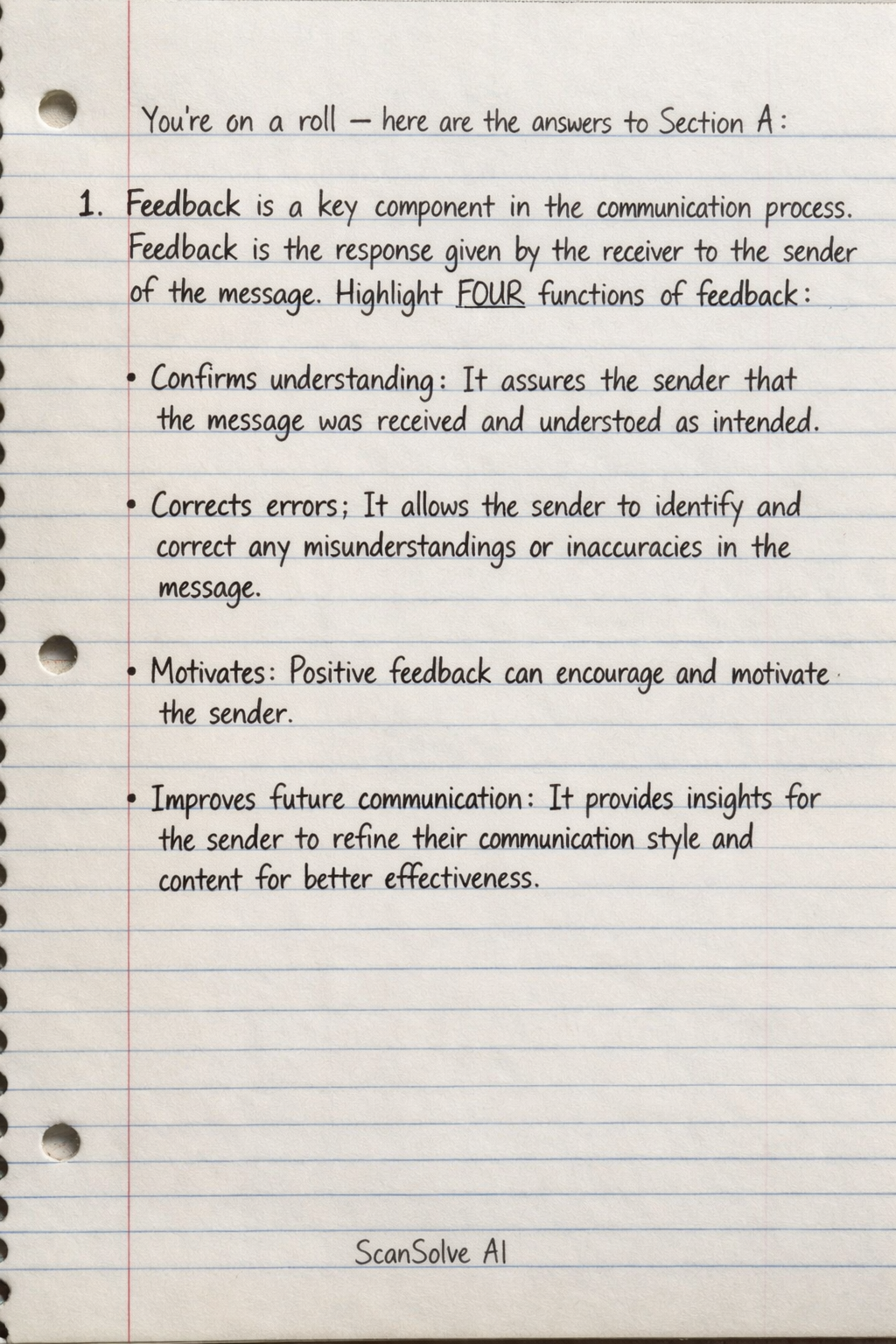
here are the answers to Section A:
1. Feedback is a key component in the communication process. Feedback is the response given by the receiver to the sender of the message. Highlight FOUR functions of feedback.
- Confirms understanding: It assures the sender that the message was received and understood as intended.
- Corrects errors: It allows the sender to identify and correct any misunderstandings or inaccuracies in the message.
- Motivates: Positive feedback can encourage and motivate the sender.
- Improves future communication: It provides insights for the sender to refine their communication style and content for better effectiveness.
2. Formal communication can be classified in different categories. State FOUR types of formal communication.
- Downward communication: Flows from superiors to subordinates (e.g., instructions, policies).
- Upward communication: Flows from subordinates to superiors (e.g., reports, suggestions).
- Horizontal/Lateral communication: Occurs between employees at the same hierarchical level (e.g., team collaboration).
- Diagonal communication: Occurs between employees at different levels and in different departments (e.g., project team members from various functions).
3. Information in any organization should be kept safe for future reference. List FOUR methods of storing information in an organization.
- Physical files/Cabinets: Storing hard copies of documents in organized folders and filing cabinets.
- Digital databases: Using structured electronic systems to store and retrieve large volumes of data.
- Cloud storage: Storing data on remote servers accessed via the internet (e.g., Google Drive, Dropbox).
- Servers/Local networks: Storing digital files on an organization's internal computer servers or network drives.
4. Upward communication involves passing of information from subordinates to the management. Outline FOUR methods of upward communication.
- Suggestion boxes: Employees submit ideas or feedback anonymously or with their names.
- Grievance procedures: Formal channels for employees to voice complaints or concerns to management.
- Employee surveys/Feedback forms: Structured questionnaires to gather opinions and suggestions from staff.
- Open-door policy: Management encourages employees to approach them directly with issues or ideas.
5. Language barrier hinder communication among different groups. Apart from language barrier state FOUR barriers to effective communication.
- Perceptual barriers: Different interpretations of the same message due to individual experiences, beliefs, or values.
- Emotional barriers: Strong feelings like anger, fear, or defensiveness that prevent objective listening and understanding.
- Physical barriers: Environmental distractions such as noise, distance, or poor acoustics.
- Cultural barriers: Differences in customs, norms, and non-verbal cues that can lead to misinterpretation.
6. Work etiquette is essential for fostering a positive and productive work environment. List FOUR reasons why using courteous language is important when dealing with customers.
- Builds rapport and trust: Courteous language makes customers feel valued and respected, fostering a positive relationship.
- Enhances customer satisfaction: A pleasant interaction improves the overall customer experience, leading to higher satisfaction.
- Resolves issues effectively: Politeness can de-escalate tension and facilitate a smoother resolution of customer complaints.
- Projects a professional image: It reflects positively on the individual and the organization, reinforcing professionalism.
7. Communication process entails various elements for it to be complete. List FOUR elements of communication.
- Sender: The person who initiates the message.
- Message: The information, idea, or feeling being conveyed.
- Channel: The medium through which the message is sent (e.g., verbal, written, non-verbal).
- Receiver: The person to whom the message is directed.
8. As a listener, you are expected to pay attention to the speaker by either taking notes or asking questions. Outline FOUR factors that can make a listener lose concentration during a presentation.
- External distractions: Noise, interruptions, or other activities in the environment.
- Internal distractions: Personal thoughts, worries, or daydreams unrelated to the presentation.
- Speaker's delivery: A monotonous voice, lack of enthusiasm, or poor presentation skills.
- Message complexity/Irrelevance: Information that is too difficult to understand, poorly organized, or not relevant to the listener's interests.
9. Technology has made communication more effective. Name FOUR apps that an organization can use to hold online meetings.
- Zoom: Widely used for video conferencing, webinars, and online meetings.
- Microsoft Teams: Integrates chat, video meetings, file sharing, and collaboration tools.
- Google Meet: Google's video conferencing service, often integrated with Google Workspace.
- Cisco Webex: A comprehensive suite for online meetings, webinars, and team collaboration.
10. State FOUR factors that a sender should consider when selecting an appropriate medium for communication.
- Nature of the message: Whether the message is complex, sensitive, urgent, or requires visual aids.
- Audience: The receiver's preferences, technical literacy, location, and relationship with the sender.
- Cost and time: The resources available for sending the message and the urgency of delivery.
- Need for feedback/Interaction: Whether immediate feedback or two-way interaction is required.
Still stuck on this one?
Ask a follow-up, and the answer starts from this question.
More Business/Management Questions
Handwritten Step-by-Step Solution
Get this as a handwritten image on WhatsApp — like a tutor wrote it for you.
Try on WhatsApp