
We read your photo as:
Market segmentation is the process of dividing a broad consumer market into smaller, more manageable groups or segments based on shared characteristics. This allows businesses to tailor marketing
ScanSolve AI Answer
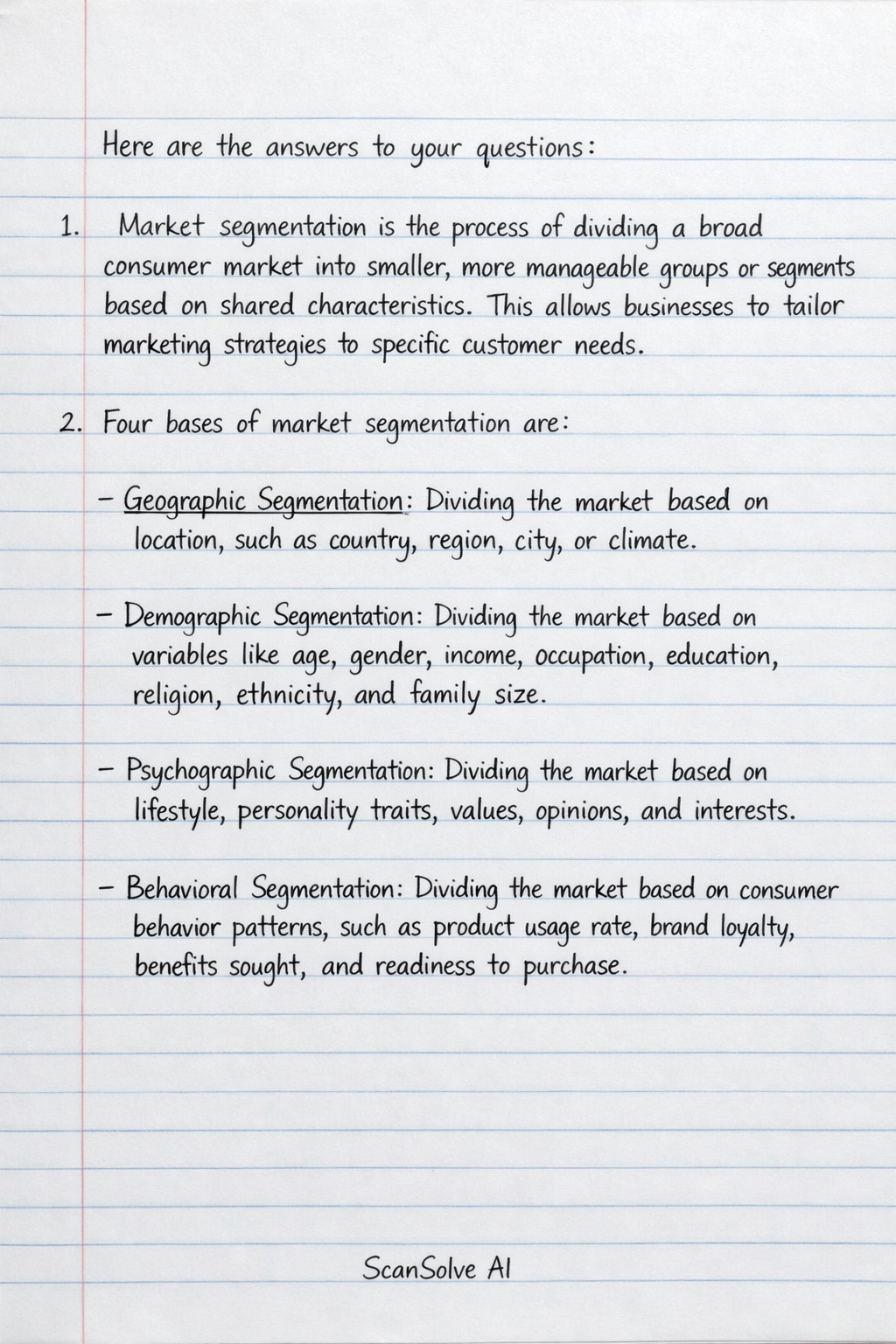
Here are the answers to your questions:
-
Market segmentation is the process of dividing a broad consumer market into smaller, more manageable groups or segments based on shared characteristics. This allows businesses to tailor marketing strategies to specific customer needs.
-
Four bases of market segmentation are:
- Geographic Segmentation: Dividing the market based on location, such as country, region, city, or climate.
- Demographic Segmentation: Dividing the market based on variables like age, gender, income, occupation, education, religion, ethnicity, and family size.
- Psychographic Segmentation: Dividing the market based on lifestyle, personality traits, values, opinions, and interests.
- Behavioral Segmentation: Dividing the market based on consumer behavior patterns, such as product usage rate, brand loyalty, benefits sought, and readiness to purchase.
-
Three circumstances which will cause an employee to be dismissed are:
- Gross Misconduct: Serious breaches of company policy or law, such as theft, fraud, violence, or harassment.
- Poor Performance: Consistent failure to meet job expectations or targets despite adequate training and warnings.
- Redundancy: When the employee's job is no longer needed due to business restructuring, technological changes, or economic downturns.
-
Three factors to be considered when paying wages and salaries are:
- Industry Standards and Competitor Rates: Companies must consider what competitors are paying for similar roles to attract and retain talent.
- Employee Skills, Experience, and Qualifications: Highly skilled, experienced, or qualified employees typically command higher wages.
- Company's Financial Health and Profitability: The overall financial capacity of the company dictates how much it can afford to pay its employees.
-
Delegation is the process where a manager assigns specific tasks and authority to a subordinate to complete a job. The manager retains overall responsibility. Decentralisation is a systematic dispersion of authority throughout an organization, where decision-making power is pushed down to lower levels of management. Delegation is a specific act of assigning tasks, while decentralisation is a broader organizational philosophy.
-
Five reasons a manager would not delegate his authority are:
- Lack of Trust in Subordinates: The manager may not believe subordinates have the capability or commitment to perform tasks effectively.
- Fear of Losing Control: The manager might worry about losing authority or oversight if tasks are delegated.
- Belief in Doing it Better Themselves: The manager may feel that they can complete the task more efficiently or to a higher standard.
- Lack of Subordinate Skills or Experience: The manager might perceive that subordinates lack the necessary skills, knowledge, or experience for the task.
- Fear of Being Shown Up: The manager may be concerned that a subordinate might perform the task too well, potentially making the manager look less competent.
Still stuck on this one?
Ask a follow-up, and the answer starts from this question.
More Business/Management Questions
Handwritten Step-by-Step Solution
Get this as a handwritten image on WhatsApp — like a tutor wrote it for you.
Try on WhatsApp