

This business/management problem is solved step by step below, with detailed explanations to help you understand the method and arrive at the correct answer.
ScanSolve AI Answer
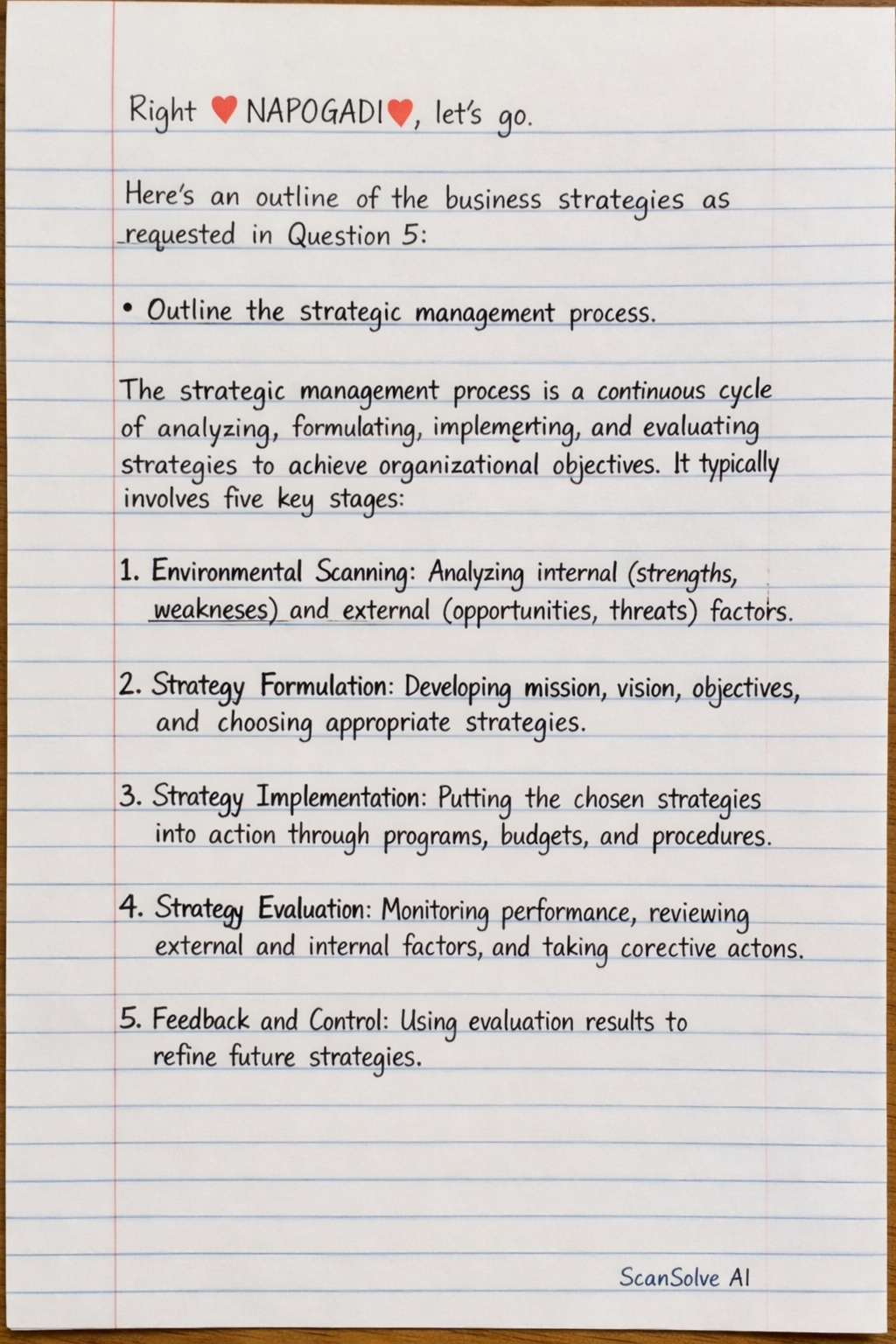
Here's an outline of the business strategies as requested in Question 5: Outline the strategic management process. The strategic management process is a continuous cycle of analyzing, formulating, implementing, and evaluating strategies to achieve organizational objectives. It typically involves five key stages: 1. Environmental Scanning: Analyzing internal (strengths, weaknesses) and external (opportunities, threats) factors. 2. Strategy Formulation: Developing mission, vision, objectives, and choosing appropriate strategies. 3. Strategy Implementation: Putting the chosen strategies into action through programs, budgets, and procedures. 4. Strategy Evaluation: Monitoring performance, reviewing external and internal factors, and taking corrective actions. 5. Feedback and Control: Using evaluation results to refine future strategies. Discuss THREE types of integration strategies. Integration strategies involve expanding a business's operations by acquiring or merging with other companies. 1. Horizontal Integration: This involves a company acquiring or merging with another company at the same stage of the value chain in the same industry. For example, a car manufacturer acquiring another car manufacturer. The goal is to increase market share, achieve economies of scale, and reduce competition. 2. Backward Vertical Integration: This occurs when a company acquires a supplier. For instance, a car manufacturer buying a tire company. This strategy aims to gain control over inputs, reduce costs, and ensure supply chain stability. 3. Forward Vertical Integration: This involves a company acquiring a distributor or retailer. For example, a car manufacturer opening its own dealerships. The purpose is to gain control over distribution channels, improve customer access, and capture a larger share of the profit margin. Explain ways in which businesses can deal with the following PESTLE factors: Technological: Businesses can deal with technological factors by investing in research and development (R&D) to innovate and stay competitive. They can also adopt new technologies, automate processes, and provide employee training to adapt to technological advancements. Forming strategic alliances* with tech companies or acquiring startups can also be effective. Legal: Businesses must ensure compliance with all relevant laws and regulations, such as consumer protection laws, labor laws, and environmental regulations. They often engage legal counsel to interpret complex laws and mitigate risks. Businesses may also participate in lobbying efforts* to influence policy-making and stay informed about impending legislative changes. Advise businesses on the advantages of diversification strategies. Diversification strategies involve expanding a business into new products or markets. 1. Risk Reduction: By operating in multiple markets or offering various products, businesses can reduce their reliance on a single revenue stream, cushioning the impact of downturns in any one area. 2. Growth Opportunities: Diversification allows businesses to tap into new markets and customer segments, leading to increased sales and overall growth potential. 3. Synergy: In some cases, diversifying into related areas can create synergies, where the combined operations are more efficient or effective than individual parts, leading to cost savings or enhanced capabilities. 4. Increased Market Power: Expanding into new areas can strengthen a company's overall market position and brand recognition. Send me the next one 📸