
We read your photo as:
Define and explain the characteristics of the following Business Activities, giving two (2) advantages and two (2) disadvantages of each: (i) State-owned enterprises/parastatal (ii) Partnership
ScanSolve AI Answer
Here's the solution for Question 1:
1. Define and explain the characteristics of the following Business Activities, giving two (2) advantages and two (2) disadvantages of each:
i) State-owned enterprises/parastatal
A state-owned enterprise (SOE) or parastatal is a business entity where the government holds a majority ownership stake and exercises significant control. These entities often operate in strategic sectors or provide essential public services.
Characteristics:
- Government Ownership and Control: The government is the primary owner and decision-maker.
- Public Service Mandate: Often established to serve public interest rather than solely maximizing profit.
- Funding: May receive funding directly from the government budget or through state-backed loans.
- Monopoly/Oligopoly: Can operate as a monopoly or in an oligopolistic market, especially in utilities or infrastructure.
Advantages:
- Provision of Essential Services: Can provide critical services (e.g., water, electricity, public transport) that the private sector might find unprofitable.
- Stability and Long-Term Planning: Less susceptible to short-term market fluctuations, allowing for long-term strategic investments.
Disadvantages:
- Inefficiency and Bureaucracy: Can suffer from a lack of competitive pressure, leading to inefficiency, slow decision-making, and bureaucratic hurdles.
- Political Interference and Corruption: Prone to political influence, which can lead to non-economic decisions, patronage, and corruption.
ii) Partnership
A partnership is a business structure where two or more individuals agree to share in the profits or losses of a business that they jointly own and operate. It is typically formed through a partnership agreement.
Characteristics:
- Shared Ownership: Two or more partners jointly own the business.
- Mutual Agency: Each partner can act on behalf of the partnership and bind it to contracts.
- Unlimited Liability (General Partnership): General partners are personally liable for the debts and obligations of the business.
- Profit/Loss Sharing: Profits and losses are distributed among partners according to the terms of their partnership agreement.
- Easy to Form: Relatively simple and inexpensive to establish compared to a corporation.
Advantages:
- Pooled Resources and Expertise: Partners can combine their capital, skills, and knowledge, leading to a stronger resource base.
- Easier Capital Raising: It is generally easier to raise capital than a sole proprietorship due to multiple owners contributing funds and potentially attracting investors.
Disadvantages:
- Unlimited Liability: General partners face unlimited personal liability, meaning their personal assets can be used to cover business debts.
- Potential for Disagreements: Conflicts can arise among partners regarding management decisions, profit distribution, or business direction, which can disrupt operations.
Still stuck on this one?
Ask a follow-up, and the answer starts from this question.
More Business/Management Questions
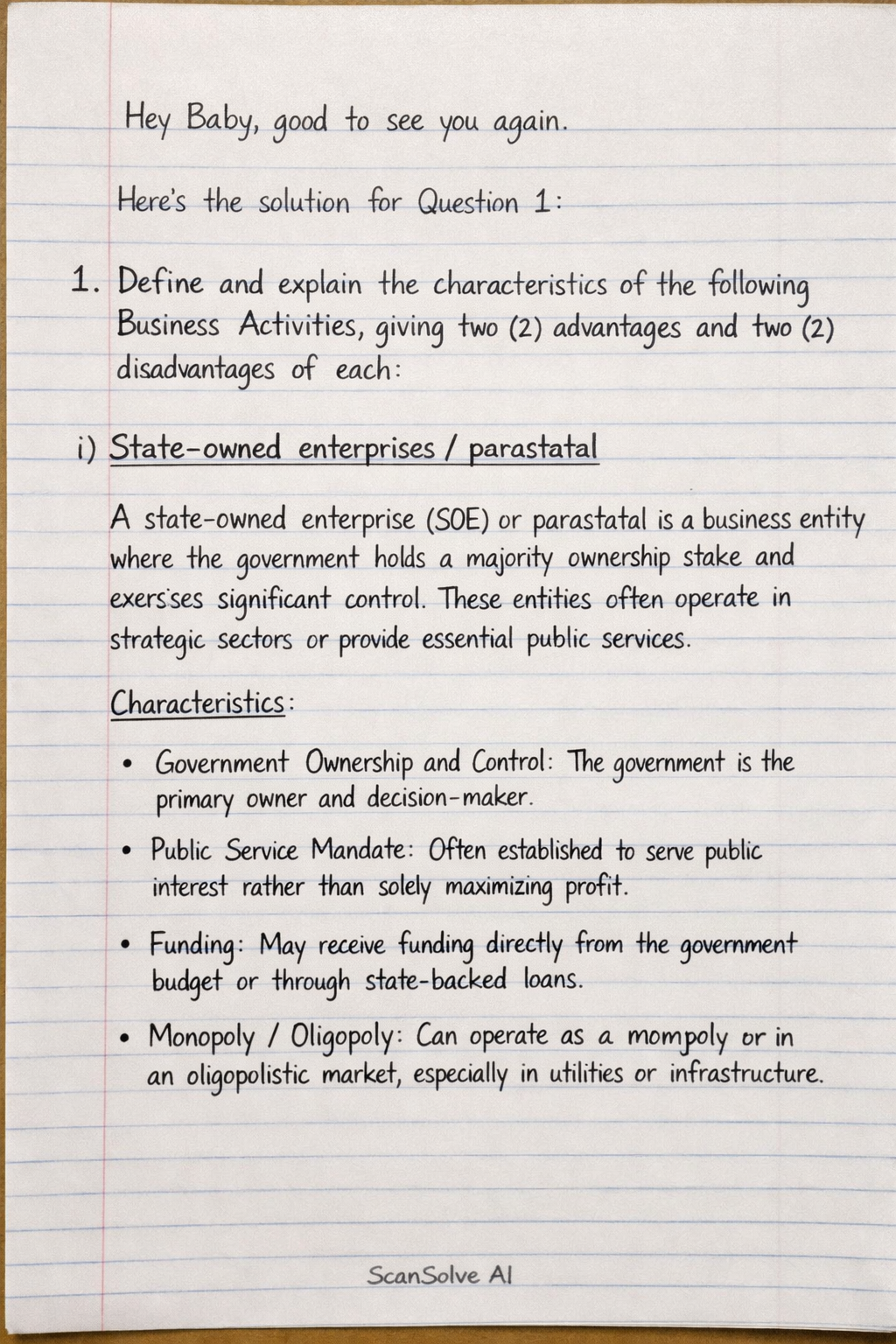
Handwritten Step-by-Step Solution
Get this as a handwritten image on WhatsApp — like a tutor wrote it for you.
Try on WhatsApp