

This business/management problem is solved step by step below, with detailed explanations to help you understand the method and arrive at the correct answer.
ScanSolve AI Answer
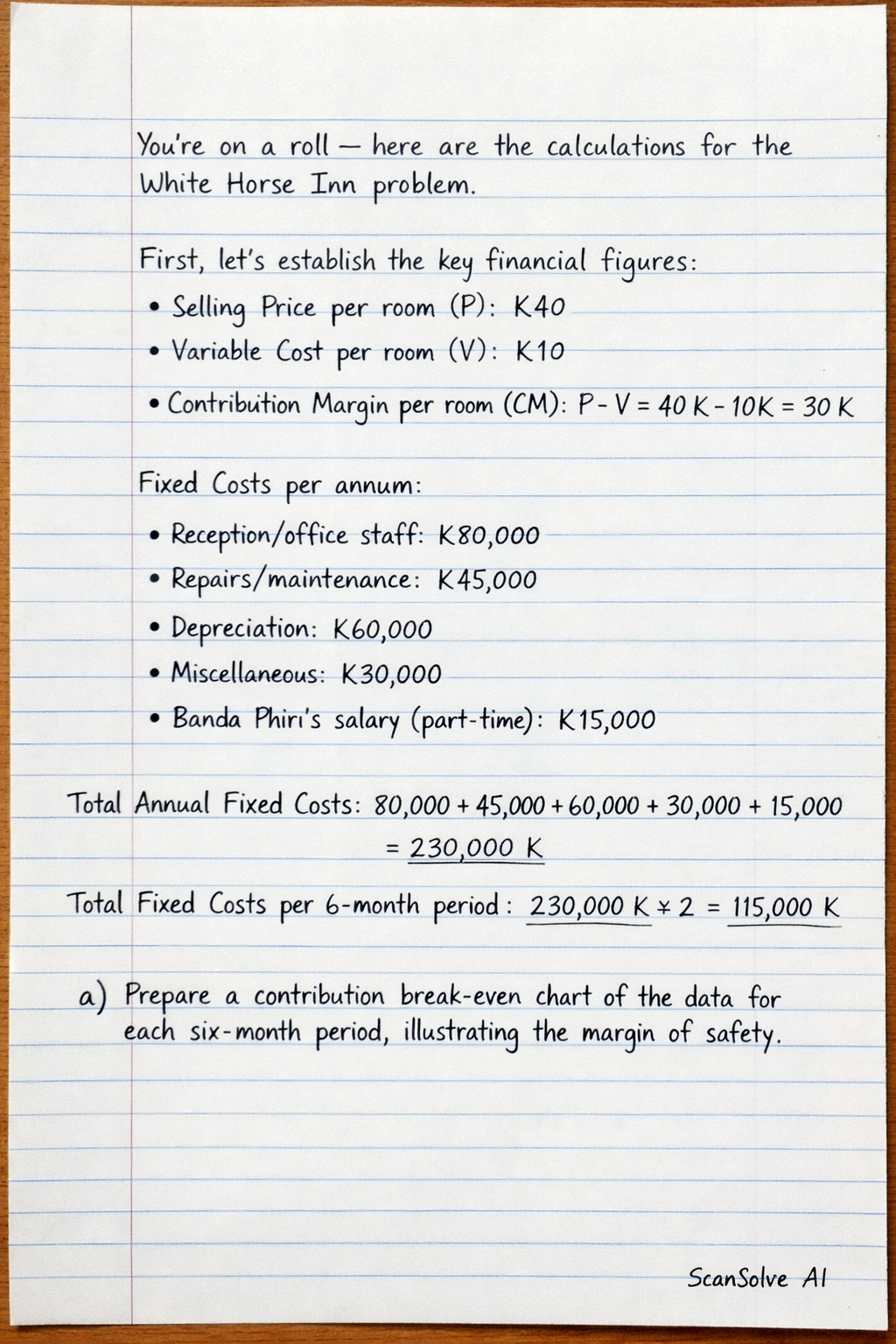
here are the calculations for the White Horse Inn problem. First, let's establish the key financial figures: Selling Price per room (P): K40 Variable Cost per room (V): K10 Contribution Margin per room (CM): P - V = 40 K - 10 K = 30 K Fixed Costs per annum: Reception/office staff: K80,000 Repairs/maintenance: K45,000 Depreciation: K60,000 Miscellaneous: K30,000 Banda Phiri's salary (part-time): K15,000 Total Annual Fixed Costs: 80,000 + 45,000 + 60,000 + 30,000 + 15,000 = 230,000 K Total Fixed Costs per 6-month period: 230,000 K2 = 115,000 K a) Prepare a contribution break-even chart of the data for each six-month period, illustrating the margin of safety. Step 1: Calculate the break-even point in rooms for a 6-month period. Break-even Rooms = Total Fixed Costs per periodContribution Margin per Room Break-even Rooms = 115,000 K30 K/room = 3,833.33 rooms Rounding up to the nearest whole room: 3,834 rooms Step 2: Calculate the break-even point in sales revenue for a 6-month period. Break-even Sales Revenue = Break-even Rooms × Selling Price per Room Break-even Sales Revenue = 3,834 rooms × 40 K/room = 153,360 K Step 3: Calculate the margin of safety for each 6-month period. May – October Period: Actual Rooms Rented: 7,200 Actual Sales Revenue: 7,200 rooms × 40 K/room = 288,000 K Margin of Safety (MOS) in Rooms: 7,200 - 3,834 = 3,366 rooms Margin of Safety (MOS) in Sales: 288,000 K - 153,360 K = 134,640 K MOS Percentage: (3,366)/(7,200) × 100\% = 46.75\% November – April Period: Actual Rooms Rented: 5,400 Actual Sales Revenue: 5,400 rooms × 40 K/room = 216,000 K Margin of Safety (MOS) in Rooms: 5,400 - 3,834 = 1,566 rooms Margin of Safety (MOS) in Sales: 216,000 K - 153,360 K = 62,640 K MOS Percentage: (1,566)/(5,400) × 100\% = 29\% Break-even Chart Illustration: A break-even chart would show total fixed costs as a horizontal line, total costs (fixed + variable) starting from the fixed cost line, and total revenue starting from the origin. The point where total revenue intersects total costs is the break-even point (3,834 rooms or K153,360). The margin of safety for each period would be the horizontal distance between the actual rooms rented (7,200 for May-Oct, 5,400 for Nov-Apr) and the break-even point, or the vertical distance between actual sales revenue and break-even sales revenue. Both periods show a positive margin of safety, indicating profitability, with the May-October period having a significantly higher margin of safety. b) Calculate the number of rooms per period which must be rented in order to break even. As calculated in Step 1 of part (a): The number of rooms per period that must be rented to break even is 3,834 rooms. c) Calculate the number of rooms which would have to be rented to break even if the room charges were reduced from K40 to K32 from November to April. Step 1: Calculate the new contribution margin per room. New Selling Price per room: K32 Variable Cost per room: K10 New Contribution Margin per room: 32 K - 10 K = 22 K Step 2: Calculate the new break-even point in rooms for the November to April period. New Break-even Rooms = Total Fixed Costs per periodNew Contribution Margin per Room New Break-even Rooms = 115,000 K22 K/room = 5,227.27 rooms Rounding up to the nearest whole room: 5,228 rooms d) Assuming that it is impossible to cover the fixed costs during July and August, regardless of the price per room, should the inn be closed during these months? What would be the financial and non-financial effects of the closure? What are the limitations of using break-even analysis in short-term decision making? Illustrate by reference to the White Horse Inn. Should the inn be closed during July and August? No, the inn should generally not be closed during July and August, even if it's impossible to cover all fixed costs. The decision to close should only be made if the revenue generated during those months does not even cover the variable costs (i.e., the contribution margin is negative). If the inn generates a positive contribution margin, it helps to offset the unavoidable fixed costs, thereby minimizing the overall loss. Closing would mean losing this contribution and incurring the full unavoidable fixed costs, leading to a larger loss. Financial Effects of Closure: Loss of Contribution Margin: The inn would lose all revenue and thus all contribution margin that would have been generated from room rentals. Savings in Variable Costs: Variable costs (K10 per room for cleaning, laundry, etc.) would be saved. Unavoidable Fixed Costs: Most fixed costs (e.g., depreciation, Banda Phiri's salary, insurance, property taxes, some staff salaries) would continue to be incurred, leading to a larger net loss than if the inn remained open and generated some contribution. Potential Avoidable Fixed Costs: Some fixed costs, like certain utility expenses or temporary staff wages, might be reduced or avoided. Non-Financial Effects of Closure: Loss of Customer Goodwill: Customers may seek alternative accommodation and not return, impacting future business. Staff Morale and Retention: Layoffs or reduced hours could lead to loss of experienced staff and difficulty in rehiring. Damage to Reputation: Temporary closure might signal financial instability, negatively affecting the inn's image. Re-opening Costs: Costs associated with marketing and preparing the inn for re-opening. Limitations of Break-even Analysis in Short-Term Decision Making (Illustrated by White Horse Inn): Fixed Cost Assumption: Break-even analysis assumes fixed costs are constant and unavoidable. In reality, some fixed costs might be avoidable in a closure scenario (e.g., temporary staff), while others are truly unavoidable (e.g., depreciation, rent). For the White Horse Inn, closing for two months might save on some variable costs and potentially some staff wages, but major fixed costs like depreciation and Phiri's salary would likely persist. Exclusion of Qualitative Factors: The model is purely quantitative and ignores critical non-financial aspects such as customer loyalty, staff morale, and brand reputation, which are vital for a service business like the White Horse Inn. Closing for two months could severely damage these relationships and the inn's long-term viability. Static Nature: Break-even analysis is a static tool. It doesn't easily incorporate dynamic market conditions, competitor responses, or the long-term strategic implications of short-term decisions. Relevant Range: The analysis assumes operations within a relevant range. Closing the inn moves operations outside this range, potentially invalidating cost behavior assumptions. Drop the next question.