

This business/management problem is solved step by step below, with detailed explanations to help you understand the method and arrive at the correct answer.
ScanSolve AI Answer
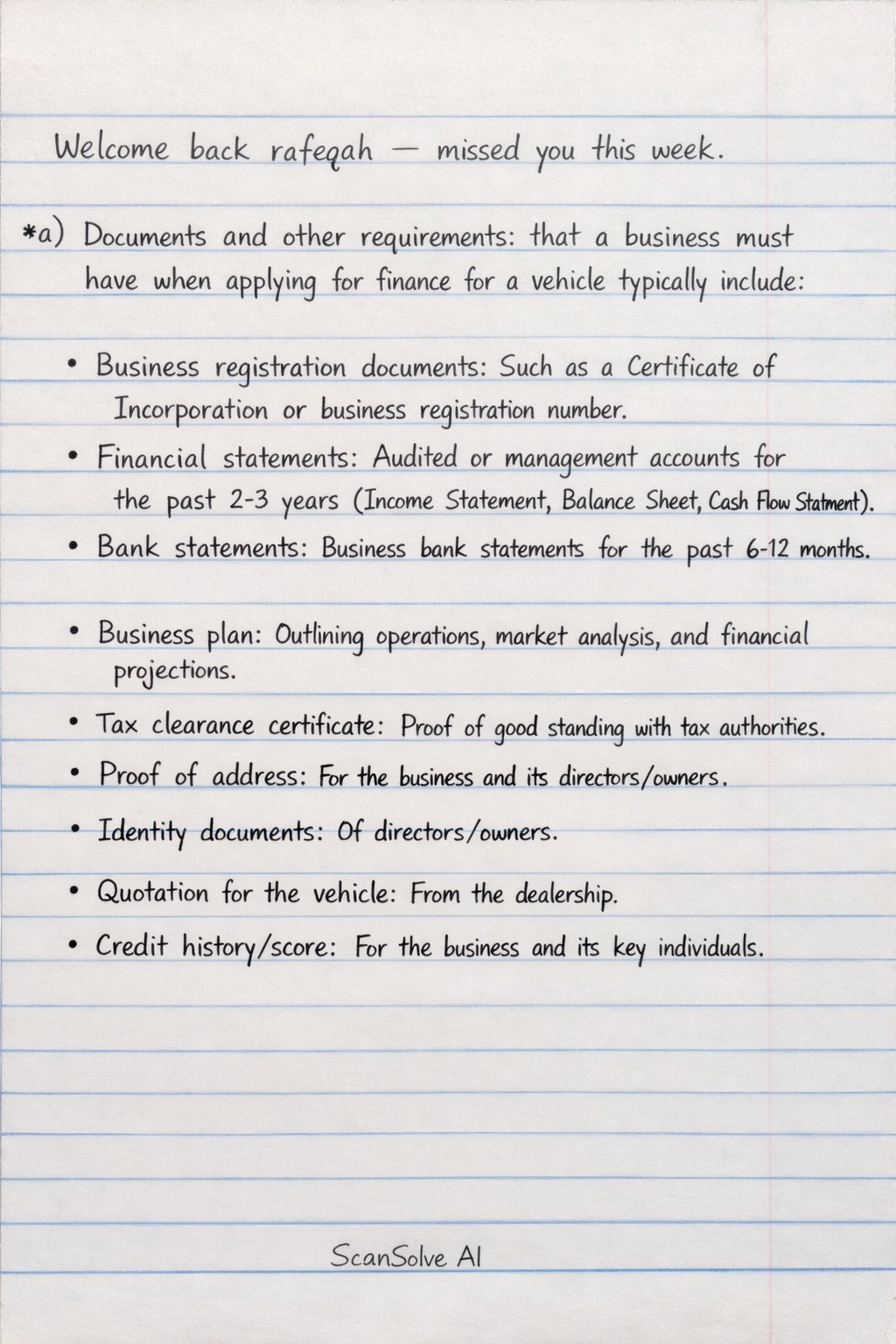
a) Documents and other requirements that a business must have when applying for finance for a vehicle typically include: • Business registration documents: Such as a Certificate of Incorporation or business registration number. • Financial statements: Audited or management accounts for the past 2-3 years (Income Statement, Balance Sheet, Cash Flow Statement). • Bank statements: Business bank statements for the past 6-12 months. • Business plan: Outlining operations, market analysis, and financial projections. • Tax clearance certificate: Proof of good standing with tax authorities. • Proof of address: For the business and its directors/owners. • Identity documents: Of directors/owners. • Quotation for the vehicle: From the dealership. • Credit history/score: For the business and its key individuals. b) Possible "extras" the business might ask for when requesting a quotation could include: • Service plan: Covering routine maintenance for a specified period or mileage. • Extended warranty: Beyond the standard manufacturer's warranty. • Insurance: Comprehensive vehicle insurance. • Accessories: Such as a tow bar, roof rack, specialized interior fittings, or branding/signage. • Delivery charges: If the vehicle needs to be transported to a specific location. • On-road costs: Including licensing, registration, and number plates. c) There is a substantial difference between the purchase price and the total the business will pay for the vehicle primarily due to the cost of financing. This difference includes: • Interest charges: The cost of borrowing money over the loan term. • Initiation fees: A once-off fee charged by the lender to set up the loan. • Monthly administration fees: Fees charged by the lender for managing the loan account. • Compulsory insurance: Such as credit life insurance or comprehensive vehicle insurance, which may be bundled into the finance agreement. • Balloon payment (if applicable): A large lump sum payment at the end of the loan term, which reduces monthly installments but means a portion of the principal is deferred. d) The number of years it will take to pay off the vehicle cannot be determined from the information provided. This requires details such as the loan term, the loan amount, and the monthly repayment schedule. e) The total interest that Honey Bee Bakery must pay for the vehicle cannot be determined from the information provided. This requires the principal loan amount, the interest rate, and the loan term. f) A Balloon payment is a lump sum payment due at the end of a loan term, typically used in vehicle finance. It allows for lower monthly installments during the loan period because a portion of the principal is deferred to the end. Advice for Honey Bee Bakery: • Pros: Lower monthly payments can improve cash flow, which might be beneficial for a business like a bakery that needs to manage daily operational expenses. It also allows the business to acquire a more expensive vehicle than it might otherwise afford with traditional financing. • Cons: The business must be prepared for a large payment at the end of the term. If they cannot afford it, they might need to refinance the balloon amount (potentially at a higher interest rate) or sell the vehicle. This option carries a risk if future cash flow is uncertain. • Recommendation: Honey Bee Bakery should only use a balloon payment option if they have a clear plan and sufficient confidence in their future cash flow to either pay off the balloon amount or refinance it under favorable terms. If their financial projections are stable and they prioritize immediate cash flow, it could be a viable option. Otherwise, a traditional loan with consistent payments might be safer. g) To prepare an asset register, we need specific details like the vehicle's description, purchase price, and serial number. Since these are not provided, I will outline the structure and use a hypothetical purchase price of R200,000 to illustrate. Honey Bee Bakery - Asset Register (Extract) | Asset ID | Asset Description | Date Acquired | Cost (Purchase Price) | Accumulated Depreciation (Start of Year) | Depreciation for the Year | Carrying Value (End of Year) | | :------- | :---------------- | :------------ | :-------------------- | :-------------------------------------- | :------------------------ | :-------------------------- | | V001 | Delivery Van | 1 March [Current Year] | R200,000 | R0 | R40,000 | R160,000 | Note: The "Depreciation for the Year" and "Carrying Value (End of Year)" are calculated based on the information in part h) and a hypothetical purchase price of R200,000. h) Honey Bee Bakery's financial year ends on 28 February. The vehicle is purchased on 1 March of the current year. The depreciation rate is 20% p.a. using the diminishing balance method. Step 1: Determine the depreciable amount for the first year. Since the vehicle is purchased on 1 March and the financial year ends on 28 February, the first depreciation period will be for a full year (March 1st to February 28th of the following year). The diminishing balance method applies the depreciation rate to the carrying value (cost less accumulated depreciation). In the first year, the carrying value is the original cost. Assuming a hypothetical purchase price of R200,000: Depreciation = Cost × Depreciation Rate Depreciation = R200,000 × 20\% Depreciation = R40,000 Step 2: Calculate the carrying value at the end of the first financial year. Carrying Value = Cost - Depreciation Carrying Value = R200,000 - R40,000 Carrying Value = R160,000 The depreciation for the first financial year (ending 28 February of the following year) is R40,000, and the carrying value at that point is R160,000. What's next? 📸