Professional accountants do not need to ensure that this is incorporated into a new system:

Economics
Professional accountants do not need to ensure that this is incorporated into a new system:

ScanSolve AI Answer

Answer

d. Computerized auditing techniques

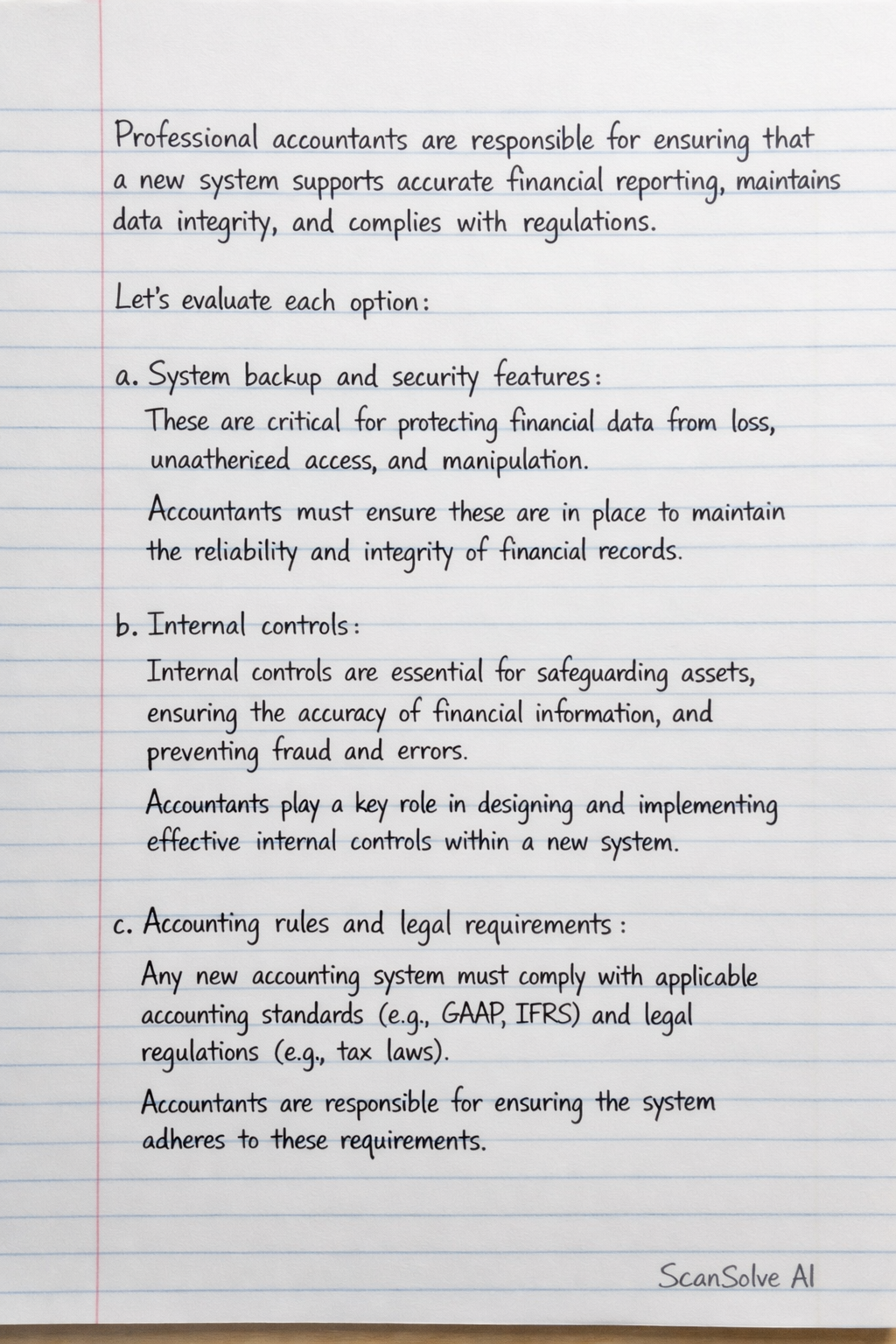
Professional accountants are responsible for ensuring that a new system supports accurate financial reporting, maintains data integrity, and complies with regulations.

Let's evaluate each option:

  • a. System backup and security features: These are critical for protecting financial data from loss, unauthorized access, and manipulation. Accountants must ensure these are in place to maintain the reliability and integrity of financial records.
  • b. Internal controls: Internal controls are essential for safeguarding assets, ensuring the accuracy of financial information, and preventing fraud and errors. Accountants play a key role in designing and implementing effective internal controls within a new system.
  • c. Accounting rules and legal requirements: Any new accounting system must comply with applicable accounting standards (e.g., GAAP, IFRS) and legal regulations (e.g., tax laws). Accountants are responsible for ensuring the system adheres to these requirements.
  • d. Computerized auditing techniques: These are tools and methods used by auditors to examine and test the system and its data. While a system should be designed to be auditable, the specific computerized auditing techniques are primarily the concern of the auditors who will perform the audit, not necessarily features that professional accountants (who are often involved in the system's design and implementation for operational use) need to incorporate into the system itself. Accountants ensure the system produces reliable data; auditors use techniques to verify that data.

Therefore, professional accountants do not primarily need to ensure that computerized auditing techniques are incorporated into a new system, but rather that the system is designed in a way that facilitates auditing.

The final answer is d.Computerizedauditingtechniques\boxed{d. Computerized auditing techniques}

Was this helpful?

Need help with your own homework?

Get instant step-by-step solutions to any question. Free to start.

Ask Your Question
Handwritten step-by-step solution preview

Handwritten Step-by-Step Solution

Get this as a handwritten image on WhatsApp — like a tutor wrote it for you.

Try on WhatsApp

Still have questions?

Quick Answer

Professional accountants are responsible for ensuring that a new system supports accurate financial reporting, maintains data integrity, and complies with regulations.

Professional accountants do not need to ensure that this is incorporated into a new system:
Economics

This economics question tests your understanding of economic models and analysis. The step-by-step answer below applies the relevant framework and explains the reasoning.

ScanSolve AI Answer
Professional accountants are responsible for ensuring that a new system supports accurate financial reporting, maintains data integrity, and complies with regulations. Let's evaluate each option: a. System backup and security features: These are critical for protecting financial data from loss, unauthorized access, and manipulation. Accountants must ensure these are in place to maintain the reliability and integrity of financial records. b. Internal controls: Internal controls are essential for safeguarding assets, ensuring the accuracy of financial information, and preventing fraud and errors. Accountants play a key role in designing and implementing effective internal controls within a new system. c. Accounting rules and legal requirements: Any new accounting system must comply with applicable accounting standards (e.g., GAAP, IFRS) and legal regulations (e.g., tax laws). Accountants are responsible for ensuring the system adheres to these requirements. d. Computerized auditing techniques: These are tools and methods used by auditors* to examine and test the system and its data. While a system should be designed to be auditable, the specific computerized auditing techniques are primarily the concern of the auditors who will perform the audit, not necessarily features that professional accountants (who are often involved in the system's design and implementation for operational use) need to incorporate into the system itself. Accountants ensure the system produces reliable data; auditors use techniques to verify that data. Therefore, professional accountants do not primarily need to ensure that computerized auditing techniques are incorporated into a new system, but rather that the system is designed in a way that facilitates auditing. The final answer is d. Computerized auditing techniques