
Q2. A trader bought goods for GH₵500 and sold them for GH₵650. Find the percentage profit. b) Find the simple interest on GH₵1000 at 5% per annum for 3 years. Q3. a) The marks obtained by 10 students are: 12, 15, 10, 18, 20, 15, 17, 19, 14, 10 i. Find the mean ii. Find the mode b) Find the range of the data. Q4. a) A point B is on a bearing of 060° from A. Find the bearing of A from B. b) A man walks 5 km east and then 12 km north. Find the distance from the starting point.
Business/Management
ScanSolve AI Answer
Step-by-step solution
6 stepshere are the solutions to your math questions.
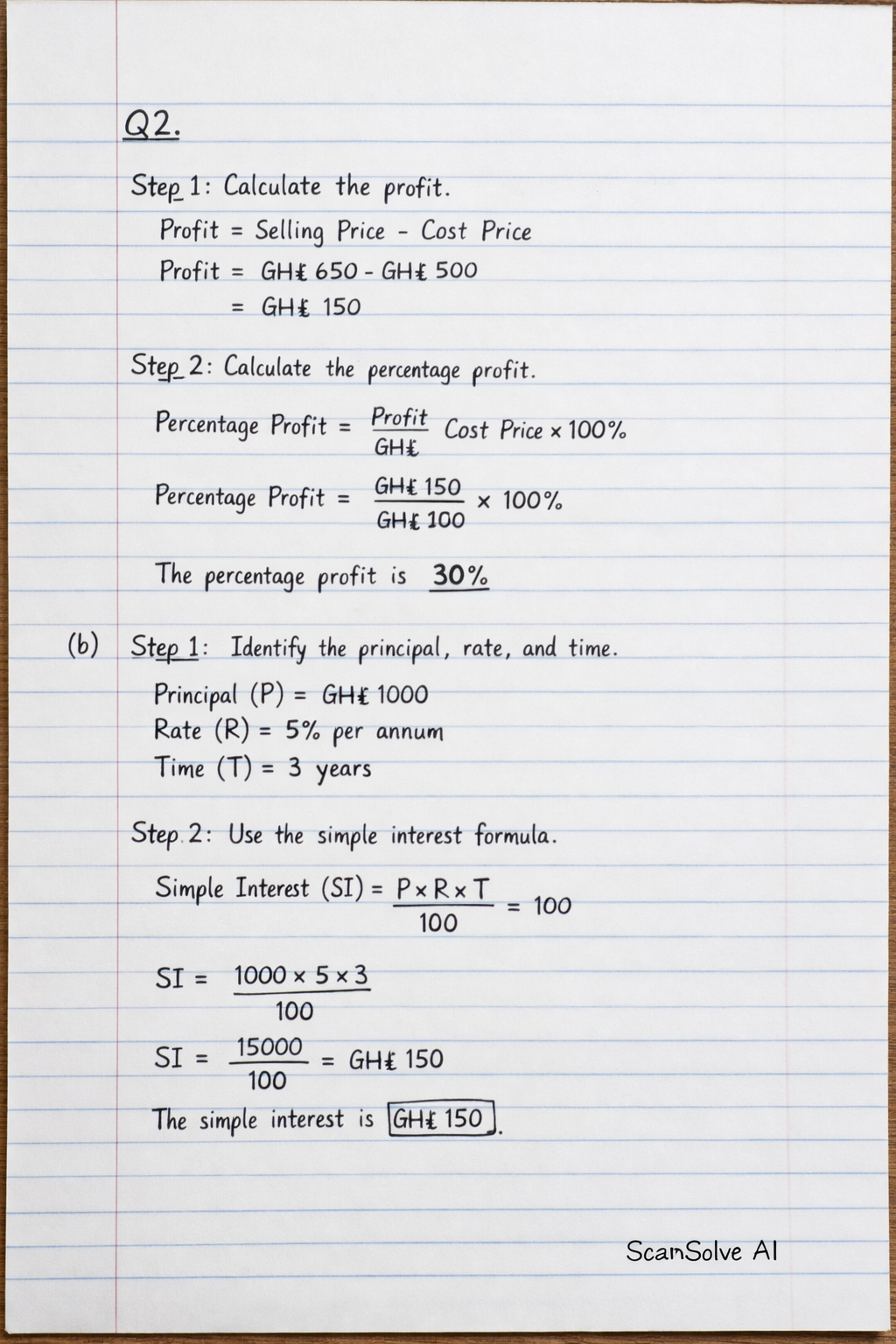
Q2.
-
a) Step 1: Calculate the profit.
-
Step 2: Calculate the percentage profit.
The percentage profit is .
-
b) Step 1: Identify the principal, rate, and time. Principal () = GH₵1000 Rate () = 5% per annum Time () = 3 years
-
Step 2: Use the simple interest formula.
-
Step 3: Calculate the simple interest.
The simple interest is .
Q3.
- a) The marks obtained by 10 students are: 12, 15, 10, 18, 20, 15, 17, 19, 14, 10.
Part i· 1 step
Step 1: Sum all the marks.
    $$
    \text{Sum} = 12 + 15 + 10 + 18 + 20 + 15 + 17 + 19 + 14 + 10 = 150
    $$
Calculate the mean.
    $$
    \text{Mean} = \frac{\text{Sum of marks}}{\text{Number of students}} = \frac{150}{10} = 15
    $$
    The mean mark is $\boxed{15}$.
Part ii· 5 steps
Step 1: Identify the frequency of each mark.
    10 appears 2 times.
    12 appears 1 time.
    14 appears 1 time.
    15 appears 2 times.
    17 appears 1 time.
    18 appears 1 time.
    19 appears 1 time.
    20 appears 1 time.
Determine the mark(s) that appear most frequently.
Both 10 and 15 appear 2 times, which is the highest frequency. The mode is $\boxed{10 \text{ and } 15}$.- b) Step 1: Identify the highest and lowest marks from the data. Highest mark = 20 Lowest mark = 10
Calculate the range.
$$ \text{Range} = \text{Highest mark} - \text{Lowest mark} $$ $$ \text{Range} = 20 - 10 = 10 $$ The range of the data is $\boxed{10}$.Q4.
- a) Step 1: Understand the relationship between bearings. If the bearing of B from A is , then the bearing of A from B is if , or if .
Apply the rule for the given bearing.
Given bearing of B from A = $060^\circ$. Since $060^\circ < 180^\circ$, we add $180^\circ$. $$ \text{Bearing of A from B} = 060^\circ + 180^\circ = 240^\circ $$ The bearing of A from B is $\boxed{240^\circ}$.- b) Step 1: Visualize the movement as a right-angled triangle. The man walks 5 km East (one leg of the triangle) and 12 km North (the other leg of the triangle). The distance from the starting point is the hypotenuse.
Use the Pythagorean theorem ().
Let $a = 5$ km and $b = 12$ km. Let $c$ be the distance from the starting point. $$ c^2 = (5 \text{ km})^2 + (12 \text{ km})^2 $$ $$ c^2 = 25 \text{ km}^2 + 144 \text{ km}^2 $$ $$ c^2 = 169 \text{ km}^2 $$Solve for .
$$
c = \sqrt{169 \text{ km}^2}
$$
$$
c = 13 \text{ km}
$$
The distance from the starting point is $\boxed{13 \text{ km}}$.
Was this helpful?
Still stuck on this one?
Ask a follow-up, and the answer starts from this question.
Got a different question?Ask your own question
More Business/Management Questions
QBECE 2026 MATHEMATICS HEAT QUESTIONS ✅ SOLVE Q1. A student scored 45 marks in a test which is 60%…QSolve the following problems related to profit and loss: 1. If the cost price is Gh¢12.50 and the…QQUESTION ONE Volta Agro Processing Ltd paid a dividend of GH¢0.25 per share last year (Do). The…QCalculate the simple interest on GHS 600.00 at a rate of 5% per annum for 8 months.QHere is your INCREASE & DECREASE - 5 Exam Questions + Memo - Grade 8 level. --- PRACTICE TEST - 20…
Handwritten Step-by-Step Solution
Get this as a handwritten image on WhatsApp — like a tutor wrote it for you.
Try on WhatsApp