
We read your photo as:
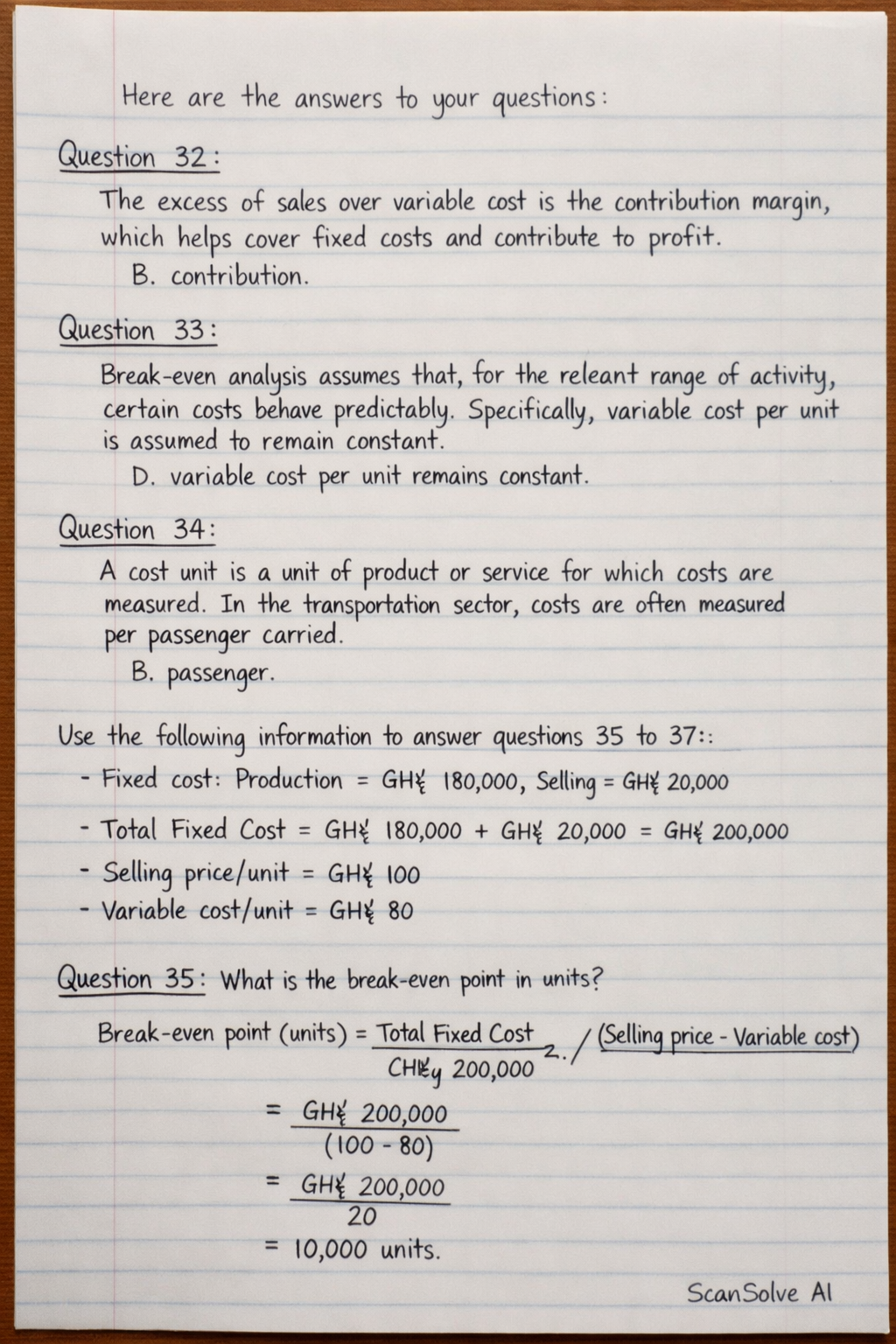
Question 32: The excess of sales over variable cost is the contribution margin, which helps cover fixed costs and contribute to profit.
ScanSolve AI Answer
Step-by-step solution
4 stepsHere are the answers to your questions:
Part 32
The excess of sales over variable cost is the contribution margin, which helps cover fixed costs and contribute to profit.
- B. contribution
Part 33
Break-even analysis assumes that, for the relevant range of activity, certain costs behave predictably. Specifically, variable cost per unit is assumed to remain constant.
- D. variable cost per unit remains constant.
Part 34
A cost unit is a unit of product or service for which costs are measured. In the transportation sector, costs are often measured per passenger carried.
- B. passenger
Use the following information to answer questions 35 to 37:
- Fixed cost: Production = GH¢ 180,000, Selling = GH¢ 20,000
- Total Fixed Cost = GH¢
- Selling price/unit = GH¢ 100
- Variable cost/unit = GH¢ 80
Part 35· 2 steps
What is the break-even point in units?
Calculate the contribution per unit.
The contribution per unit is the selling price per unit minus the variable cost per unit.
Calculate the break-even point in units.
The break-even point in units is the total fixed costs divided by the contribution per unit.
- C. 10,000 units
Part 36· 1 step
Determine the contribution to sales ratio.
Calculate the contribution to sales ratio.
The contribution to sales ratio (or P/V ratio) is the contribution per unit divided by the selling price per unit.
This can be expressed as a ratio of 1:5.
- B. 1:5
Part 37· 1 step
A desired sales to achieve a target profit of GH¢ 6,000 is
Calculate the number of units needed to achieve the target profit.
The number of units required to achieve a target profit is calculated by adding the target profit to the total fixed costs and then dividing by the contribution per unit.
Assuming the "GH¢" in option D is a typo and it refers to units.
- D. GH¢ 10,300 (interpreted as 10,300 units)
Part 38
The procedure for budget preparation typically starts with setting clear objectives that the budget aims to achieve.
- D. identifying objectives to achieve.
Part 39
A limiting factor is a constraint that restricts an organization's activities. In capital expenditure budgeting, the most common limiting factor is the availability of funds.
- D. non-availability of funds.
Still stuck on this one?
Ask a follow-up, and the answer starts from this question.
More Business/Management Questions
Handwritten Step-by-Step Solution
Get this as a handwritten image on WhatsApp — like a tutor wrote it for you.
Try on WhatsApp