
We read your photo as:
Question (iii) - Project Management Terms
ScanSolve AI Answer
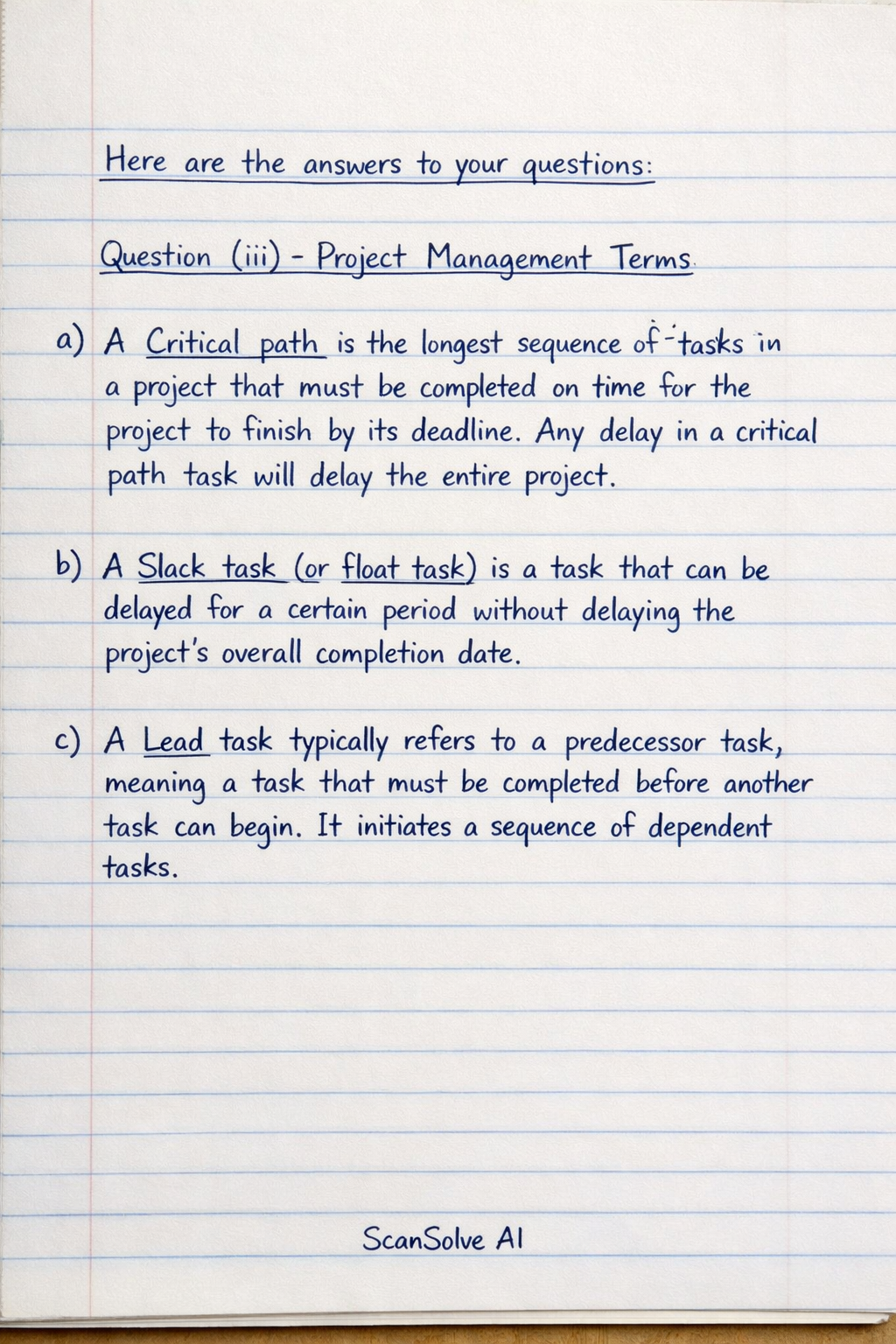
Here are the answers to your questions:
Question (iii) - Project Management Terms
a) A Critical path is the longest sequence of tasks in a project that must be completed on time for the project to finish by its deadline. Any delay in a critical path task will delay the entire project.
b) A Slack task (or float task) is a task that can be delayed for a certain period without delaying the project's overall completion date.
c) A Lead task typically refers to a predecessor task, meaning a task that must be completed before another task can begin. It initiates a sequence of dependent tasks.
Question (i) - Computer Ergonomics
a) Computer ergonomics is the science of designing and arranging computer workstations, products, and environments to fit the user. Its goal is to maximize productivity while reducing discomfort, fatigue, and the risk of injury.
b) Two ergonomics advice for a school laboratory:
- Provide adjustable chairs that allow students to adjust seat height and back support. This solves the problem of poor posture and back pain by enabling students to maintain proper spinal alignment and foot support.
- Ensure monitors are placed at the correct height and distance. This solves the problem of eye strain and neck pain by positioning the screen so the top is at or slightly below eye level and at arm's length, reducing the need to strain the neck or eyes.
c) Two health problems caused by prolonged eye to monitor contact:
- Eye strain (also known as Computer Vision Syndrome), which can manifest as dry eyes, blurred vision, and general eye discomfort.
- Headaches, often resulting from eye strain, glare from the screen, or poor lighting conditions in the workspace.
Question (ii) - Data Security Terms
a) Data encryption is the process of converting data into a coded format to prevent unauthorized access. It transforms readable data into an unreadable form, requiring a decryption key to revert it to its original state.
b) Data verification is the process of checking data for accuracy and consistency after it has been entered or transferred. It ensures that the data is correct, complete, and matches its original source.
c) Scamming refers to a deceptive scheme used to trick individuals into giving away money, personal information, or other valuables. This often occurs through fraudulent emails, websites, or phone calls.
Question (iii) - Computer Components and Processing Power
Three components and how they influence processing power:
- CPU (Central Processing Unit): The CPU is the "brain" of the computer, executing instructions and performing calculations. A faster CPU with more cores and a higher clock speed can process more instructions per second, directly increasing the computer's overall processing power.
- RAM (Random Access Memory): RAM stores data that the CPU needs to access quickly for active tasks. More RAM allows the computer to run more applications simultaneously and handle larger datasets without slowing down, thereby improving multitasking capabilities and overall processing efficiency.
- Storage (SSD/HDD): The speed of the storage device (e.g., Solid State Drive or Hard Disk Drive) influences how quickly data can be read from and written to the disk. A faster SSD significantly reduces boot times, application loading times, and file transfer speeds, making the computer feel more responsive and efficient in processing tasks that involve frequent data access.
Still stuck on this one?
Ask a follow-up, and the answer starts from this question.
More Business/Management Questions
Handwritten Step-by-Step Solution
Get this as a handwritten image on WhatsApp — like a tutor wrote it for you.
Try on WhatsApp