
We read your photo as:
Does the described undertaking qualify as a project and what project performance dimensions are applicable?
Business/Management
ScanSolve AI Answer
Answer
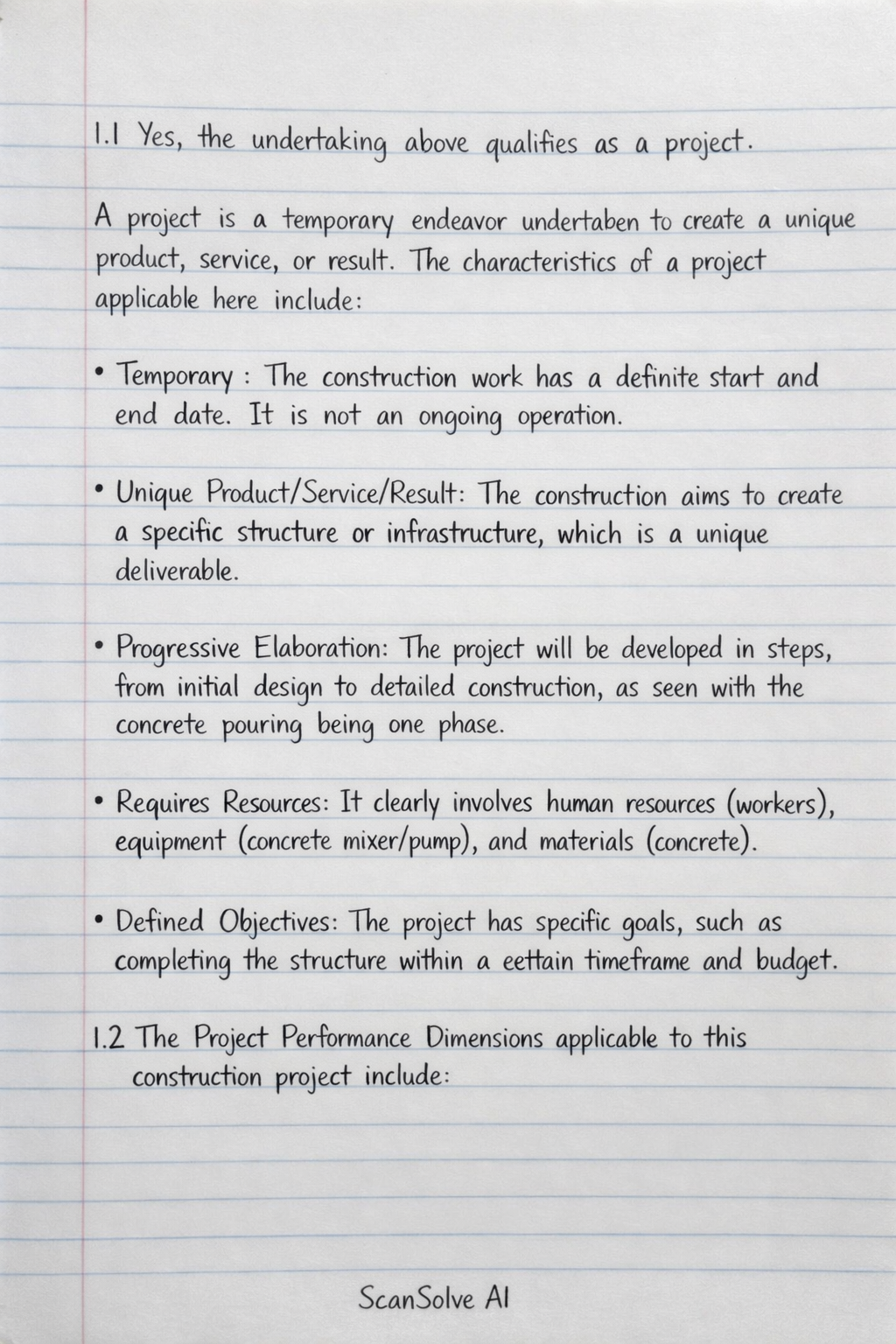
1.1 Yes, the undertaking above qualifies as a project.
A project is a temporary endeavor undertaken to create a unique product, service, or result. The characteristics of a project applicable here include:
- Temporary: The construction work has a definite start and end date. It is not an ongoing operation.
- Unique Product/Service/Result: The construction aims to create a specific structure or infrastructure, which is a unique deliverable.
- Progressive Elaboration: The project will be developed in steps, from initial design to detailed construction, as seen with the concrete pouring being one phase.
- Requires Resources: It clearly involves human resources (workers), equipment (concrete mixer/pump), and materials (concrete).
- Defined Objectives: The project has specific goals, such as completing the structure within a certain timeframe and budget.
1.2 The Project Performance Dimensions applicable to this construction project include:
- Scope: This defines what needs to be built. For this project, it would include the specific design, features, and boundaries of the structure being constructed (e.g., the length and width of a road, the number of floors in a building).
- Time: This refers to the schedule for completing the project. The construction must be finished by a specific deadline, requiring careful planning and management of activities like concrete pouring.
- Cost: This is the budget allocated for the project. It includes expenses for labor, materials (like concrete), equipment, and other overheads, which must be managed to avoid overruns.
- Quality: This dimension ensures the standards of the deliverables. For construction, it means the concrete must meet specific strength requirements, the structure must be safe, and the finish must be satisfactory.
- Resources: These are the people, equipment, and materials needed. In the image, workers and concrete pouring equipment are visible, and concrete is a key material resource.
- Risk: This involves identifying and managing potential uncertainties that could impact the project, such as weather delays, material shortages, equipment breakdowns, or safety incidents on the construction site.
1.3 The project life cycle that this project will follow typically consists of five main phases: Initiation, Planning, Execution, Monitoring & Controlling, and Closure.
Here is a discussion of each phase:
- Initiation: In this phase, the project's feasibility is assessed, and the project charter is developed. For this construction project, it would involve defining the project's purpose (e.g., building a new road or foundation), identifying key stakeholders, and obtaining initial approvals.
- Planning: This phase involves detailed planning of all project activities. For construction, this includes creating architectural designs, engineering specifications, developing a detailed schedule, budgeting, identifying required resources (labor, materials, equipment), and planning for quality and risk management.
- Execution: This is where the actual work of the project is carried out. As seen in the image, this phase involves activities like site preparation, foundation work, pouring concrete, erecting structures, and installing utilities, all according to the plans.
- Monitoring & Controlling: This phase runs concurrently with execution. It involves tracking project progress against the plan, managing changes, ensuring quality standards are met, monitoring costs and schedules, and addressing any issues or risks that arise. Regular inspections and progress reports are crucial here.
- Closure: In the final phase, the project is formally completed and handed over. For a construction project, this includes final inspections, obtaining necessary permits and certifications, handing over the completed structure to the client, documenting lessons learned, and releasing project resources.
Was this helpful?
Still stuck on this one?
Ask a follow-up, and the answer starts from this question.
Got a different question?Ask your own question
More Business/Management Questions
QQuestion (iii) - Project Management TermsQThe Product Line Extension criterion evaluates a project based on:QWhat are the key performance indicators for project success and how is a risk assessment conducted…QCan you detail the guidelines and report format for a mini-project focusing on IT solutions for…QExplain in details your understanding of Project as a terminology used in Project Management…
Handwritten Step-by-Step Solution
Get this as a handwritten image on WhatsApp — like a tutor wrote it for you.
Try on WhatsApp