Simplify the following expressions: 5.1 9y⁰ + (9y)⁰ × (-1)⁹, 5.2 (-2ab²)³, 5.3 (-30x¹⁰y³)/(3x⁵y²), 5.4 (3ab⁶x - (-3ab)⁴)/(3³a⁵b¹⁰), 5.5 ((-2x²y⁴)² × 5xy²)/√(100x⁴y¹⁰), 5.6 ((y² + 1/y⁻²)/(y²x/y⁻²))⁻²

Mathematics
Simplify the following expressions: 5.1 9y⁰ + (9y)⁰ × (-1)⁹, 5.2 (-2ab²)³, 5.3 (-30x¹⁰y³)/(3x⁵y²), 5.4 (3ab⁶x - (-3ab)⁴)/(3³a⁵b¹⁰), 5.5 ((-2x²y⁴)² × 5xy²)/√(100x⁴y¹⁰), 5.6 ((y² + 1/y⁻²)/(y²x/y⁻²))⁻²

ScanSolve AI Answer

Answer

-29

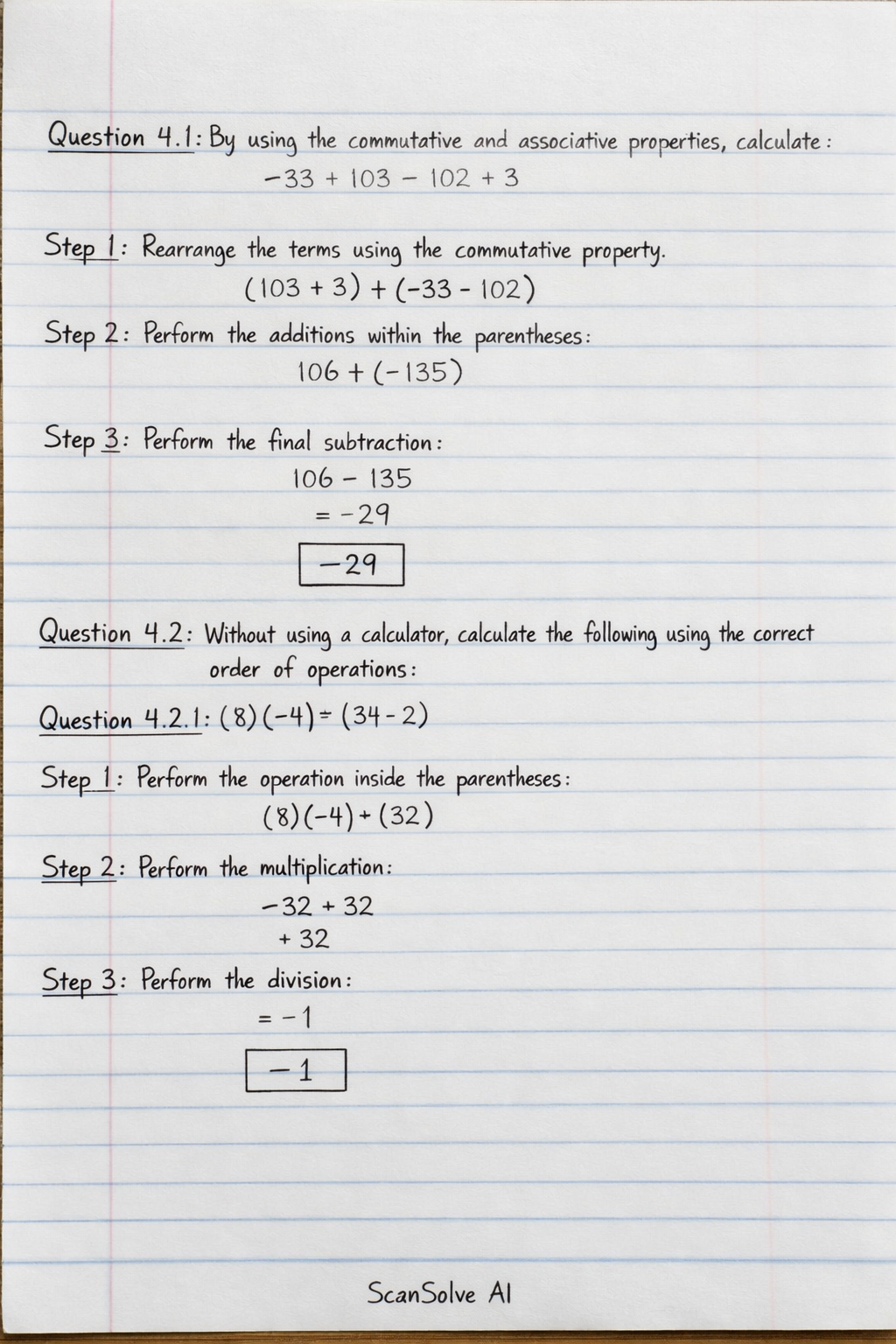
Question 4.1: By using the commutative and associative properties, calculate: 33+103102+3-33 + 103 - 102 + 3 Step 1: Rearrange the terms using the commutative property (a+b=b+aa+b=b+a) to group positive and negative numbers, or numbers that simplify easily. =(103+3)+(33102)= (103 + 3) + (-33 - 102) Step 2: Perform the additions within the parentheses. =106+(135)= 106 + (-135) Step 3: Perform the final subtraction. =106135= 106 - 135 =29= -29 29\boxed{-29}

Question 4.2: Without using a calculator, calculate the following using the correct order of operations:

Question 4.2.1: (8)(4)÷(342)(8)(-4) \div (34-2) Step 1: Perform the operation inside the parentheses first. =(8)(4)÷(32)= (8)(-4) \div (32) Step 2: Perform the multiplication. =32÷32= -32 \div 32 Step 3: Perform the division. =1= -1 1\boxed{-1}

Question 4.2.2: 64+162731253\frac{\sqrt{64} + \sqrt{16}}{\sqrt[3]{27} - \sqrt[3]{125}} Step 1: Calculate the square roots in the numerator. 64=8\sqrt{64} = 8 16=4\sqrt{16} = 4 Step 2: Calculate the cube roots in the denominator. 273=3\sqrt[3]{27} = 3 1253=5\sqrt[3]{125} = 5 Step 3: Substitute these values back into the expression. =8+435= \frac{8 + 4}{3 - 5} Step 4: Perform the addition in the numerator and the subtraction in the denominator. =122= \frac{12}{-2} Step 5: Perform the division. =6= -6 6\boxed{-6}

Question 5: Simplify

Question 5.1: 9y0+(9y)0×(1)99y^0 + (9y)^0 \times (-1)^9 Step 1: Apply the exponent rule a0=1a^0 = 1 (for a0a \neq 0). Assume y0y \neq 0. y0=1y^0 = 1 (9y)0=1(9y)^0 = 1 Step 2: Calculate (1)9(-1)^9. An odd power of 1-1 is 1-1. (1)9=1(-1)^9 = -1 Step 3: Substitute these values into the expression. =9(1)+1×(1)= 9(1) + 1 \times (-1) Step 4: Perform the multiplication. =91= 9 - 1 Step 5: Perform the subtraction. =8= 8 8\boxed{8}

Question 5.2: (2ab2)3(-2ab^2)^3 Step 1: Apply the exponent rule (xyz)n=xnynzn(xyz)^n = x^n y^n z^n. =(2)3a3(b2)3= (-2)^3 a^3 (b^2)^3 Step 2: Calculate (2)3(-2)^3 and apply the exponent rule (xm)n=xmn(x^m)^n = x^{mn}. =8a3b2×3= -8 a^3 b^{2 \times 3} =8a3b6= -8 a^3 b^6 8a3b6\boxed{-8a^3b^6}

Question 5.3: 30x10y33x5y2\frac{-30x^{10}y^3}{3x^5y^2} Step 1: Divide the coefficients. =(303)x10y3x5y2= \left(\frac{-30}{3}\right) x^{10}y^3 x^{-5}y^{-2} =10x10y3x5y2= -10 x^{10}y^3 x^{-5}y^{-2} Step 2: Apply the exponent rule xmxn=xm+nx^m x^n = x^{m+n} for variables with the same base. =10x105y32= -10 x^{10-5} y^{3-2} =10x5y1= -10 x^5 y^1 =10x5y= -10 x^5 y 10x5y\boxed{-10x^5y}

Question 5.4: 3ab6×(3ab)433a5b10\frac{3ab^6 \times (-3ab)^4}{3^3 a^5 b^{10}} Step 1: Simplify the term (3ab)4(-3ab)^4 using (xyz)n=xnynzn(xyz)^n = x^n y^n z^n. (3ab)4=(3)4a4b4=81a4b4(-3ab)^4 = (-3)^4 a^4 b^4 = 81 a^4 b^4 Step 2: Substitute this back into the expression and simplify 333^3. =3ab6×81a4b427a5b10= \frac{3ab^6 \times 81a^4b^4}{27 a^5 b^{10}} Step 3: Multiply the terms in the numerator. =(3×81)(a1×a4)(b6×b4)27a5b10= \frac{(3 \times 81) (a^1 \times a^4) (b^6 \times b^4)}{27 a^5 b^{10}} =243a1+4b6+427a5b10= \frac{243 a^{1+4} b^{6+4}}{27 a^5 b^{10}} =243a5b1027a5b10= \frac{243 a^5 b^{10}}{27 a^5 b^{10}} Step 4: Divide the coefficients and apply the exponent rule xmxn=xmn\frac{x^m}{x^n} = x^{m-n}. =(24327)a55b1010= \left(\frac{243}{27}\right) a^{5-5} b^{10-10} =9a0b0= 9 a^0 b^0 Step 5: Apply a0=1a^0 = 1. =9×1×1= 9 \times 1 \times 1 =9= 9 9\boxed{9}

Question 5.5: (2x2y4)2×5xy2100x4y10\frac{(-2x^2y^4)^2 \times 5xy^2}{\sqrt{100x^4y^{10}}} Step 1: Simplify the numerator. (2x2y4)2=(2)2(x2)2(y4)2=4x4y8(-2x^2y^4)^2 = (-2)^2 (x^2)^2 (y^4)^2 = 4x^4y^8 Now multiply by 5xy25xy^2: 4x4y8×5xy2=(4×5)(x4×x1)(y8×y2)4x^4y^8 \times 5xy^2 = (4 \times 5) (x^4 \times x^1) (y^8 \times y^2) =20x4+1y8+2=20x5y10= 20 x^{4+1} y^{8+2} = 20x^5y^{10} Step 2: Simplify the denominator. 100x4y10=100×x4×y10\sqrt{100x^4y^{10}} = \sqrt{100} \times \sqrt{x^4} \times \sqrt{y^{10}} =10×x4/2×y10/2= 10 \times x^{4/2} \times y^{10/2} =10x2y5= 10x^2y^5 Step 3: Combine the simplified numerator and denominator. =20x5y1010x2y5= \frac{20x^5y^{10}}{10x^2y^5} Step 4: Divide the coefficients and apply the exponent rule xmxn=xmn\frac{x^m}{x^n} = x^{m-n}. =(2010)x52y105= \left(\frac{20}{10}\right) x^{5-2} y^{10-5} =2x3y5= 2x^3y^5 2x3y5\boxed{2x^3y^5}

Question 5.6: (y2x1y2xy2)2\left(\frac{y^2x^{-1}}{y^2x y^2}\right)^{-2} Step 1: Simplify the expression inside the parentheses. Combine the terms in the denominator: y2xy2=xy2+2=xy4y^2x y^2 = x y^{2+2} = x y^4. The fraction becomes: y2x1xy4\frac{y^2x^{-1}}{xy^4} Step 2: Apply the exponent rules for division (xmxn=xmn\frac{x^m}{x^n} = x^{m-n}). For xx: x11=x2x^{-1-1} = x^{-2} For yy: y24=y2y^{2-4} = y^{-2} So, the expression inside the parentheses simplifies to:

Was this helpful?

Need help with your own homework?

Get instant step-by-step solutions to any question. Free to start.

Ask Your Question
Handwritten step-by-step solution preview

Handwritten Step-by-Step Solution

Get this as a handwritten image on WhatsApp — like a tutor wrote it for you.

Try on WhatsApp

Still have questions?

Quick Answer

Question 4.1: By using the commutative and associative properties, calculate: -33 + 103 - 102 + 3 Step 1: Rearrange the terms using the commutative property (a+b=b+a) to group positive and negative numbers, or numbers that simplify easily.

Simplify the following expressions: 5.1 9y⁰ + (9y)⁰ × (-1)⁹, 5.2 (-2ab²)³, 5.3 (-30x¹⁰y³)/(3x⁵y²), 5.4 (3ab⁶x - (-3ab)⁴)/(3³a⁵b¹⁰), 5.5 ((-2x²y⁴)² × 5xy²)/√(100x⁴y¹⁰), 5.6 ((y² + 1/y⁻²)/(y²x/y⁻²))⁻²
Mathematics

This mathematics problem involves applying core mathematical principles and formulas. Below you will find a complete step-by-step solution with detailed explanations for each step, helping you understand not just the answer but the method behind it.

ScanSolve AI Answer
Question 4.1: By using the commutative and associative properties, calculate: -33 + 103 - 102 + 3 Step 1: Rearrange the terms using the commutative property (a+b=b+a) to group positive and negative numbers, or numbers that simplify easily. = (103 + 3) + (-33 - 102) Step 2: Perform the additions within the parentheses. = 106 + (-135) Step 3: Perform the final subtraction. = 106 - 135 = -29 -29 Question 4.2: Without using a calculator, calculate the following using the correct order of operations: Question 4.2.1: (8)(-4) ÷ (34-2) Step 1: Perform the operation inside the parentheses first. = (8)(-4) ÷ (32) Step 2: Perform the multiplication. = -32 ÷ 32 Step 3: Perform the division. = -1 -1 Question 4.2.2: sqrt(64) + sqrt(16)[3]27 - [3]125 Step 1: Calculate the square roots in the numerator. sqrt(64) = 8 sqrt(16) = 4 Step 2: Calculate the cube roots in the denominator. [3]27 = 3 [3]125 = 5 Step 3: Substitute these values back into the expression. = (8 + 4)/(3 - 5) Step 4: Perform the addition in the numerator and the subtraction in the denominator. = (12)/(-2) Step 5: Perform the division. = -6 -6 Question 5: Simplify Question 5.1: 9y^0 + (9y)^0 × (-1)^9 Step 1: Apply the exponent rule a^0 = 1 (for a ≠ 0). Assume y ≠ 0. y^0 = 1 (9y)^0 = 1 Step 2: Calculate (-1)^9. An odd power of -1 is -1. (-1)^9 = -1 Step 3: Substitute these values into the expression. = 9(1) + 1 × (-1) Step 4: Perform the multiplication. = 9 - 1 Step 5: Perform the subtraction. = 8 8 Question 5.2: (-2ab^2)^3 Step 1: Apply the exponent rule (xyz)^n = x^n y^n z^n. = (-2)^3 a^3 (b^2)^3 Step 2: Calculate (-2)^3 and apply the exponent rule (x^m)^n = x^mn. = -8 a^3 b^2 × 3 = -8 a^3 b^6 -8a^3b^6 Question 5.3: -30x^10y^33x^5y^2 Step 1: Divide the coefficients. = ((-30)/(3)) x^10y^3 x^-5y^-2 = -10 x^10y^3 x^-5y^-2 Step 2: Apply the exponent rule x^m x^n = x^m+n for variables with the same base. = -10 x^10-5 y^3-2 = -10 x^5 y^1 = -10 x^5 y -10x^5y Question 5.4: (3ab^6 × (-3ab)^4)/(3^3 a^5 b^10) Step 1: Simplify the term (-3ab)^4 using (xyz)^n = x^n y^n z^n. (-3ab)^4 = (-3)^4 a^4 b^4 = 81 a^4 b^4 Step 2: Substitute this back into the expression and simplify 3^3. = (3ab^6 × 81a^4b^4)/(27 a^5 b^10) Step 3: Multiply the terms in the numerator. = ((3 × 81) (a^1 × a^4) (b^6 × b^4))/(27 a^5 b^10) = 243 a^1+4 b^6+427 a^5 b^10 = 243 a^5 b^1027 a^5 b^10 Step 4: Divide the coefficients and apply the exponent rule (x^m)/(x^n) = x^m-n. = ((243)/(27)) a^5-5 b^10-10 = 9 a^0 b^0 Step 5: Apply a^0 = 1. = 9 × 1 × 1 = 9 9 Question 5.5: ((-2x^2y^4)^2 × 5xy^2)/(sqrt(100x^4y^10)) Step 1: Simplify the numerator. (-2x^2y^4)^2 = (-2)^2 (x^2)^2 (y^4)^2 = 4x^4y^8 Now multiply by 5xy^2: 4x^4y^8 × 5xy^2 = (4 × 5) (x^4 × x^1) (y^8 × y^2) = 20 x^4+1 y^8+2 = 20x^5y^10 Step 2: Simplify the denominator. sqrt(100x^4y^10) = sqrt(100) × sqrt(x^4) × sqrt(y^10) = 10 × x^4/2 × y^10/2 = 10x^2y^5 Step 3: Combine the simplified numerator and denominator. = 20x^5y^1010x^2y^5 Step 4: Divide the coefficients and apply the exponent rule (x^m)/(x^n) = x^m-n. = ((20)/(10)) x^5-2 y^10-5 = 2x^3y^5 2x^3y^5 Question 5.6: (y^2x^-1y^2x y^2)^-2 Step 1: Simplify the expression inside the parentheses. Combine the terms in the denominator: y^2x y^2 = x y^2+2 = x y^4. The fraction becomes: y^2x^-1xy^4 Step 2: Apply the exponent rules for division ((x^m)/(x^n) = x^m-n). For x: x^-1-1 = x^-2 For y: y^2-4 = y^-2 So, the expression inside the parentheses simplifies to: