
We read your photo as:
Calculate the revenue per month.
ScanSolve AI Answer
Answer
Step-by-step solution
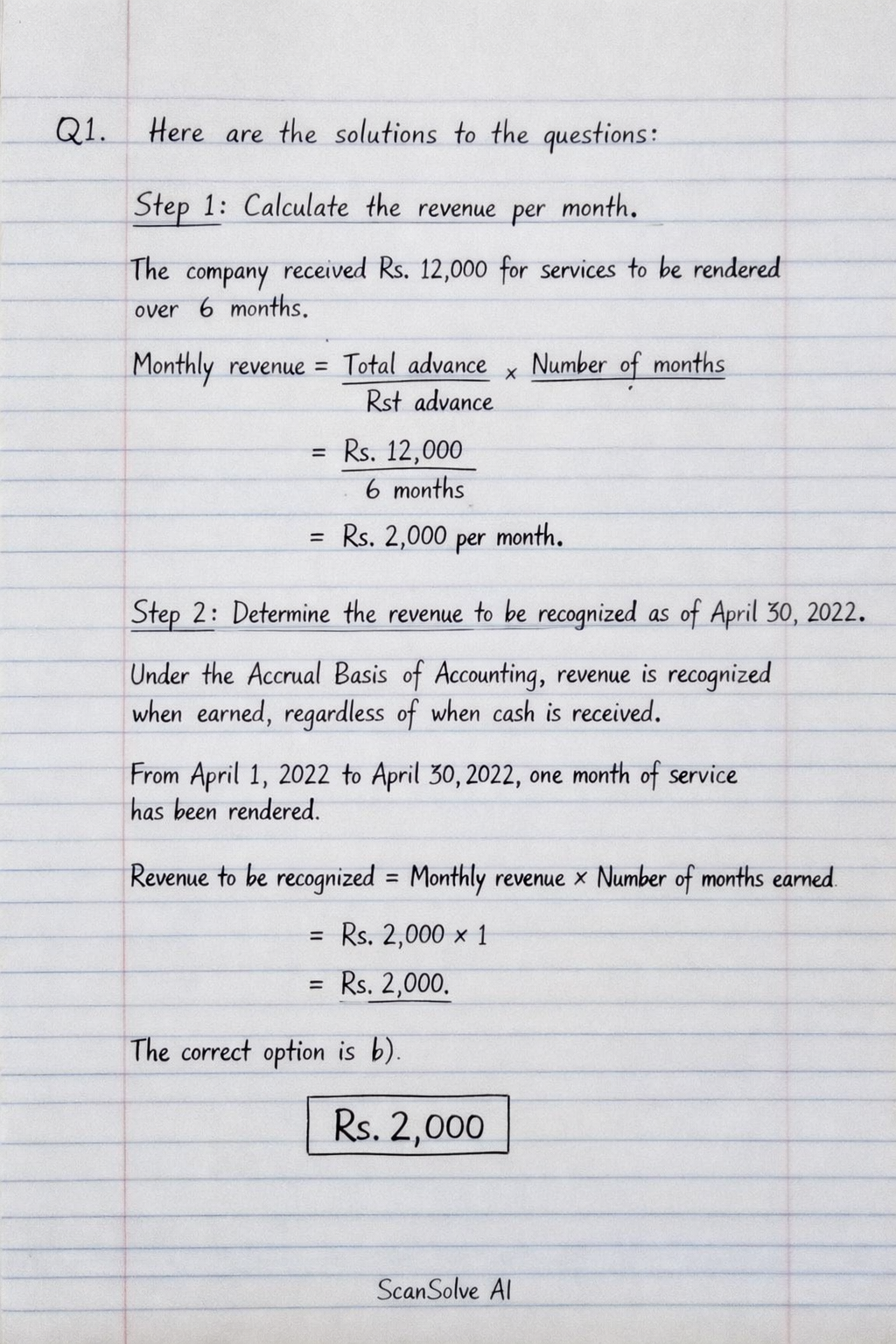
2 stepsHere are the solutions to the questions:
Q1.
Calculate the revenue per month.
The company received Rs. 12,000 for services to be rendered over 6 months.
Monthly revenue = .Determine the revenue to be recognized as of April 30, 2022.
Under the Accrual Basis of Accounting, revenue is recognized when earned, regardless of when cash is received. From April 1, 2022, to April 30, 2022, one month of service has been rendered.
Revenue to be recognized = .The correct option is b).
Q2.
- Assertion (A): Single Entry System of accounting is not suitable for large businesses. This statement is true because large businesses require comprehensive and systematic records for complex operations, regulatory compliance, and detailed financial analysis.
- Reason (R): Single Entry System does not provide a complete record of all financial transactions. This statement is also true. The Single Entry System typically records only cash and personal accounts, lacking the dual aspect of every transaction, which is crucial for a complete financial picture.
- Relationship: The reason (R) directly explains why the assertion (A) is true. The incompleteness of the Single Entry System makes it inadequate for the extensive needs of large businesses.
The correct option is a).
Q3.
The Business Entity Principle (or separate entity concept) states that a business is considered a separate and distinct entity from its owner(s) for accounting purposes. This means that the financial transactions of the business are kept separate from the personal transactions of the owner(s).The correct option is b).
Q4.
Bookkeeping is the process of recording financial transactions. While journal entries, ledger accounts, and trial balance are all integral parts of the bookkeeping and accounting cycle, the main output that summarizes the financial performance and position of a business for internal and external users are the financial statements. These include the Income Statement, Balance Sheet, and Cash Flow Statement.The correct option is a).
Q5.
When X Ltd. purchased goods from Y Ltd. on credit, it means X Ltd. owes money to Y Ltd. for the goods received. In this scenario:- Y Ltd. is the entity that supplied the goods.
- Y Ltd. is also the entity to whom X Ltd. owes money. Therefore, Y Ltd. is both a supplier (because they provided the goods) and a creditor (because X Ltd. has a liability to pay them).
The correct option is d).
Q6.
The term "sales" in accounting specifically refers to the revenue generated from selling the primary goods or merchandise that a business deals in. It is generally not used for the sale of assets (like machinery, land, or investments) that are not part of the business's regular inventory for trading.The correct option is d).
Q6 (OR part).
The limitation of accounting that states accounts may be manipulated to conceal vital facts is known as window dressing. This refers to the practice of intentionally presenting financial statements in a way that makes the company appear more financially sound than it actually is, often by misrepresenting or hiding information.The correct option is b).
Try one yourself
A new problem that tests the same skill.
Still stuck on this one?
Ask a follow-up, and the answer starts from this question.
More Business/Management Questions
Handwritten Step-by-Step Solution
Get this as a handwritten image on WhatsApp — like a tutor wrote it for you.
Try on WhatsApp