
We read your photo as:
Describe the steps to a good strategic plan and list and explain six types of plans for a healthcare institution.
ScanSolve AI Answer
Step-by-step solution
6 stepsQuestion One (30 marks)
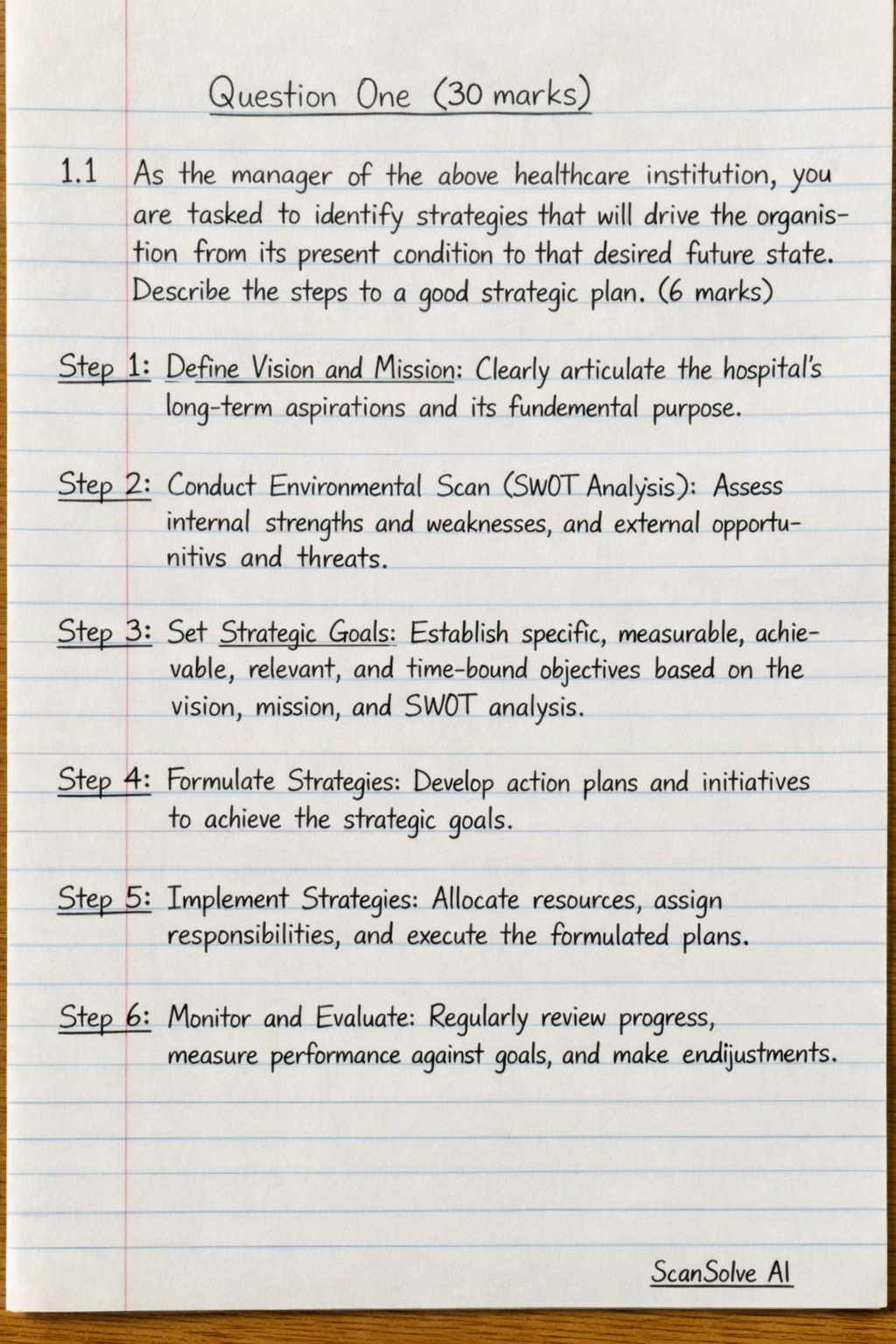
1.1 As the manager of the above healthcare institution, you are tasked to identify strategies that will drive the organisation from its present condition to that desired future state. Describe the steps to a good strategic plan. (6 marks)
Define Vision and Mission:** Clearly articulate the hospital's long-term aspirations and its fundamental purpose.
Conduct Environmental Scan (SWOT Analysis):** Assess internal strengths and weaknesses, and external opportunities and threats.
Set Strategic Goals:** Establish specific, measurable, achievable, relevant, and time-bound objectives based on the vision, mission, and SWOT analysis.
Formulate Strategies:** Develop action plans and initiatives to achieve the strategic goals.
Implement Strategies:** Allocate resources, assign responsibilities, and execute the formulated plans.
Monitor and Evaluate:** Regularly review progress, measure performance against goals, and make necessary adjustments.
1.2 Different types of plans will address the issues faced at Livingstone Hospital. List and explain the six (6) types of plans. (12 marks)
- Strategic Plans: These are long-term plans (3-5 years) that define the overall direction of the hospital, aligning with its vision and mission. They address broad organizational goals like improving service quality or expanding facilities.
- Tactical Plans: These are medium-term plans (1-2 years) that translate strategic goals into specific departmental or functional objectives. For Livingstone, this might involve plans to recruit specific staff or upgrade emergency unit equipment.
- Operational Plans: These are short-term, day-to-day plans that detail the specific actions and procedures required to achieve tactical goals. Examples include daily staffing schedules, patient flow protocols, or inventory management for medical supplies.
- Contingency Plans: These are backup plans developed to address potential unforeseen events or crises, such as a major disease outbreak, a natural disaster, or a significant staff strike. They ensure the hospital can continue critical operations.
- Financial Plans: These plans outline the hospital's financial objectives, including budgeting, revenue generation, cost control, and investment strategies to ensure financial sustainability and resource allocation for services.
- Human Resources Plans: These plans focus on managing the hospital's workforce, including recruitment, training, retention, performance management, and addressing staff shortages and welfare issues.
1.3 Long waiting times are a poor reflection of service delivery in a healthcare institution. Identify four (4) factors that contribute to long waiting times at the above hospital. (4 marks)
- Chronic staff shortages: Lack of doctors, nurses, and porters.
- Overcrowding: The hospital is buckling under strain.
- Lack of regional primary healthcare: Patients rely solely on Livingstone Hospital due to no after-hours care or primary facilities in the region.
- Bottleneck in emergency and casualty units: Leading to restricted access to some wards.
- Shortages of essential medical supplies: Such as IV cannulae, ECG electrodes, and inter-costal drains.
1.4 Tabulate a SWOT analysis for the above Healthcare institution. (8 marks)
| Category | Description
| Strengths | Livingstone Hospital is one of the biggest in the Eastern Cape.
Still stuck on this one?
Ask a follow-up, and the answer starts from this question.
More Business/Management Questions
Handwritten Step-by-Step Solution
Get this as a handwritten image on WhatsApp — like a tutor wrote it for you.
Try on WhatsApp