
We read your photo as:
Sudden or unexpected increase in demand for products and services: If an organization cannot scale its operations, production, or service delivery to meet a sudden surge in demand, it can lead
Business/Management
ScanSolve AI Answer
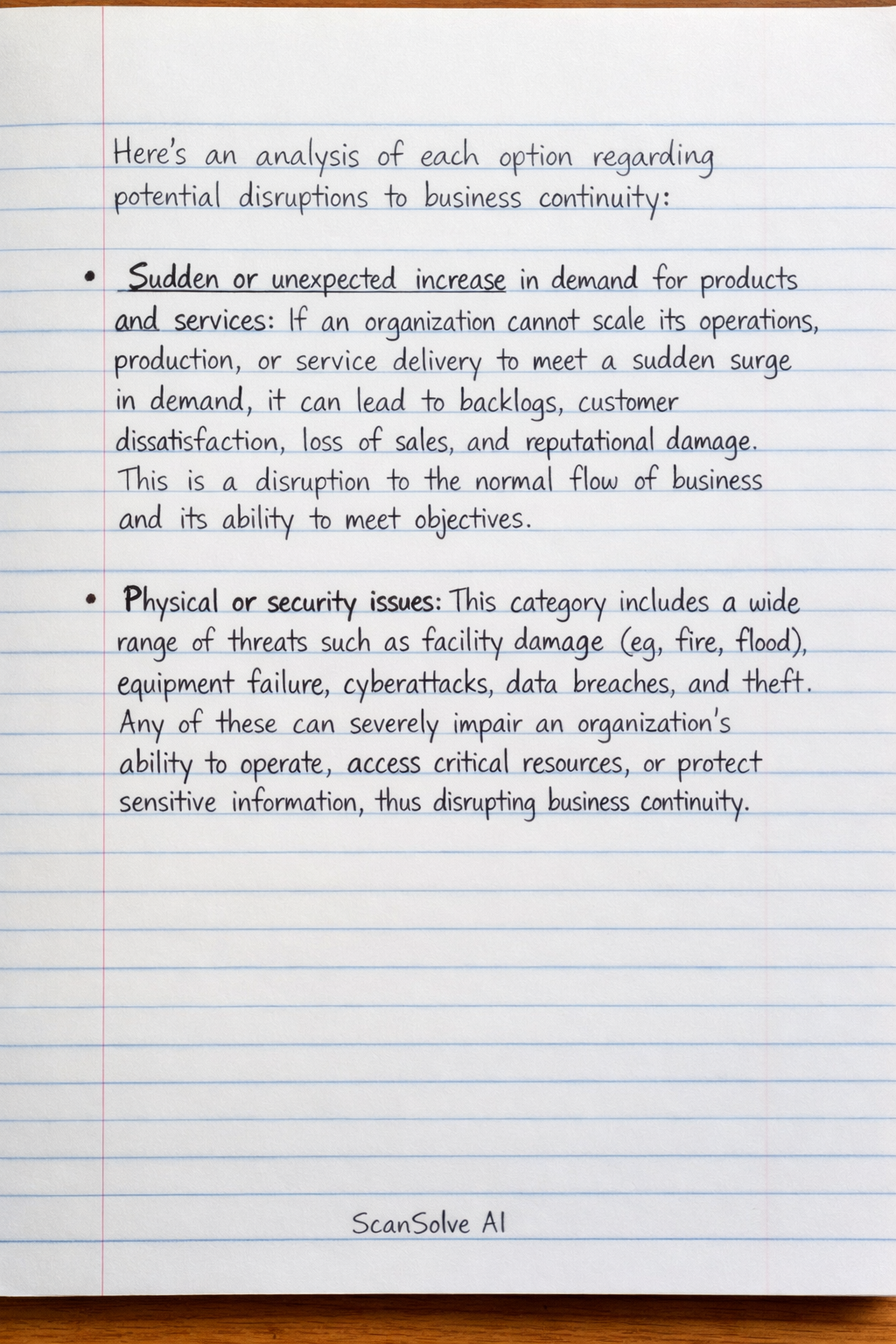
Here's an analysis of each option regarding potential disruptions to business continuity:
- Sudden or unexpected increase in demand for products and services: If an organization cannot scale its operations, production, or service delivery to meet a sudden surge in demand, it can lead to backlogs, customer dissatisfaction, loss of sales, and reputational damage. This is a disruption to the normal flow of business and its ability to meet objectives.
- Physical or security issues: This category includes a wide range of threats such as facility damage (e.g., fire, flood), equipment failure, cyberattacks, data breaches, and theft. Any of these can severely impair an organization's ability to operate, access critical resources, or protect sensitive information, thus disrupting business continuity.
- Sudden or unexpected crunch in the availability of human or technical resources: A shortage of key staff (e.g., due to illness, strike, or mass departure) or the failure/unavailability of critical technology systems (e.g., software malfunction, network outage, supply chain issues for components) can directly prevent an organization from performing its essential functions. This is a direct cause of business continuity disruption.
- Natural or man-made disasters: These are major events like earthquakes, hurricanes, pandemics, widespread power outages, terrorist attacks, or major infrastructure failures. Such disasters can cause widespread damage, loss of life, and significant operational interruptions, making them primary drivers of business continuity disruptions.
All the listed options are valid reasons that can cause disruptions to business continuity.
The correct answers are:
- Sudden or unexpected increase in demand for products and services
- Physical or security issues
- Sudden or unexpected crunch in the availability of human or technical resources
- Natural or man-made disasters
Was this helpful?
Still stuck on this one?
Ask a follow-up, and the answer starts from this question.
Got a different question?Ask your own question
More Business/Management Questions
QExtension or contraction of supply is caused byQChanges in the business environment: This includes new products, services, processes, organizational…QOutline four factors that may lead to an increase in the demand for commodity X.QWhat factors may lead to an outward shift of the production possibility cure How can an outward…QOther things being equal, an increase in the supply of money may lead to
Handwritten Step-by-Step Solution
Get this as a handwritten image on WhatsApp — like a tutor wrote it for you.
Try on WhatsApp