
We read your photo as:
Suppose the value of the stock has fallen to $70 per share, sketch the balance sheet for this investment as a result of this change. How much has the portfolio lost or gain and you distribute that gain or loss?
ScanSolve AI Answer
Step-by-step solution
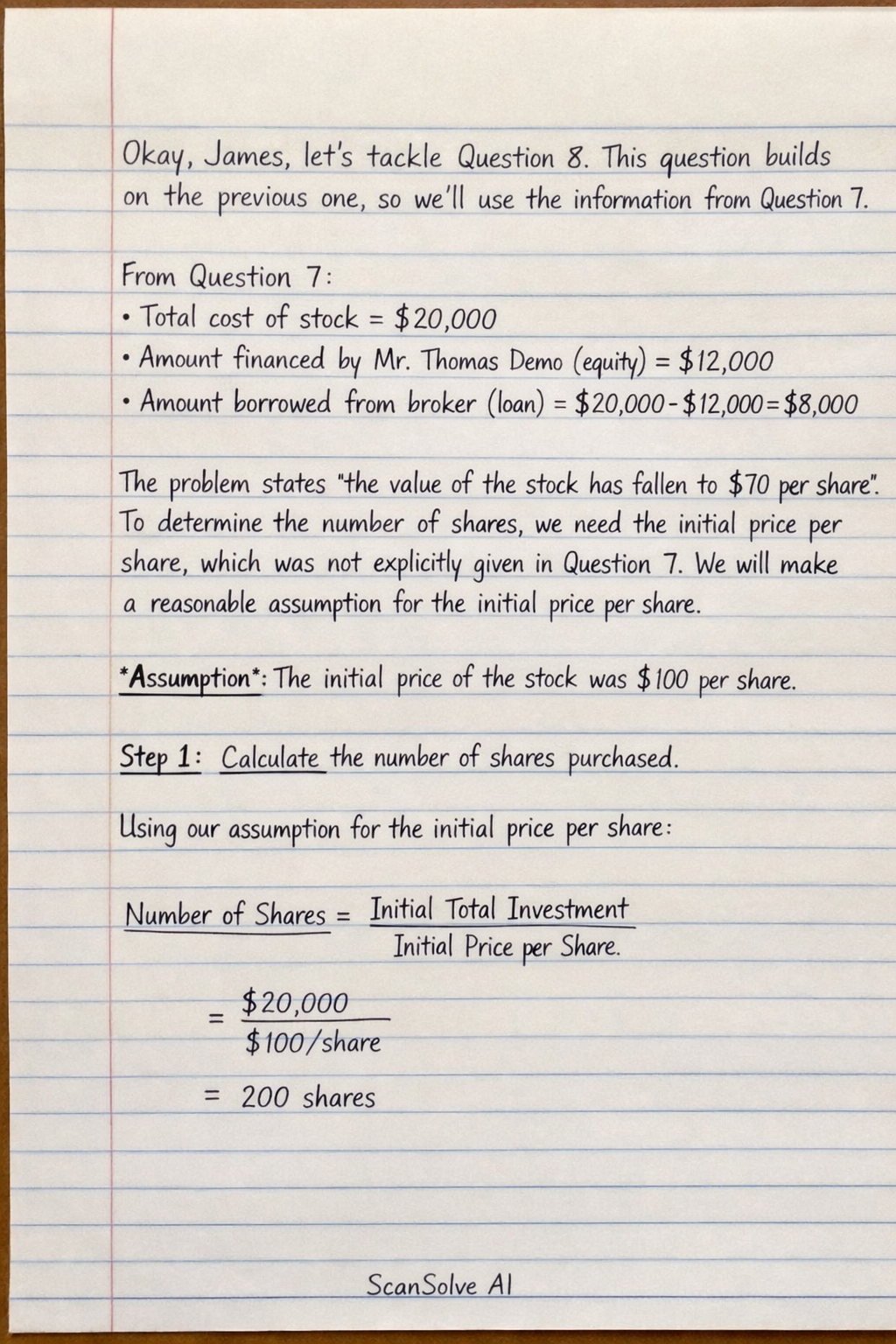
5 stepsOkay, James, let's tackle Question 8. This question builds on the previous one, so we'll use the information from Question 7.
From Question 7:
- Total cost of stock =
\20,000$ - Amount financed by Mr. Thomas Demo (equity) =
\12,000$ - Amount borrowed from broker (loan) =
\20,000 - $12,000 = $8,000$
The problem states "the value of the stock has fallen to $70 per share". To determine the number of shares, we need the initial price per share, which was not explicitly given in Question 7. We will make a reasonable assumption for the initial price per share.
Assumption: The initial price of the stock was \100$ per share.
Calculate the number of shares purchased.
Using our assumption for the initial price per share:
Calculate the new total value of the investment.
The value of the stock has fallen to
\70per share. $$ \text{New Total Value} = \text{Number of Shares} \times \text{New Price per Share} = 200 \text{ shares} \times \70/\text{share} = $14,000 $$Calculate the portfolio's loss or gain.
The portfolio has incurred a loss of
\6,000$.Sketch the balance sheet.
The balance sheet reflects the current financial position.
- Assets: The current market value of the stock.
- Liabilities: The amount borrowed from the broker. This loan amount remains constant unless repaid.
- Equity: The investor's current stake (Assets - Liabilities).
Distribute the gain or loss.
The loss of
\6,000$12,000$6,000$12,000 - $6,000 = $6,000$.
This matches the equity shown in the balance sheet. The broker's loan amount remains unchanged.The portfolio has a
\boxed{\text{loss of \6,000}}\boxed{\text{investor's equity}}from \12,000 to $6,000.
Still stuck on this one?
Ask a follow-up, and the answer starts from this question.
More Business/Management Questions
Handwritten Step-by-Step Solution
Get this as a handwritten image on WhatsApp — like a tutor wrote it for you.
Try on WhatsApp