

This business/management problem is solved step by step below, with detailed explanations to help you understand the method and arrive at the correct answer.
ScanSolve AI Answer
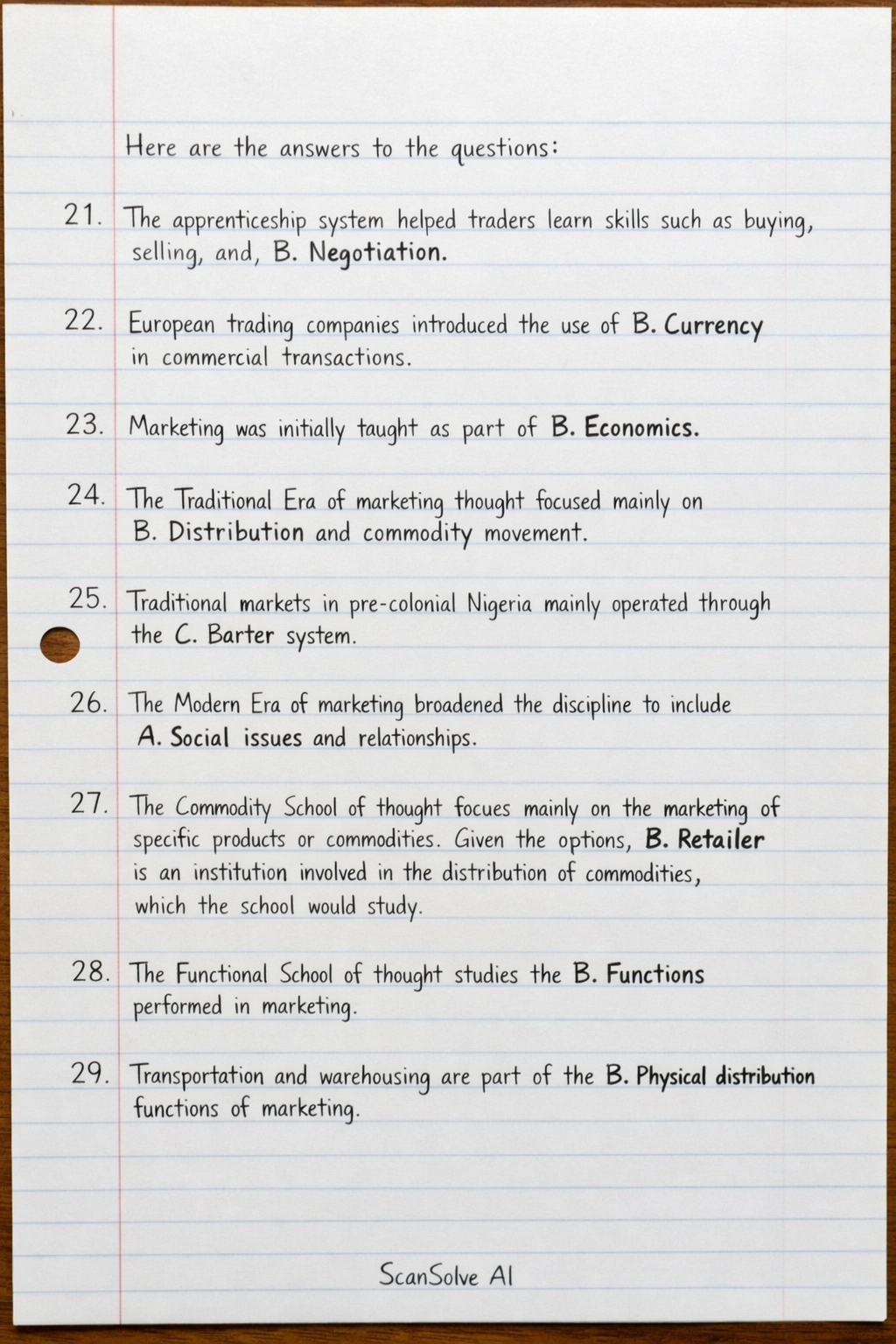
Here are the answers to the questions: 21. The apprenticeship system helped traders learn skills such as buying, selling, and B. Negotiation. 22. European trading companies introduced the use of B. Currency in commercial transactions. 23. Marketing was initially taught as part of B. Economics. 24. The Traditional Era of marketing thought focused mainly on B. Distribution and commodity movement. 25. Traditional markets in pre-colonial Nigeria mainly operated through the C. Barter system. 26. The Modern Era of marketing broadened the discipline to include A. Social issues and relationships. 27. The Commodity School of thought focuses mainly on the marketing of specific products or commodities. Given the options, B. Retailer is an institution involved in the distribution of commodities, which the school would study. 28. The Functional School of thought studies the B. Functions performed in marketing. 29. Transportation and warehousing are part of the B. Physical distribution functions of marketing. 30. The Marketing Mix consists of Product, Price, Place, and B. Promotion. 31. The Buyer Behavior School focuses on understanding B. Consumer decisions. 32. The Systems School views marketing as a system of C. Interrelated parts. 33. The Exchange School defines marketing as the process of B. Exchange. 34. Marketing research involves gathering and analyzing B. Customer and competitor data. 35. Promotion in marketing includes advertising, sales promotion, and B. Personal selling. 36. Small-scale businesses usually focus on serving a B. Local market. 37. A major challenge faced by small businesses is B. Lack of marketing expertise. 38. Competitive pricing means setting prices that are B. Affordable and profitable within the market. 39. Customer retention in small businesses can be improved through good B. Customer service. 40. Loyalty programs encourage customers to B. Buy the company goods repeatedly. What's next?